Thanks very much to NZEI Te Riu Roa* for permission to post this speech from one of their members. They are currently engaged in a campaign to win a fair deal for support staff in schools, particularly around the issue of pay.
Speech to the pay equity rally
30 June 2009
My name is Lewellyn Sumenko-Bucknell. I am one of around 20,000 school support staff working in schools all across New Zealand.
The range of work support staff do is huge and absolutely essential to the life of the school and the education of the young people we work with. We are librarians, school secretaries, sports co-ordinators, physiotherapists and lots more. Many of us are teacher aides, working with the most vulnerable children in our communities.
We work at the frontline of education, and for these demanding roles, support staff can earn as little as $12.94 an hour – 44cents above the minimum wage.
As if the low pay is not enough to cope with, school support staff end every school year with uncertainty of employment for the next year and a long holiday with no pay days.
It will be no surprise to you that school support staff are overwhelmingly women.
I am a teacher aide. My mornings are spent at a primary school, where I work with up to 10 children with different needs. I then have 15 minutes to drive to my second job where I work with a year 11 student who suffers from post traumatic stress syndrome.
My work is difficult and often emotionally draining and the rewards are very small, but when one comes along it is a fantastic feeling.
I am always thinking of how I can present work to my children in a more appealing way, so I end up taking my work home with me and to bed at night. But I know the work I do makes a difference to the children I help.
That’s why school support staff do the work we do. Our roles are absolutely vital to our children receiving quality education.
Sadly most support staff feel undervalued and with good reason. The government says there is no money in a recession for a pay increase for school support staff. But principals and teachers have pay increases and school cleaners and caretakers are getting a pay jolt. More power to them for winning their pay jolt. They deserve it. But school support staff deserve a fair deal too, and the recession is not an excuse to ignore low pay.
It’s hard to hear government respond to our collective agreement claims with a zero percent pay increase when our pay rates are rock bottom already.
It’s hard to hear the government has abandoned the pay equity investigation into special education support workers employed by the Ministry of Education and won’t proceed with an investigation into school support staff like me employed directly by schools.
It’s hard to say no to our own children when we can’t afford the things they need and it’s hard to face Christmas holidays without an income or the certainty of a job in the New Year.
I’m here today on behalf of 20,000 school support staff. Our work is hard, complex and demanding, requiring responsibility, patience and skills. Our roles are vital in the education of our children with special needs.
We are fighting to have our work valued. We are fighting for equal pay for the work we do with work of equal value. We are fighting for a fair deal. Our challenge to government is to value the work of school support staff and to reward us accordingly.
Thank you for your support today. Please keep supporting school support staff and other women who are undervalued for the work they do. We are stronger together.
* Although I work for NZEI Te Riu Roa I don't do stuff in this area and have put this up in a personal capacity not cos anyone in charge of me asked me to.
Tuesday, 30 June 2009


Coverage of Wellington's Pay Equity Challenge event
 Here's a pic I've snaffled from the Tertiary Education Union's website, and you can see their flickr slideshow from today's demonstration at Parliament here.
They're going to have some video up too.
Red Thinking Hat tipped most gratefully in the direction of Mr D at the TEU who emailed with all this linky lovin'.
I'll add in any more coverage I find as I find it. Feel free to add links in comments until I get sorted!
Update the First: Here's the Council of Trade Union's flickr album from Wellington today (thanks again to the Mysterious Mr D) and some video from NZEI Te Riu Roa, including chanting, part of the speech from Sophia Blair (NZUSA Co-President) and comments from a teacher aide (speech from her going up here later today!) and a community campaigner, both from NZEI Te Riu Roa.
Update the Second: Don't forget the Facebook Group for the Pay Equity Challenge and the CTU's main page on the campaign. I hear rumours of a Day of Action around Pay Equity in late August...
Update the Third: Labour MP Grant Robertson explains how Department of Labour staff were discouraged from attending the rally. Here's a summary of the coverage on the Radio NZ National News from today.
Update the Fourth: NZPA shots (thanks to Anon in comments), and Nikki's own shots and impressions of the rally which she attended. Plus it was on at least 3News last night, I will try to find a link to the video and add it in later today.
Auckland Pay Equity rally today
Dragged a couple of workmates along today and was pleased as punch to see about fifty other people all turn up on the four corners of Queen & Victoria to wave flags, hold banners, parade placards and leaflet the public about the issue of pay equity for women. The responses I saw were pretty positive; my little group even had a man come up to us and question us further about what would happen next as he was really concerned about the issue, seeing as how he was a nurse.
If anyone has reports from Hamilton or Wellington please feel free to email them to me (julie dot fairey via gmail) and I'll see about getting them up :-)
And here be a couple of pics. Please excuse the poor quality, and if you have links to better shots let me know!

Big ups to the group of Hand Mirrovians from out of town who turned up and were stationed outside Whitcoulls, great to meet you!
 During Jill Ovens' speech, I was trying to get arty but the man with the placard kept moving!
I did take more snaps, on the Working Women's Resource Centre camera, which I'll link to or put up if they come my way.
If anyone has reports from Hamilton or Wellington please feel free to email them to me (julie dot fairey via gmail) and I'll see about getting them up :-)
And here be a couple of pics. Please excuse the poor quality, and if you have links to better shots let me know!

Big ups to the group of Hand Mirrovians from out of town who turned up and were stationed outside Whitcoulls, great to meet you!
 During Jill Ovens' speech, I was trying to get arty but the man with the placard kept moving!
I did take more snaps, on the Working Women's Resource Centre camera, which I'll link to or put up if they come my way.
Behind the Scenes Award Ceremony this Friday
Last night I helped to choose the winner and runner-up in the Behind the Scenes competition. All the short films on the short list were powerful, and I'm still thinking about several of them today. If you are in Auckland on Friday you can go along to the awards ceremony - all welcome as long as you RSVP:
You are cordially invited to the...Hopefully this will be able to become an annual event. I'm aiming to put the winner and runner-up videos up here on Friday afternoon, technical capabilites allowing. Many thanks to the organisers for inviting me to be involved, and for all their hard work to get this off the ground.
Behind the Scenes Award Ceremony
1-2pm, Friday 3rd July 2009
Federation of University Women’s Room
First Floor, Old Government House, University of Auckland
Come help us celebrate the talented young filmakers who took on this thought-provoking project. The task was to create a short film about relationship violence against women. Five selected videos will be shown, and the winners announced! MC’d by Danielle Cormack, star of Topless Women Talk About Their Lives, and upcoming film Separation City.
Food and drinks on offer. See attached flyer for more information, or visit www.behindthescenes.co.nz. Please RSVP by 1 July to women@ausa.org.nz
Organised by the Auckland Coalition for the Safety of Women and Children, PO Box 78 271, Grey Lynn
Pay gap, what pay gap?

From Ampersand's leftycartoons.com
Don't forget today's Pay Equity Challenge activities in Wellington, Auckland and Hamilton!
The Odds & Ends Drawer
Make with the clicky if you so desire!
New to the blogroll:
Hannah's Edible Garden
Alice Boyes' blog
- Alice Boyes has a full summary of the findings from her survey on weight and relationships, thanks very much to her for emailing me about it in response to our quick hit on the matter.
- Wellywood Woman considers the privileging of men's projects in feature film work.
- Tesni values her autonomy of self.
- The Paradoxical Cat has been reading Fiona Kidman's second volume of memoirs.
- Lauredhel writes about the public pressures women face about breastfeeding (hat tipped to Azelmed)

- Emma examines the nasty defence tactic used in Nai Yin Xue's trial.
- Luddite Journo continues to look at the cutting of ACC funding for sexual violence support services.
- David Farrar reports on a talk by Manda Zan-Erzin of the Alliance of Iranian Women.
- Idiot/Savant highlights research on outcomes for children whose parents stay together for the sake of the kids.
- Mrs Skin considers women's storytelling.
- Psycho Milt points out Berlusconi's predilection for "conquest" is scary, resulting in an explosive and potentially TRIGGERING comment thread at No Minister.
- Meganwegan tells us what she thinks is hotter than a certain All Black's cheekbones.
- Lita has some sleeve-face marvels.
- Anarkaytie chronicles a solstice celebration she attended recently.
- Paul reports on the Minister of Education's insistence that There Shall Be No Tables.

New to the blogroll:
Hannah's Edible Garden
Alice Boyes' blog
Monday, 29 June 2009
Political Spectrometry
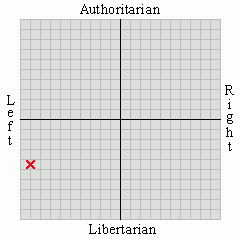
Scrubone is mapping the Political Spectrum scores of various NZ political bloggers, so here's mine:
My Political Views
I am a far-left social libertarian
Left: 8.8, Libertarian: 4.57
Political Spectrum Quiz
A few years back Idiot/Savant undertook a similar task, although it should be noted that the political compass test he used was quite different.
You can do the current test yourself here. Deborah has already noted that it's quite US-focused, and presumes there is a God. I'd also add that I'm not clear about why it asked about abortion twice, and there didn't seem to be much else explicitly on the feminist agenda (e.g. pay equality, rape, political representation). Even so if everyone does the same test it will still be a useful exercise in comparison.
My Political Views
I am a far-left social libertarian
Left: 8.8, Libertarian: 4.57
Political Spectrum Quiz
A few years back Idiot/Savant undertook a similar task, although it should be noted that the political compass test he used was quite different.
You can do the current test yourself here. Deborah has already noted that it's quite US-focused, and presumes there is a God. I'd also add that I'm not clear about why it asked about abortion twice, and there didn't seem to be much else explicitly on the feminist agenda (e.g. pay equality, rape, political representation). Even so if everyone does the same test it will still be a useful exercise in comparison.
Monday Funday with "I can't believe they're cupcakes" cupcakes
Blue felt captain's cap tipped to Meganwegan for this one!

For the sceptical here is Bakerella's full post, with pics, on how this was created.

For the sceptical here is Bakerella's full post, with pics, on how this was created.
Quick hit: Possible change to the way rape cases are tried?
From the Herald this morning:
Bomber has written approvingly about this, and I tend to think it is a step in the right direction, although I will withhold my judgement (see what I did there?) until we see some actual concrete proposals.
Justice Minister Simon Power has asked the Law Commission to investigate introducing a European-style inquisitorial justice system in sexual offending cases.That's the whole thing.
Despite the outcry following the David Bain trial, Mr Power said he had no intention of overhauling the adversarial-style system used here where the role of the judge is essentially that of an impartial referee.
But he said the inquisitorial system, where the judge is involved in collecting and determining the facts of the case, could have its uses in victim-intensive situations such as sexual offending and child abuse.
"There might be some elements of the inquisitorial process that might be less traumatic for victims of crime if they are applied in a limited context," Mr Power said.
He said he would also ask Prime Minister John Key for permission to travel next year to assess the inquisitorial system in a country where it is in use, such as France.
The adversarial system is a source of controversy in sexual cases, because the women or child victims can be cross-examined by defence lawyers while the defendant is allowed to exercise the right to silence.
Bomber has written approvingly about this, and I tend to think it is a step in the right direction, although I will withhold my judgement (see what I did there?) until we see some actual concrete proposals.
Pay Equity Challenge activities around the country on Tuesday

A message from the Council of Trade Unions:
Would it be fair if $10 was only worth $8.80 to you just because you’re a woman? Well it might be, because on average women in NZ earn 12% less than men.There's a Facebook group too with lots of info.
But this Government seems not to care about that because it has scrapped its own pay equity unit. It is more than 30 years since equal pay legislation was introduced in NZ. Equality won’t happen all by itself.
Join the Pay Equity Challenge and demand equal pay for women NOW! Show the Government you want action not words by coming to the:
WELLINGTON PAY EQUITY RALLY – 12.30pm, Tuesday 30 June
Parliament grounds, Wellington
AUCKLAND PAY EQUITY RALLY - Midday, Tuesday 30 June
Corner Victoria and Queen Streets, Auckland
HAMILTON PAY EQUITY RALLY - Midday, Tuesday 30 June
Wintec Campus, Student Centre Hub, Hamilton CBD
Thanks to the multitude of people who have sent this to me. I'm going to be at the Auckland event, hope to see some of you there!
Sunday, 28 June 2009
Sex is not just a book by Madonna
Dear darling Wriggly,
When you are older, I'm not sure how much older, we'll end up having chats about sex. Just in case I lose my bottle, as I understand that such conversations can be difficult for parents to initiate, I'm going to get down some of my thoughts now, when you are but a year and a half old and thus much less blush-inducing to talk to. You are understanding more and more each day, like on Friday when I asked you to choose some toys to put in the bath, but I think it'll be a few years yet before any words I utter on this subject will be even remotely interesting to you.
Firstly, my disclaimers: I'm your mother, and I can't even see the sides of how that must be shaping my thinking towards your future sex life, and the way I'll be choosing my words around it.
I'm using "sex" as a broad term here that encompasses a whole range of activity, not just the penetrative act itself. Penetration is not the be all and end all of sex and don't let anyone tell you otherwise.
Also I'm not all that keen to write about my sex life, to you or anyone else. Of course my experiences do influence my ideas, but you don't have to get your cheek capillaries ready; this is not going to contain any salacious details of your mother's sexual history. Do be aware though that I am a bit vanilla and there are more opinions out there than mine. These are my views alone, and there's no harm in casting the net wider and testing what I think against the ideas of others.
Ok, enough procrastinating, let's take this point by point:
Point the First: Sex should be an enjoyable experience
Sex isa beautiful thing, what happens when a Mummy and a Daddy love each other very much, a special dance that you should only undertake when you really love someone, primarily about pleasure. Here and now a lot of people like to say it's mainly for procreation, or emotional intimacy, and of course it can be, but in plenty of cases it isn't. It's about people making themselves, and others, feel good. Hopefully extra-special super-wonderfully good.
All kinds of things can be enjoyable, and it'll take time and some experimentation to find out what that means for you. You might like some things that others don't. That's ok, see if you can find those who share your interests. I hope that by the time you're looking around there won't be the stupid social taboos around sex that currently exist, and that the judgements attached to various sexual activities will be historic. If not then let me just say the Internet is probably still your friend. Just keep it at home and not on any work-related computer please.
Point the Second: Actively seek consent, and actively give it
Contrary to popular opinion in my time, telling someone you want to have sex with them, in those words or others, is often a turn-on, not a turn-off. You might have to seek or give consent at various different points in a sexual encounter, and you should be ready to stop at any time if anyone else wants you to stop. Embrace the yes, and respect the no. Don't assume a physical sexual response means a yes. Uncertainty is much more likely to be a no than a yes, so treat it carefully and seek clarification.
Point the Third: Communicate
Whether there's one person you need to communicate with or six, no one can read minds and no one can make allowances for things they don't know about. If you're uncomfortable or don't like it, say so. If you like something, make that clear. Encourage others to do the same, and listen when they do. Words aren't the only way to communicate of course. However they are the clearest and least likely to be misunderstood, particularly when communicating with someone you don't know very well.
Don't be afraid to seek help or further information. If they're still around, Family Planning are a good non-judgemental place to start, and for all their failings magazines like Cosmo and Dolly, and their equivalents in your time do often have some helpful advice too. Read it with a critical eye and identify a trusted adult or two you can talk to *cough* your mother?*cough*
Point the Fourth: You don't have to love someone to make love with them
This goes back to the previous points really. Sex can just be about having some fun. As long as everyone involved knows where they stand you will avoid the awkwardness and potential heartbreak of a post-coital conversation along the lines of "would you like to have dinner with my parents next week" or "thanks for the shag, I'm back off to my partner's place now."
Don't let the Moral Police of the 1950s (and before) tell you when sex is ok and when it's not; as long as there's consent from all parties (and all parties can meaningfully give consent) then to my mind it's fine. In my humble opinion this applies to pornography/erotica too, but hopefully by the time you are reading this that industry will be unionised and exploitation-free and you'll wonder what on earth I am talking about.
Point the Fifth: Look out for yourself and others
Use condoms, birth control, safe words, whatever helps to keep sex what you want it to be. Respect that others will have their own rules and expectations that you'll need to take into account so they get what they want too. Read Point the Third again.
---
That's all I can think of right now. I hope it helps rather than hinders. No doubt more pearls of wisdom will come to me as we both age, and I may decide all or some of this is ridiculous. Time will tell!
Yours lovingly and with the best of intentions,
Mum
When you are older, I'm not sure how much older, we'll end up having chats about sex. Just in case I lose my bottle, as I understand that such conversations can be difficult for parents to initiate, I'm going to get down some of my thoughts now, when you are but a year and a half old and thus much less blush-inducing to talk to. You are understanding more and more each day, like on Friday when I asked you to choose some toys to put in the bath, but I think it'll be a few years yet before any words I utter on this subject will be even remotely interesting to you.
Firstly, my disclaimers: I'm your mother, and I can't even see the sides of how that must be shaping my thinking towards your future sex life, and the way I'll be choosing my words around it.
I'm using "sex" as a broad term here that encompasses a whole range of activity, not just the penetrative act itself. Penetration is not the be all and end all of sex and don't let anyone tell you otherwise.
Also I'm not all that keen to write about my sex life, to you or anyone else. Of course my experiences do influence my ideas, but you don't have to get your cheek capillaries ready; this is not going to contain any salacious details of your mother's sexual history. Do be aware though that I am a bit vanilla and there are more opinions out there than mine. These are my views alone, and there's no harm in casting the net wider and testing what I think against the ideas of others.
Ok, enough procrastinating, let's take this point by point:
Point the First: Sex should be an enjoyable experience
Sex is
All kinds of things can be enjoyable, and it'll take time and some experimentation to find out what that means for you. You might like some things that others don't. That's ok, see if you can find those who share your interests. I hope that by the time you're looking around there won't be the stupid social taboos around sex that currently exist, and that the judgements attached to various sexual activities will be historic. If not then let me just say the Internet is probably still your friend. Just keep it at home and not on any work-related computer please.
Point the Second: Actively seek consent, and actively give it
Contrary to popular opinion in my time, telling someone you want to have sex with them, in those words or others, is often a turn-on, not a turn-off. You might have to seek or give consent at various different points in a sexual encounter, and you should be ready to stop at any time if anyone else wants you to stop. Embrace the yes, and respect the no. Don't assume a physical sexual response means a yes. Uncertainty is much more likely to be a no than a yes, so treat it carefully and seek clarification.
Point the Third: Communicate
Whether there's one person you need to communicate with or six, no one can read minds and no one can make allowances for things they don't know about. If you're uncomfortable or don't like it, say so. If you like something, make that clear. Encourage others to do the same, and listen when they do. Words aren't the only way to communicate of course. However they are the clearest and least likely to be misunderstood, particularly when communicating with someone you don't know very well.
Don't be afraid to seek help or further information. If they're still around, Family Planning are a good non-judgemental place to start, and for all their failings magazines like Cosmo and Dolly, and their equivalents in your time do often have some helpful advice too. Read it with a critical eye and identify a trusted adult or two you can talk to *cough* your mother?*cough*
Point the Fourth: You don't have to love someone to make love with them
This goes back to the previous points really. Sex can just be about having some fun. As long as everyone involved knows where they stand you will avoid the awkwardness and potential heartbreak of a post-coital conversation along the lines of "would you like to have dinner with my parents next week" or "thanks for the shag, I'm back off to my partner's place now."
Don't let the Moral Police of the 1950s (and before) tell you when sex is ok and when it's not; as long as there's consent from all parties (and all parties can meaningfully give consent) then to my mind it's fine. In my humble opinion this applies to pornography/erotica too, but hopefully by the time you are reading this that industry will be unionised and exploitation-free and you'll wonder what on earth I am talking about.
Point the Fifth: Look out for yourself and others
Use condoms, birth control, safe words, whatever helps to keep sex what you want it to be. Respect that others will have their own rules and expectations that you'll need to take into account so they get what they want too. Read Point the Third again.
---
That's all I can think of right now. I hope it helps rather than hinders. No doubt more pearls of wisdom will come to me as we both age, and I may decide all or some of this is ridiculous. Time will tell!
Yours lovingly and with the best of intentions,
Mum
Quick hit: HPV vaccine uptake v low
From the Herald on Sunday:
Now I've included the title (in bold) because it ticks me off. Signed parental consent is necessary for most schoolgirls to access this vaccination programme. It may well be that the so-called shunning is not originating with those who would be vaccinated but with their parents. So perhaps the heading could reflect that?
In related news I did get a response to my OIA asking for the list of schools who declined to offer the vaccine, and I hope to blog about it when I get time to read it properly.
Young women shun GardasilClick through for the whole article.
Less than a third of New Zealand schoolgirls have received the controversial cervical cancer vaccine, as health concerns persist around the $177 million programme.
The Labour Government launched the Gardasil programme in September last year, with the aim of immunising 300,000 Kiwi schoolgirls over the next two years.
Latest figures show 26 per cent of 12 to 16-year-olds and 35 per cent of 17 and 18-year-olds have received the first of three Gardasil doses.
One advocate conceded the numbers are "very low"...
Now I've included the title (in bold) because it ticks me off. Signed parental consent is necessary for most schoolgirls to access this vaccination programme. It may well be that the so-called shunning is not originating with those who would be vaccinated but with their parents. So perhaps the heading could reflect that?
In related news I did get a response to my OIA asking for the list of schools who declined to offer the vaccine, and I hope to blog about it when I get time to read it properly.
Friday Feminist on a Sunday
Deborah's spotlight goes on Catharine MacKinnon.
And the expanding index of her Friday Feminist series is here.
And the expanding index of her Friday Feminist series is here.
pull the petition, ms savill
now we find out that we dont have to be spending $9 million on the poorly worded question about hitting chidren:
"The promoters of the petition forcing the referendum, Sheryl Saville, Larry Baldock and Bob McCoskrie, have a short window of time in which they could demonstrate some common sense and commitment to New Zealand families in these hard economic times, by withdrawing their petition," said Yes Vote spokesperson Deborah Morris-Travers.
Legally, the petition can be withdrawn by its promoters before the Governor-General issues the writ for the referendum, which must be done by Friday 3 July 2009.
it appears that the full responsibility for pulling the referendum lies with sheryl savill, as the instigator of the referendum. let's hope some serious pressure builds up during this week to get these people to withdraw, so that maybe we can focus on the rights of children during this recession rather than the rights of their parents to hit them.
"The promoters of the petition forcing the referendum, Sheryl Saville, Larry Baldock and Bob McCoskrie, have a short window of time in which they could demonstrate some common sense and commitment to New Zealand families in these hard economic times, by withdrawing their petition," said Yes Vote spokesperson Deborah Morris-Travers.
Legally, the petition can be withdrawn by its promoters before the Governor-General issues the writ for the referendum, which must be done by Friday 3 July 2009.
it appears that the full responsibility for pulling the referendum lies with sheryl savill, as the instigator of the referendum. let's hope some serious pressure builds up during this week to get these people to withdraw, so that maybe we can focus on the rights of children during this recession rather than the rights of their parents to hit them.
Saturday, 27 June 2009
14th down under feminists carnival

the 14th down under feminists carnival is coming up soon. please go through your own posts for june, or recommend posts that you've enjoyed. carnival entries can be submitted here. and yes, the carnival will going up on my blog, hopefully by the end of next weekend.
Is this ad offensive?
Some Lower Hutt residents are unhappy with a billboard promoting breast cancer awareness, with the words 'Seriously, breast cancer's not a big deal'. The billboard promotes the Breast Cancer Research Trust, and was designed by Saatchi & Saatchi.
Advertising of this sort brings up a world of thorny issues. Does is it encourage people to lobby for a share of the health dollar, against medical and ethical good sense (eg Herceptin)? Why should a Trust which researches breast cancer have to rely on fundraising? Is an advertising campaign the best way to promote breast cancer awareness, and is it a bit on the nose that Saatchi & Saatchi should profit from it?
Intriguing stuff to ponder ... but the question I'm interested in is whether the ad is actually offensive. A woman quoted in the article, who has breast cancer herself, says of the billboard, 'It trivialises what we're going through'. I don't believe it does - unless you interpret what's clearly supposed to be an ironic statement really, really literally. To me, the slogan 'Seriously, breast cancer's not a big deal' seems obviously intended to challenge people's (presumed) apathy around the illness. I'd think that most people would interpret it the same way.
It's understandable that people with a potentially terminal illness might react differently to this campaign than others. But we others are the target of the campaign: we're the ones supposed to have our awareness raised by it. I'm not sure that this is an effective campaign - I don't know enough about breast cancer or public health stuff to form an opinion one way or the other - but if it is effective, should women who've suffered breast cancer seek to censor it?
Of course, the billboard's slogan was intended to be provocative. If being provocative is a sign of effectiveness for a campaign (and I'm not convinced it is), this ad is a winner.
Advertising of this sort brings up a world of thorny issues. Does is it encourage people to lobby for a share of the health dollar, against medical and ethical good sense (eg Herceptin)? Why should a Trust which researches breast cancer have to rely on fundraising? Is an advertising campaign the best way to promote breast cancer awareness, and is it a bit on the nose that Saatchi & Saatchi should profit from it?
Intriguing stuff to ponder ... but the question I'm interested in is whether the ad is actually offensive. A woman quoted in the article, who has breast cancer herself, says of the billboard, 'It trivialises what we're going through'. I don't believe it does - unless you interpret what's clearly supposed to be an ironic statement really, really literally. To me, the slogan 'Seriously, breast cancer's not a big deal' seems obviously intended to challenge people's (presumed) apathy around the illness. I'd think that most people would interpret it the same way.
It's understandable that people with a potentially terminal illness might react differently to this campaign than others. But we others are the target of the campaign: we're the ones supposed to have our awareness raised by it. I'm not sure that this is an effective campaign - I don't know enough about breast cancer or public health stuff to form an opinion one way or the other - but if it is effective, should women who've suffered breast cancer seek to censor it?
Of course, the billboard's slogan was intended to be provocative. If being provocative is a sign of effectiveness for a campaign (and I'm not convinced it is), this ad is a winner.
The sex lives of scorpions
I bought my daughter the first in a series of kids' magazines about bugs. She was absolutely thrilled - but I was kind of bemused by this comment, in the section about scorpion reproduction:
In the human species, the female is sometimes taken out for dinner by the male. In some scorpion species, the male IS the dinner!
That's not something you see much of these days. Kids' books and materials usually work pretty hard not to inscribe gender roles on their readers.
Equally quaint is the phrase 'courtship', used in the magazine to protect children from the nasty reality of scorpions gettin' jiggy. My daughter was just confused by this. 'Mummy', she asked earnestly, 'Would you call sexual intercourse "courtship"?'
Ever the quick thinker, I replied, 'Um...not sure'.
This quaint word 'courtship' was only a temporary hurdle, and soon my daughter was regaling me with all the horrible, horrible details of scorpion mating habits. It was almost enough to put me off my dinner (which was not bought for me by the male of the species, if you're wondering).
In the human species, the female is sometimes taken out for dinner by the male. In some scorpion species, the male IS the dinner!
That's not something you see much of these days. Kids' books and materials usually work pretty hard not to inscribe gender roles on their readers.
Equally quaint is the phrase 'courtship', used in the magazine to protect children from the nasty reality of scorpions gettin' jiggy. My daughter was just confused by this. 'Mummy', she asked earnestly, 'Would you call sexual intercourse "courtship"?'
Ever the quick thinker, I replied, 'Um...not sure'.
This quaint word 'courtship' was only a temporary hurdle, and soon my daughter was regaling me with all the horrible, horrible details of scorpion mating habits. It was almost enough to put me off my dinner (which was not bought for me by the male of the species, if you're wondering).
Friday, 26 June 2009
The nice guy (TM)
I was going to write something on the "the bitch made me do it" defence offered up in the trial of Sophie Elliot, but I see Anjum has already beaten me to it. Thank christ, that case was really too horrible for words.
So instead I'm going to go on bad teen movie nostalgia trip.
Zuh? You may be wondering what the hell does a gruesome murder have to do with bad teen movies.
The answer would be the "Nice Guy."
Many a teen movie is built around the idea of the "Nice Guy." There's the "Nice Guy" who wants to get things going with beautiful girl who only dates arseholes until one day she finally sees the light and they get together. ike Preston Myers in Can't Hardly Wait and poor old Duckie in Pretty in Pink if John Hughes had got the ending he wanted. Alternatively we have the nice guy who only wants the beautiful girl who is a total bitch and treats him badly until one day he sees the light and turns to his supposedly less attractive, but much more lovely in personality, overlooked female best friend. Think of Emilio Estevez hooking with up with Ally Sheedy's character in the Breakfast club or Some Kind of Wonderful the lesser-known of John Hughes teen movie classics.
We have all at some point another heard the rantings of self-professed "Nice Guys." They'll complain ad museum about how "Nice Guys finish last" and that women must WANT to be treated like shit, because he, the "Nice Guy," has failed repeatedly in relationships. Excuse me while I go hurl. It is such an incredibly arrogant thing to claim, "I’m such a good person, and she never chose me so she's the arsehole." But apparently the idea that the problem may in fact be with the "Nice Guy" never enters their head. I suppose it is because they are too busy being "nice."
So aunty ex-expat is going to offer up a valuable piece advice for all those self-described "nice guys." Being "nice" does not make up for stuff like lacking a personality, a sense of humour, confidence and humility. If you have one bad relationship after another, the only common denominator is YOU.
Also nice guy or not, if you’re in a relationship romantic or otherwise where the like where one person is far more adoring than the other, then you’ve got to expect that the results may not be pretty. From the perspective of the person who is taking, it doesn’t necessarily occur to them that they "owe" you something especially if you haven't clearly communicated your desires and expectations. You can’t really be that bitter when you’ve put yourself in a position to be trodden over. If you don't want to "just be friends", why not grow a spine and tell your object of affection that? There's a 50% chance she might say yes, but if she says no, then you've saved yourself all that emotional energy from chasing a girl that to borrow another bad movie title, just isn't that in to you.
The truth of the matter is if you’re truly a "nice guy" you don’t need these kind of excuses. The guys I know are neither "nice guys" or "bad guys", merely "guys." However, the truly nice guys that I’ve met, regardless of their romantic experiences, good or bad, are STILL nice guys, not closet misogynists looking for an excuse to cover up their own romantic incompetence (or should that be impotence?).
Honestly, I think the adage should be changed to nice guys who don't communicate their desires properly but still expect to get laid finish last.
So instead I'm going to go on bad teen movie nostalgia trip.
Zuh? You may be wondering what the hell does a gruesome murder have to do with bad teen movies.
The answer would be the "Nice Guy."
Many a teen movie is built around the idea of the "Nice Guy." There's the "Nice Guy" who wants to get things going with beautiful girl who only dates arseholes until one day she finally sees the light and they get together. ike Preston Myers in Can't Hardly Wait and poor old Duckie in Pretty in Pink if John Hughes had got the ending he wanted. Alternatively we have the nice guy who only wants the beautiful girl who is a total bitch and treats him badly until one day he sees the light and turns to his supposedly less attractive, but much more lovely in personality, overlooked female best friend. Think of Emilio Estevez hooking with up with Ally Sheedy's character in the Breakfast club or Some Kind of Wonderful the lesser-known of John Hughes teen movie classics.
We have all at some point another heard the rantings of self-professed "Nice Guys." They'll complain ad museum about how "Nice Guys finish last" and that women must WANT to be treated like shit, because he, the "Nice Guy," has failed repeatedly in relationships. Excuse me while I go hurl. It is such an incredibly arrogant thing to claim, "I’m such a good person, and she never chose me so she's the arsehole." But apparently the idea that the problem may in fact be with the "Nice Guy" never enters their head. I suppose it is because they are too busy being "nice."
So aunty ex-expat is going to offer up a valuable piece advice for all those self-described "nice guys." Being "nice" does not make up for stuff like lacking a personality, a sense of humour, confidence and humility. If you have one bad relationship after another, the only common denominator is YOU.
Also nice guy or not, if you’re in a relationship romantic or otherwise where the like where one person is far more adoring than the other, then you’ve got to expect that the results may not be pretty. From the perspective of the person who is taking, it doesn’t necessarily occur to them that they "owe" you something especially if you haven't clearly communicated your desires and expectations. You can’t really be that bitter when you’ve put yourself in a position to be trodden over. If you don't want to "just be friends", why not grow a spine and tell your object of affection that? There's a 50% chance she might say yes, but if she says no, then you've saved yourself all that emotional energy from chasing a girl that to borrow another bad movie title, just isn't that in to you.
The truth of the matter is if you’re truly a "nice guy" you don’t need these kind of excuses. The guys I know are neither "nice guys" or "bad guys", merely "guys." However, the truly nice guys that I’ve met, regardless of their romantic experiences, good or bad, are STILL nice guys, not closet misogynists looking for an excuse to cover up their own romantic incompetence (or should that be impotence?).
Honestly, I think the adage should be changed to nice guys who don't communicate their desires properly but still expect to get laid finish last.
RIP michael jackson
news has just been coming in of michael jackson's death. although his life could be described as nothing short of strange, his music was amazing. i grew up with michael jackson songs, and was definitely a fan of the stuff he did in the 70's and 80's. it's a sad end to a pretty sad life.
i wish i could do those links to songs and stuff, but i'm not any good at that. so if any of my fellow bloggers get time, feel free to add some in.
i wish i could do those links to songs and stuff, but i'm not any good at that. so if any of my fellow bloggers get time, feel free to add some in.
provocation
ok, this just makes me physically ill:
Lesley Elliott is this afternoon being cross-examined by defence counsel Judith Ablett-Kerr.
She has been questioned about aspects of her daughter's past relationships, including a four-year relationship which ended acrimoniously.
Ablett-Kerr suggested Elliott had struck her former boyfriend and scratched him in the face, but Lesley Elliott said she was not aware of that happening.
The defence argues that Weatherston was provoked to kill Elliott. They say Elliott attacked Weatherston with a pair of scissors and that he was provoked by a "torrid and tumultuous" relationship with her.
provoked? provoked into kneeling over her and continuing to repeatedly stab her, even after she was dead? the defence is basically putting forward the notion that sophie elliot was asking to be stabbed to death, and it's absolutely sickening. how can this even be an allowable defence to a murder of this nature? and if he was being provoked, what exactly stopped him from leaving the room, leaving the house, just walking away and ending the relationship, instead of ending her life.
there is something seriously wrong here.
Lesley Elliott is this afternoon being cross-examined by defence counsel Judith Ablett-Kerr.
She has been questioned about aspects of her daughter's past relationships, including a four-year relationship which ended acrimoniously.
Ablett-Kerr suggested Elliott had struck her former boyfriend and scratched him in the face, but Lesley Elliott said she was not aware of that happening.
The defence argues that Weatherston was provoked to kill Elliott. They say Elliott attacked Weatherston with a pair of scissors and that he was provoked by a "torrid and tumultuous" relationship with her.
provoked? provoked into kneeling over her and continuing to repeatedly stab her, even after she was dead? the defence is basically putting forward the notion that sophie elliot was asking to be stabbed to death, and it's absolutely sickening. how can this even be an allowable defence to a murder of this nature? and if he was being provoked, what exactly stopped him from leaving the room, leaving the house, just walking away and ending the relationship, instead of ending her life.
there is something seriously wrong here.
Thursday, 25 June 2009
stop night class cuts
i'm putting up an email i received today from my friend and hamilton city councillor, daphne bell, regarding cuts to adult and community education:
Dear Friends
You may know that funding to community education classes will be cut by 80% in 2010. This will save the government $16m. nationally but will mean that most high schools will no longer offer affordable neighbourhood learning for more than 200,000 adults each year.
If you value evening classes and would like them to continue, please
Many thanks
Daphne Bell
in a related issue, i'm also pretty pissed off at the proposal to cut student loans and allowances to senior citizens. it's such a small amount of money, given the relative numbers (around 150 out 61,000 students, i think), yet the benefits in terms of health and well-being are relatively high. this is the height of stupidity.
Dear Friends
You may know that funding to community education classes will be cut by 80% in 2010. This will save the government $16m. nationally but will mean that most high schools will no longer offer affordable neighbourhood learning for more than 200,000 adults each year.
If you value evening classes and would like them to continue, please
- write or email the Minister of Education simply saying why you value evening classes. MPs regard each letter they receive as representing 300 voters. Write to Anne Tolley, Minister of Education, PO Box 18-888, Wellington (copy to your local MP - same address) No stamp needed. Or email - anne.tolley@parliament.govt.nz - same format for your local MP.
- send campaign postcards to MPs. I have a supply or you may order your own from Moana Papa email: moanapapa@ihug.co.nz (no charge).
- you may also wish to sign the petition at your local library
- letters to the editor are well read, help to gather support and keep the issue alive
Please email or talk to people you know and encourage them to support the campaign to keep evening classes in our communities.
Community education classes encourage lifelong learning and respond to local needs. They help people to learn new skills, to be more confident, to be healthier and fitter and to keep connected to their community http://www.stopnightclasscuts.org.nz/Many thanks
Daphne Bell
in a related issue, i'm also pretty pissed off at the proposal to cut student loans and allowances to senior citizens. it's such a small amount of money, given the relative numbers (around 150 out 61,000 students, i think), yet the benefits in terms of health and well-being are relatively high. this is the height of stupidity.
Guest post: school balls, queer* youth and Stonewall: How far have we come?
THM reader Louise gives us the rundown on an upcoming queer pride event in Dunedin, and the history behind it.
On the 28th June 1969 Stonewall, a prominent gay bar in New York, was raided by the police; the patrons of Stonewall resisted and five days of rioting ensued. At this time, police would regularly raid clubs, arresting people with no identification or those who broke the law regarding gendered clothing. In New York the law stated that one must wear a certain amount of clothing appropriate to one’s sex; women were required to wear at least 3 items of female clothing. The start of the ‘Gay and Lesbian’ civil rights movement is often linked with the Stonewall riots. Stonewall represented an instance of solidarity with global implications and was one of the catalysts for the rise of the Gay and Lesbian liberation movement in New Zealand.
This Sunday, 28th June 2009, Dunedin will hold a queer pride event, Stonewall Dunedin, to celebrate 40 years since Stonewall, to affirm diversity and to support queer* people in our community.
While this event will be a celebration of the queer community, the impetus for this event is not all positive. The majority of teenagers are quite excited around this time of year; it is school ball season. However, in Dunedin a number of schools have refused students the right to bring same-sex partners to their formal. This appears a blatant breach of an individual’s basic human right to not be discriminated against on the basis of sexual orientation.
The Star, a Dunedin community newspaper, devoted 5 pages to this issue. These policies, which deny students the right to bring same-sex partners to the school ball, demonstrate the disregard that our schools have for queer* students. These students face a myriad of discrimination within the school environment: bullying, both physical and verbal; heterosexism within sexual health education – hell – one could argue the entire curriculum is heterosexist! There is a general lack of affirming support for diversity within the school structure.
It is important to note, however, that some schools are making positive steps towards providing a safer environment for queer* students. The Star shows, for example, that some schools in the Dunedin area support diversity and allow young people to bring same-sex partners to school balls. However, such schools are by far the minority.
This is not a regional issue, nor is it a one-off issue. Last year a similar problem was faced by young people in Auckland where students had to sign a pledge stating they were same-sex attracted in order to bring a same-sex partner to their balls.
The question this raised for me was simple: We’re 40 years on from Stonewall and what has changed? Yes, we can argue that we ‘know’ homophobia and transphobia are wrong, and certainly the existence of same-sex attracted and gender/sex diverse people is more widely accepted. However, I ask – has homophobia and transphobia simply become more insidious? Are we actively affirming diversity? Are we supporting our kids, our young adults, and our adults in their sexuality and/or sex/gender? Or have we just become subtler in our discrimination?
In the last 40 years a lot has changed in New Zealand: we decriminalised homosexuality in 1986; same-sex couples were granted the ability have a civil union in 2004; the Human Rights Commission’s Trans Inquiry got reasonably positive press in 2008. It is certainly important to acknowledge these changes, however, the flipside is equally important to acknowledge. We still exist in a society where trans and same-sex attracted people are subject to physical and verbal abuse; ‘gay’ is consistently used as a derogative statement (along with countless other similar words and phrases); schools often do not acknowledge or allow their queer students to express themselves, let alone thrive; and it is acceptable to accuse Helen Clark of being a lesbian, as if it would be a bad thing if she were!
What I’m left with is that well-known phrase: ‘Houston, we have a problem’.
I may have a utopian vision for New Zealand, or quite possibly it is my left wing queer politics stamping its foot, but is it really too much to ask that we support our youth, our wider community, in their sexual orientation and their gender/sex expression?
The “Youth ’07 New Zealand Health and Wellbeing”i survey found that:
54% of queer youth had been hit or harmed compared with 42% of straight youth,
Of those who were bullied
- 5 times as many (33% vs 6%) were bullied because they were queer or because people thought they were queer,
- Queer youth are twice as likely as straight youth to have run away from home,
- Queer youth are 3 times more likely to get depressed than straight youth,
- Queer students were more than 2 times as likely to deliberately self-harm than straight youth (53% vs 19%),
- Queer youth are at greater risk of alcohol and drug misuse than straight youth,
- Queer youth were 3 times more likely to have had a sexually transmitted infection than straight youth.
Surely, these are indicators that something is not right in our schools and communities.
Numerous studies support the implementation of queer-positive (not simply queer-tolerant) policies within our schools. A 2006 study suggested that the process of dealing with queer identities, often without support, meant that young people were delaying other life skills, mainly, career development. The study showed that higher levels of support, including friends, role-models, family and staff, lead to a lessening of anxiety about self identity and therefore help in all round psychological development. Out-there, a joint Queer Youth Development project between the New Zealand AIDS Foundation and Rainbow Youth, is making a difference to queer youth as well as the Safety in Schools for Queers programme.
The impact of heterosexism is widespread; the assumption that everyone is ‘straight’ is just as damaging as blatant homophobia. Not allowing young adults to bring their same-sex partners to the ball, or having alternate policies for queer couples than straight ones, is discrimination. And what message is that teaching us? The message sent out to our young people, our teachers, and our wider community, whether queer or straight, is that we should not value diversity. I believe the way schools, universities, workplaces, etc. deal with sexuality and gender/sex affects everyone. We need environments where diversity is celebrated and respected.
So 40 years on from Stonewall, let’s celebrate what we have achieved, let us show young people that being queer* is ok, that sexuality and gender/sex diversity is something to celebrate. Let us all think about things we can do that will make a difference for our youth, for the queer community, and for encouraging acceptance of diversity in our wider community. If you are in Dunedin on Sunday between 12-3pm, come along to the Octagon (it is a straight-friendly event), and show your support for diversity.
Click through for the Facebook page for the event!
*Queer is a reclaimed word used to represent sexual/gender/sex diversity and includes anyone who identifies as lesbian, gay, bisexual, asexual, trans, intersex, takatāpui, fa’afafine, queer and questioning. It is acknowledged that Queer is not the preferred term for everybody.
On the 28th June 1969 Stonewall, a prominent gay bar in New York, was raided by the police; the patrons of Stonewall resisted and five days of rioting ensued. At this time, police would regularly raid clubs, arresting people with no identification or those who broke the law regarding gendered clothing. In New York the law stated that one must wear a certain amount of clothing appropriate to one’s sex; women were required to wear at least 3 items of female clothing. The start of the ‘Gay and Lesbian’ civil rights movement is often linked with the Stonewall riots. Stonewall represented an instance of solidarity with global implications and was one of the catalysts for the rise of the Gay and Lesbian liberation movement in New Zealand.
This Sunday, 28th June 2009, Dunedin will hold a queer pride event, Stonewall Dunedin, to celebrate 40 years since Stonewall, to affirm diversity and to support queer* people in our community.
While this event will be a celebration of the queer community, the impetus for this event is not all positive. The majority of teenagers are quite excited around this time of year; it is school ball season. However, in Dunedin a number of schools have refused students the right to bring same-sex partners to their formal. This appears a blatant breach of an individual’s basic human right to not be discriminated against on the basis of sexual orientation.
The Star, a Dunedin community newspaper, devoted 5 pages to this issue. These policies, which deny students the right to bring same-sex partners to the school ball, demonstrate the disregard that our schools have for queer* students. These students face a myriad of discrimination within the school environment: bullying, both physical and verbal; heterosexism within sexual health education – hell – one could argue the entire curriculum is heterosexist! There is a general lack of affirming support for diversity within the school structure.
It is important to note, however, that some schools are making positive steps towards providing a safer environment for queer* students. The Star shows, for example, that some schools in the Dunedin area support diversity and allow young people to bring same-sex partners to school balls. However, such schools are by far the minority.
This is not a regional issue, nor is it a one-off issue. Last year a similar problem was faced by young people in Auckland where students had to sign a pledge stating they were same-sex attracted in order to bring a same-sex partner to their balls.
The question this raised for me was simple: We’re 40 years on from Stonewall and what has changed? Yes, we can argue that we ‘know’ homophobia and transphobia are wrong, and certainly the existence of same-sex attracted and gender/sex diverse people is more widely accepted. However, I ask – has homophobia and transphobia simply become more insidious? Are we actively affirming diversity? Are we supporting our kids, our young adults, and our adults in their sexuality and/or sex/gender? Or have we just become subtler in our discrimination?
In the last 40 years a lot has changed in New Zealand: we decriminalised homosexuality in 1986; same-sex couples were granted the ability have a civil union in 2004; the Human Rights Commission’s Trans Inquiry got reasonably positive press in 2008. It is certainly important to acknowledge these changes, however, the flipside is equally important to acknowledge. We still exist in a society where trans and same-sex attracted people are subject to physical and verbal abuse; ‘gay’ is consistently used as a derogative statement (along with countless other similar words and phrases); schools often do not acknowledge or allow their queer students to express themselves, let alone thrive; and it is acceptable to accuse Helen Clark of being a lesbian, as if it would be a bad thing if she were!
What I’m left with is that well-known phrase: ‘Houston, we have a problem’.
I may have a utopian vision for New Zealand, or quite possibly it is my left wing queer politics stamping its foot, but is it really too much to ask that we support our youth, our wider community, in their sexual orientation and their gender/sex expression?
The “Youth ’07 New Zealand Health and Wellbeing”i survey found that:
54% of queer youth had been hit or harmed compared with 42% of straight youth,
Of those who were bullied
- 5 times as many (33% vs 6%) were bullied because they were queer or because people thought they were queer,
- Queer youth are twice as likely as straight youth to have run away from home,
- Queer youth are 3 times more likely to get depressed than straight youth,
- Queer students were more than 2 times as likely to deliberately self-harm than straight youth (53% vs 19%),
- Queer youth are at greater risk of alcohol and drug misuse than straight youth,
- Queer youth were 3 times more likely to have had a sexually transmitted infection than straight youth.
Surely, these are indicators that something is not right in our schools and communities.
Numerous studies support the implementation of queer-positive (not simply queer-tolerant) policies within our schools. A 2006 study suggested that the process of dealing with queer identities, often without support, meant that young people were delaying other life skills, mainly, career development. The study showed that higher levels of support, including friends, role-models, family and staff, lead to a lessening of anxiety about self identity and therefore help in all round psychological development. Out-there, a joint Queer Youth Development project between the New Zealand AIDS Foundation and Rainbow Youth, is making a difference to queer youth as well as the Safety in Schools for Queers programme.
The impact of heterosexism is widespread; the assumption that everyone is ‘straight’ is just as damaging as blatant homophobia. Not allowing young adults to bring their same-sex partners to the ball, or having alternate policies for queer couples than straight ones, is discrimination. And what message is that teaching us? The message sent out to our young people, our teachers, and our wider community, whether queer or straight, is that we should not value diversity. I believe the way schools, universities, workplaces, etc. deal with sexuality and gender/sex affects everyone. We need environments where diversity is celebrated and respected.
So 40 years on from Stonewall, let’s celebrate what we have achieved, let us show young people that being queer* is ok, that sexuality and gender/sex diversity is something to celebrate. Let us all think about things we can do that will make a difference for our youth, for the queer community, and for encouraging acceptance of diversity in our wider community. If you are in Dunedin on Sunday between 12-3pm, come along to the Octagon (it is a straight-friendly event), and show your support for diversity.
Click through for the Facebook page for the event!
*Queer is a reclaimed word used to represent sexual/gender/sex diversity and includes anyone who identifies as lesbian, gay, bisexual, asexual, trans, intersex, takatāpui, fa’afafine, queer and questioning. It is acknowledged that Queer is not the preferred term for everybody.
Quick hit: Weights and dates
From the Herald today:
Overweight women tend to end up with lower-quality mates - but excess kilos are no disadvantage for men, a psychologist has found.
Dr Alice Boyes, a New Zealander who returned from Britain six months ago to rejoin her partner in Christchurch, says heavier women pair with men who give themselves low ratings on scales of "attractiveness/vitality" and "status/resources".
But men's weight makes no statistically significant difference to their partners' ratings of themselves on any of the three scales used - attractiveness/vitality, status/resources and warmth/trustworthiness.
"For women the standards are much more restrictive," Dr Boyes said yesterday.
"A woman with a wee bit of a round tummy might be judged negatively. There is a bit of a bias there."
Click through for the whole article.
Overweight women tend to end up with lower-quality mates - but excess kilos are no disadvantage for men, a psychologist has found.
Dr Alice Boyes, a New Zealander who returned from Britain six months ago to rejoin her partner in Christchurch, says heavier women pair with men who give themselves low ratings on scales of "attractiveness/vitality" and "status/resources".
But men's weight makes no statistically significant difference to their partners' ratings of themselves on any of the three scales used - attractiveness/vitality, status/resources and warmth/trustworthiness.
"For women the standards are much more restrictive," Dr Boyes said yesterday.
"A woman with a wee bit of a round tummy might be judged negatively. There is a bit of a bias there."
Click through for the whole article.
Wednesday, 24 June 2009
symbol of rebellion
cross posted
i did a little spot on radio nz's the panel this afternoon (right at the end of the clip). it was regarding a discussion about the killing of neda soltani during the recent protests in iran. her dying moments were caught on camera and put on youtube, and have now been viewed by millions around the world.
i'm not going to link to the clip here, i couldn't bear to watch it myself. i agree with rosemary mcleod's comments that there is something inherently wrong in putting a video of someone's death into the public sphere in this way. there was no question of her consent having been obtained, and there is no doubt that this video is being used as a political tool.
which is not to say that people should remain ignorant of the effects of violence and the suppression of political dissent. and in a way, the current spotlight on the protests has changed the narrative around the iranian people. many in the west are now beginning to identify with them, to see the humanity and the commonalities. they are becoming less and less the evil "other".
in that regard, the reports filed by jason jones on the daily show have been pretty amazing. i've been watching the last two nights as he has gone into an iranian home to do an interview, and he has interviewed iranians who have subesequently been detained by the current regime. while he has generally behaved like an ass, which he usually does, he shows us that these are just people like us but involved in an extremely difficult struggle.
i don't see any great outcome for iran at present. i hope the country doesn't fall into civil war. i have no great faith in mr mousavi, who even mr obama thinks is not too much different from mr ahmedinejad (and the evidence appears to support that view). if he plans to make substantial reforms, he will be behaving quite differently to when he was last in office, and i find it hard to believe that he's offering more than just words.and when he uses the phrase "an alms-based economy", it reminds of national party rhetoric about working for families turning people into beneficiaries. it's so typical of right-wing arguments against any kind of state support for the less well-off, and is just a sham excuse for for inaction on poverty.
on the other hand, there is no doubt that reform is required in iran in many areas. the response of the current regime to the recent protests is appalling. the fact is that they are floundering and don't know how to deal with the situation, so have fallen back on suppression.
and neda soltani got caught in the crossfire. i admire her courage in standing up for what she believed, in a particularly dangerous situation. if there is any silver lining to be gained from her death, it's that she has managed to narrow the gap between east and west. she has ensured that we no longer remain indifferent to th plight of the iranian people. may she rest in peace. inna lillahe wa inna ilaihi raji'oon.
i did a little spot on radio nz's the panel this afternoon (right at the end of the clip). it was regarding a discussion about the killing of neda soltani during the recent protests in iran. her dying moments were caught on camera and put on youtube, and have now been viewed by millions around the world.
i'm not going to link to the clip here, i couldn't bear to watch it myself. i agree with rosemary mcleod's comments that there is something inherently wrong in putting a video of someone's death into the public sphere in this way. there was no question of her consent having been obtained, and there is no doubt that this video is being used as a political tool.
which is not to say that people should remain ignorant of the effects of violence and the suppression of political dissent. and in a way, the current spotlight on the protests has changed the narrative around the iranian people. many in the west are now beginning to identify with them, to see the humanity and the commonalities. they are becoming less and less the evil "other".
in that regard, the reports filed by jason jones on the daily show have been pretty amazing. i've been watching the last two nights as he has gone into an iranian home to do an interview, and he has interviewed iranians who have subesequently been detained by the current regime. while he has generally behaved like an ass, which he usually does, he shows us that these are just people like us but involved in an extremely difficult struggle.
i don't see any great outcome for iran at present. i hope the country doesn't fall into civil war. i have no great faith in mr mousavi, who even mr obama thinks is not too much different from mr ahmedinejad (and the evidence appears to support that view). if he plans to make substantial reforms, he will be behaving quite differently to when he was last in office, and i find it hard to believe that he's offering more than just words.and when he uses the phrase "an alms-based economy", it reminds of national party rhetoric about working for families turning people into beneficiaries. it's so typical of right-wing arguments against any kind of state support for the less well-off, and is just a sham excuse for for inaction on poverty.
on the other hand, there is no doubt that reform is required in iran in many areas. the response of the current regime to the recent protests is appalling. the fact is that they are floundering and don't know how to deal with the situation, so have fallen back on suppression.
and neda soltani got caught in the crossfire. i admire her courage in standing up for what she believed, in a particularly dangerous situation. if there is any silver lining to be gained from her death, it's that she has managed to narrow the gap between east and west. she has ensured that we no longer remain indifferent to th plight of the iranian people. may she rest in peace. inna lillahe wa inna ilaihi raji'oon.
Pay Equity action on 30th June
 Thanks to the numerous people who have sent me this, including Idiot/Savant. It sounds like there will also be something happening in Auckland, and I'm hoping to confirm the details soon. If you know of anything in your neck of the woods do get in touch!
 The 30th June has been picked as it is the day that the Department of Labour's Pay and Employment Equity investigations unit is officially disbanded.
Quick hit: The Good Fight?
I saw this on the news the other night and here's a snippet from a Stuff article from yesterday:
As someone who had a negative midwife experience I actually have a high level of confidence in the midwifery system and would go that route again (just with a different midwife).
Women who have lost children during childbirth or have had severely disabled babies will petition Parliament today for an independent review of the maternity sector.The group, called The Good Fight, was established because of safety concerns.
Its petition calls for the establishment of a database that records all outcomes for babies, such as near misses and disabilities, not just deaths.
The petition also calls for an independent review of midwife training and supervision.
Click through for the whole thing.
As someone who had a negative midwife experience I actually have a high level of confidence in the midwifery system and would go that route again (just with a different midwife).
A health disaster waiting to happen
Research from Otago University, revealing the low consumption of milk by children, is really alarming. The research found that only 38% of kids are drinking milk daily - a statistic suggesting that debilitating osteoporosis could be in store for a generation of women. The problem is particularly acute for low socio-economic families.
The Otago researchers have compared the prices of milk and fizzy drinks. Milk has gone up dramatically over the last several years, but the cost of fizz has stayed static. I'm sure the researchers are quite right about the high price of milk discouraging parents from buying it. That doesn't seem to be the whole story, though. If you're on a low budget, you can still drink water rather than substitute fizz for milk. As the researchers note, fizz is marketed far more heavily than milk. Maybe advertising has contributed to changing people's tastes, and there has been little push back in the form of public health campaigning.
My parents were of the 'milk in schools' generation, so the health benefits of milk were drummed into them. They got it right in that respect - but they were also of a generation that ate far too much red meat and fat. I knew absolutely nothing about nutrition myself until I got gestational diabetes during my second pregnancy, at age 30. It was really a blessing - I was forced to learn a bunch of stuff that has benefited my kids' health, as well as my own. Until that time, I'd really just repeated the diet I'd had as a kid, but with a greater amount of convenience food, reflecting that fact that I was a busy working mum.
My guess is that there are a few factors at play in the milk situation. Price is one. Lack of nutritional knowledge, for some people at least, is probably another; particularly for those too young to be exposed to milk in schools, or other large scale public health campaigns. (And these days, public health campaigns have to compete with saturation-level advertising across myriad media - a whole different issue.) Third, I think it can be really hard to interest kids in healthy kai when they're used to an incredible world of choice, and having their tastebuds blasted with MSG and salt and artificial flavouring and every other bad thing you can name.
What do other THMers think?
The Otago researchers have compared the prices of milk and fizzy drinks. Milk has gone up dramatically over the last several years, but the cost of fizz has stayed static. I'm sure the researchers are quite right about the high price of milk discouraging parents from buying it. That doesn't seem to be the whole story, though. If you're on a low budget, you can still drink water rather than substitute fizz for milk. As the researchers note, fizz is marketed far more heavily than milk. Maybe advertising has contributed to changing people's tastes, and there has been little push back in the form of public health campaigning.
My parents were of the 'milk in schools' generation, so the health benefits of milk were drummed into them. They got it right in that respect - but they were also of a generation that ate far too much red meat and fat. I knew absolutely nothing about nutrition myself until I got gestational diabetes during my second pregnancy, at age 30. It was really a blessing - I was forced to learn a bunch of stuff that has benefited my kids' health, as well as my own. Until that time, I'd really just repeated the diet I'd had as a kid, but with a greater amount of convenience food, reflecting that fact that I was a busy working mum.
My guess is that there are a few factors at play in the milk situation. Price is one. Lack of nutritional knowledge, for some people at least, is probably another; particularly for those too young to be exposed to milk in schools, or other large scale public health campaigns. (And these days, public health campaigns have to compete with saturation-level advertising across myriad media - a whole different issue.) Third, I think it can be really hard to interest kids in healthy kai when they're used to an incredible world of choice, and having their tastebuds blasted with MSG and salt and artificial flavouring and every other bad thing you can name.
What do other THMers think?
Tuesday, 23 June 2009
Good parenting, my arse
Family First has come out in defence of a guy who plead guilty to repeatedly pushing his seven year old son to the ground, because the child didn't want to go onto the rugby field. The pushing incident went like this:
Glenn Groves, 44, of Wellington, pleaded guilty to assault in Lower Hutt District Court yesterday but will undergo an anger management course in a bid to get discharged without conviction.
In May he and his young son were at a rugby game at Lower Hutt's Fraser Park, but when the boy refused to play because he was missing part of his uniform, Groves became "extremely agitated" at his attitude, court documents show.
Groves laid a hand on his back to redirect him, but as the boy resisted he fell. He stood up three times and was pushed by his father, falling to the ground each time. After a bystander complained to police, Groves admitted pushing his son.
He told police he was "tired and determined that his son would not let the team down".
Sorry, but a grown adult repeatedly pushing over a small child, in the interests of a kids' rugby game, doesn't look like good parenting to me. It looks like physical intimidation and bullying - and if it had happened between two kids in a playground, that's how it would have been treated. The bystander who complained about Groves' behaviour clearly didn't think it was good parenting. Nor did Groves himself, who plead guilty. Groves is now undertaking an anger management course. It's to be hoped that he'll emerge a better, more confident parent, and his relationship with his son will benefit. Instead of treating him punitively, the court has attempted to support Groves to learn better parenting techniques. How is this a dire failure of the law?
I don't want to have a go at Groves here. He made a mistake and admitted it, and now he's taking steps to improve his parenting through an anger management course. We fuck up and we move on. Everyone who's got kids has experienced moments of frustration - we can sympathise with that, if not with Groves' response.
But instead of acknowledging that parenting can be hard and parents sometimes get it wrong (and I include myself in this category, although I don't smack), McCoskrie seems to feel that dodgy 'discipline' is OK by definition, so long as it's carried out by a parent who means well and usually behaves OK. McCoskrie downplays the incident by saying that Groves may have got it wrong this time, but he's a great dad. Groves might well be a good parent 99.9% of the time, but that doesn't mean we should turn a blind eye to abusive behaviour from him or any other parent, whether that behaviour is an isolated incident or not - and calling someone to account for inappropriate 'discipline' doesn't equate to trashing every aspect of their parenting, as this oft-heard bullshit about 'criminalising good parents' seems to imply.
McCroskie doesn't seem to see the difference between being understanding of the fact that parents fuck up, and condoning it. I suspect a lot of pro-smackers will not feel comfortable with Groves' actions, or McCroskie's defence of them. And, quite frankly, if you can't see what's wrong with a grown man repeatedly pushing a small child to the ground, you've got a problem.
Glenn Groves, 44, of Wellington, pleaded guilty to assault in Lower Hutt District Court yesterday but will undergo an anger management course in a bid to get discharged without conviction.
In May he and his young son were at a rugby game at Lower Hutt's Fraser Park, but when the boy refused to play because he was missing part of his uniform, Groves became "extremely agitated" at his attitude, court documents show.
Groves laid a hand on his back to redirect him, but as the boy resisted he fell. He stood up three times and was pushed by his father, falling to the ground each time. After a bystander complained to police, Groves admitted pushing his son.
He told police he was "tired and determined that his son would not let the team down".
Sorry, but a grown adult repeatedly pushing over a small child, in the interests of a kids' rugby game, doesn't look like good parenting to me. It looks like physical intimidation and bullying - and if it had happened between two kids in a playground, that's how it would have been treated. The bystander who complained about Groves' behaviour clearly didn't think it was good parenting. Nor did Groves himself, who plead guilty. Groves is now undertaking an anger management course. It's to be hoped that he'll emerge a better, more confident parent, and his relationship with his son will benefit. Instead of treating him punitively, the court has attempted to support Groves to learn better parenting techniques. How is this a dire failure of the law?
I don't want to have a go at Groves here. He made a mistake and admitted it, and now he's taking steps to improve his parenting through an anger management course. We fuck up and we move on. Everyone who's got kids has experienced moments of frustration - we can sympathise with that, if not with Groves' response.
But instead of acknowledging that parenting can be hard and parents sometimes get it wrong (and I include myself in this category, although I don't smack), McCoskrie seems to feel that dodgy 'discipline' is OK by definition, so long as it's carried out by a parent who means well and usually behaves OK. McCoskrie downplays the incident by saying that Groves may have got it wrong this time, but he's a great dad. Groves might well be a good parent 99.9% of the time, but that doesn't mean we should turn a blind eye to abusive behaviour from him or any other parent, whether that behaviour is an isolated incident or not - and calling someone to account for inappropriate 'discipline' doesn't equate to trashing every aspect of their parenting, as this oft-heard bullshit about 'criminalising good parents' seems to imply.
McCroskie doesn't seem to see the difference between being understanding of the fact that parents fuck up, and condoning it. I suspect a lot of pro-smackers will not feel comfortable with Groves' actions, or McCroskie's defence of them. And, quite frankly, if you can't see what's wrong with a grown man repeatedly pushing a small child to the ground, you've got a problem.
Asian Women Blog Carnival
Via the excellent Racialicious blog I came across this call for submissions for the Asian Women Blog Carnival at Rebellious Jezebel Blogging.
The [completely optional] theme for the 3rd Asian Women Blog Carnival is:Intersections between Culture and SexismFor many of us, "white feminism" tends to be our introduction towards recognizing sexism, racism, and other kinds of -isms that are relevant to our lives. But because we come from varying cultures, what others may call sexism, we call a cultural trait (the hijab is a prime example). Occasionally, we may have encountered sexism in our own cultures, but we never thought about it that way until after coming into contact with other cultures.Deadline for submissions is August 15.
children at work
i was quite interested by the discussion around this story about an australian MP who took her child into the house for a short while:
Politics has to be, perhaps along with long-distance road transport, one of the least family-friendly occupations in the country.
Even your average backbench Federal MP works long hours. They’re away in Canberra 19-20 weeks of the year, and with a long schedule of electorate events and duties when they’re back home. Ministers, shadow ministers and swing vote senators, who have to get their heads around every piece of legislation and work out whether to back it or amend it, work even harder.
This time of year, the last sittings before the winter recess, are particularly intense.
Sarah Hanson-Young is to be commended for having her child with her in the chamber yesterday. It was for a division, not a debate, and her daughter was about to leave to return to Adelaide.
Instead there has been some remarkable vitriol, particularly on radio, and from at least one of her colleagues, Barnaby Joyce, who accused her of pulling a stunt. That was one of the lowest jibes I’ve seen in this place for a while. The distraught look on Hanson-Young’s face as a staffer took her daughter outside didn’t look much like a stunt.
the debate is mostly between those who think there's no place for children at all in the workplace, and those who think workplaces should be more accommodating of family needs. and then there are those who are saying that this was just a one-off event in the case of a particular crisis, and why is everyone making such a huge deal of it.
as for me, i'm a working mum & well know the pressures associated with that. i'm really lucky to have a workplace where my employers are really understanding, and i'm also lucky to have an office of my own. which means that i've had one or other of the children with me during the day, now and again, when childcare has fallen through in the school holidays or when one of them is sick. it does mean i'm not as productive as i would have been if the child wasn't there, but it's at least a lot more productive than if i hadn't been there at all.
when my eldest was really little & i was working at a university, i'd often take her in with me to lectures. she'd be well fed and sleeping on the floor near me in her little carry cot. or, when she was a bit older, i'd sit her to one side with a few toys and she'd play away quietly. of course, once they're toddlers who want to be running around, there isn't the scope for that.
i know that many workers don't have the luxury of having their kids with them in the workplace, and i'm sure this places stress on many families. it's probably high time that we, as a society, put much more thought into the structure of workplaces. at least this aussie MP has gotten a real debate going in her country.
Politics has to be, perhaps along with long-distance road transport, one of the least family-friendly occupations in the country.
Even your average backbench Federal MP works long hours. They’re away in Canberra 19-20 weeks of the year, and with a long schedule of electorate events and duties when they’re back home. Ministers, shadow ministers and swing vote senators, who have to get their heads around every piece of legislation and work out whether to back it or amend it, work even harder.
This time of year, the last sittings before the winter recess, are particularly intense.
Sarah Hanson-Young is to be commended for having her child with her in the chamber yesterday. It was for a division, not a debate, and her daughter was about to leave to return to Adelaide.
Instead there has been some remarkable vitriol, particularly on radio, and from at least one of her colleagues, Barnaby Joyce, who accused her of pulling a stunt. That was one of the lowest jibes I’ve seen in this place for a while. The distraught look on Hanson-Young’s face as a staffer took her daughter outside didn’t look much like a stunt.
the debate is mostly between those who think there's no place for children at all in the workplace, and those who think workplaces should be more accommodating of family needs. and then there are those who are saying that this was just a one-off event in the case of a particular crisis, and why is everyone making such a huge deal of it.
as for me, i'm a working mum & well know the pressures associated with that. i'm really lucky to have a workplace where my employers are really understanding, and i'm also lucky to have an office of my own. which means that i've had one or other of the children with me during the day, now and again, when childcare has fallen through in the school holidays or when one of them is sick. it does mean i'm not as productive as i would have been if the child wasn't there, but it's at least a lot more productive than if i hadn't been there at all.
when my eldest was really little & i was working at a university, i'd often take her in with me to lectures. she'd be well fed and sleeping on the floor near me in her little carry cot. or, when she was a bit older, i'd sit her to one side with a few toys and she'd play away quietly. of course, once they're toddlers who want to be running around, there isn't the scope for that.
i know that many workers don't have the luxury of having their kids with them in the workplace, and i'm sure this places stress on many families. it's probably high time that we, as a society, put much more thought into the structure of workplaces. at least this aussie MP has gotten a real debate going in her country.
Monday, 22 June 2009
Victim blaming extended to blokes
The unpleasant aroma of victim blaming is following French rugby player Mathieu Bastareaud, who was seriously assaulted by a group of strangers in Wellington during the weekend.
The news this evening featured a representative of the NZRFU, who said that Bastareaud shouldn't have been out by himself, adding that 'we' train our players to stick together.
Bastareaud, who is a big bloke, keeps having his height and weight quoted by the media. I'm not sure what's being implied here: that Bastareaud should have defended himself better, or that large men must expect to be targets of violence? Or that by getting beaten up, Bastareaud has shown he's not tough enough? Said the French coach enigmatically, "He [Bastareaud] is very strong, but at the same time ...".
Victim-blaming, applied to men, has a different emphasis. My brother once got punched in the head on the main street, and the security guard who came to his 'aid' was derisive, telling him he needed to spend more time at the gym - apparently, the mark of a man is having sufficient capacity for violence to duke it out in a street brawl. But, whether it's directed at men or women, the effect of victim-blaming is the same: it implies that a certain level of violence or mistreatment is to be expected in our society, and it's the victim's job to take precautions against this.
Was Bastareaud also wearing a short skirt? Sheesh.
The news this evening featured a representative of the NZRFU, who said that Bastareaud shouldn't have been out by himself, adding that 'we' train our players to stick together.
Bastareaud, who is a big bloke, keeps having his height and weight quoted by the media. I'm not sure what's being implied here: that Bastareaud should have defended himself better, or that large men must expect to be targets of violence? Or that by getting beaten up, Bastareaud has shown he's not tough enough? Said the French coach enigmatically, "He [Bastareaud] is very strong, but at the same time ...".
Victim-blaming, applied to men, has a different emphasis. My brother once got punched in the head on the main street, and the security guard who came to his 'aid' was derisive, telling him he needed to spend more time at the gym - apparently, the mark of a man is having sufficient capacity for violence to duke it out in a street brawl. But, whether it's directed at men or women, the effect of victim-blaming is the same: it implies that a certain level of violence or mistreatment is to be expected in our society, and it's the victim's job to take precautions against this.
Was Bastareaud also wearing a short skirt? Sheesh.
Friday Feminist on a day that is not Friday
Deborah's given me permission to promote the continuation of her excellent Friday Feminist series.
And this is her most recent addition:
Sandra Lee Bartky
And the previous one which I missed, sorry about that:
Toni Morrison
Deborah's putting together an index of them all and I'll be putting links up to them here each weekend/Monday, although I strongly encourage that you add In A Strange Land to your regular reading list anyway.
And this is her most recent addition:
Sandra Lee Bartky
And the previous one which I missed, sorry about that:
Toni Morrison
Deborah's putting together an index of them all and I'll be putting links up to them here each weekend/Monday, although I strongly encourage that you add In A Strange Land to your regular reading list anyway.
Monday Funday with lol kitteh
 From here.
Mostly I thought I'd put this up because I read an article in Canvas on the weekend about the modelling industry and a documentary coming out soon based on five years' footage from behind the scenes. Given our recent discussions about pornography (which I haven't written about yet because I tend to think people who write about porn should be those who have actually seen enough to know what they are talking about) I was thinking about how blurry the line is at times between the modelling world and the porn world. I don't have anything more substantial to offer on that right now, maybe if I win Big Wednesday I'll be blogging full-time from Thursday! ;-)
Sexual harassment not ok anywhere, actually
There was much kerfuffle on Sunday about ACT MP David Garrett making stupid sexist comments. For those who missed it, here's the guts:
However I'm not too chuffed about the implication that this kind of thing should/would be alright in other workplaces; that somehow Parliament works to some higher standard that an ordinary person (i.e. not a saint) would struggle to meet.
Actually it's not that hard to avoid sexually harassing people. The first step is to see others as human beings first, not just characters in your sexual fantasies. If someone seems uncomfortable (or tells you they are) with sexual innuendo then stop doing it around them. You can pretty safely assume that bjectifying a co-worker is not going to be cool with them. See, not that hard really, is it?
The Herald on Sunday learned that Hide was approached by a staff member who expressed concerns about comments made by Garrett. The comments were to another staff member inside the party office, and about her elsewhere in the Parliamentary complex.Now on the one hand sounds like Hide gets a bare pass mark for quick action (particulary in comparison with John Key re his erstwhile Minister of Whatever Richard Worth Was Minister Of).
Those comments allegedly included one made when the MP saw the woman filling a drink bottle at a water cooler. The comment described an oral sex act.
Hide said he had not heard of that comment but confirmed that Garrett had made "off-colour remarks". He had not sought details of the incidents as it was not his role to act as "judge and jury".
Instead, he spoke to Garrett "about the need to maintain high standards at all times".
Hide said the matter could be escalated to the Parliamentary Service - which employs the staff member - if there was a formal complaint. He had met with the staff member to assure her any complaint she made would be handled properly.
Hide said Garrett was "a guy who has come from a rough, tough background".
"I explained to him we set high standards in our Parliament across all parties.
"It is a learning experience in becoming an MP. I said it is good he can learn quickly - because he has to."
However I'm not too chuffed about the implication that this kind of thing should/would be alright in other workplaces; that somehow Parliament works to some higher standard that an ordinary person (i.e. not a saint) would struggle to meet.
Actually it's not that hard to avoid sexually harassing people. The first step is to see others as human beings first, not just characters in your sexual fantasies. If someone seems uncomfortable (or tells you they are) with sexual innuendo then stop doing it around them. You can pretty safely assume that bjectifying a co-worker is not going to be cool with them. See, not that hard really, is it?
Sunday, 21 June 2009
world refugee day
a bit late, but nonetheless, i did want to put up a post reminding us all that yesterday (20 june) was world refugee day. it's a chance for those of who are fortunate to have them to be thankful for so many things - for a roof over our heads, decent food, clean water, the ability to participate in the political process without fear of persecution.
there are an estimated 45 million displaced persons in the world, and an estimated 75-80% of these are women and children, and the majority of them are people of colour. many of the women have suffered rape as a deliberate act of war. we have recently covered on this blog the situation of women in sri lanka, and a short post on the situation in iran. of course there are many other countries around the world where people are continuing to be discplaced.
just to finish, i thought you might be interested in this slideshow with photographs and stories of refugee women.
there are an estimated 45 million displaced persons in the world, and an estimated 75-80% of these are women and children, and the majority of them are people of colour. many of the women have suffered rape as a deliberate act of war. we have recently covered on this blog the situation of women in sri lanka, and a short post on the situation in iran. of course there are many other countries around the world where people are continuing to be discplaced.
just to finish, i thought you might be interested in this slideshow with photographs and stories of refugee women.
Quick hit: Rankin will front the Vote No campaign
Ye gads.
Zoiks! I haz no wrdz. Feel free to share yours while I phaff around the internet in a speechless fashion.
Families Commissioner Christine Rankin's decision to be a face of the "vote no" campaign for the smacking referendum is "quite incredible", Green MP Sue Bradford says.From Stuff (who have changed their article to be about Rankin not going to the Vote No campaign launch)
Ms Bradford was the architect of a 2007 law change which removed the defence of reasonable force in child abuse cases. Ms Rankin vehemently opposed the law change and was spokeswoman of For The Sake Of Our Children Trust.
Tomorrow Ms Rankin will front at the launch of a campaign urging voters to vote no to the question "should a smack as part of good parental correction be a criminal offence in New Zealand"?
That is despite Prime Minister John Key last week saying he would not expect Ms Rankin to continue to campaign against the law change, and the Families Commission saying it supported the new law.
"I am surprised because I had thought that Christine Rankin was under strict instructions from the Government to keep her head down now that she's been appointed a Families Commissioner," Ms Bradford told NZPA.
"It seems extraordinary that she's willing and able to be the public face of the vote `no' campaign. . . it's quite incredible."
Ms Rankin was paid $565 a day up to 100 days a year in her position as a commissioner and as such was supposed to represent the interests of all New Zealand families, Ms Bradford said.
She questioned how that was compatible with being "out there on the front line campaigning for the `no' vote".
"I just do not see how her position as a Families Commissioner is tenable and would ask John Key and Paula Bennett to urgently reconsider her position."
Ms Rankin last week refused to comment on the referendum as the media had "ripped her to shreds" when she was appointed to the commission last month.
Ms Rankin's history of extravagant spending as a public servant and her relationship with a newly widowed man were publicised widely after her appointment to the commission.
The citizen initiated non-binding referendum will be held by postal ballot from July 31 to August 21. It was forced by a petition organised by opponents of the 2007 law change.
Bob McCoskrie, director of Family First NZ which is leading the "vote no" campaign, said Ms Rankin had not expressed any concerns about being involved.
"She's got freedom to speak out on it," he said.
Zoiks! I haz no wrdz. Feel free to share yours while I phaff around the internet in a speechless fashion.
Saturday, 20 June 2009
Bullrush renaissance?
I actually enjoyed playing bullrush as a kid (even though as a small, weedy and non-competitive kid, I was quite useless at it). At my rural primary school, almost all the children participated. But I also remember the damage it caused: occasional concussions and destroyed clothing were just two of bullrush's more unpleasant side effects.
I get kind of annoyed with people who go on about how soft we've made our kids, giving the ban on bullrush as an example. If you want kids playing unregulated, physical games, you need to a) not complain when kids occasionally break a collar bone or knock out a tooth, or b) be prepared to pay more tax, so schools can employ enough staff to supervise kids as they play.
Having the opportunity for physical play is really important for kids. Maybe I'm a bit boyish in this regard - I grew up with three brothers, and spent a lot of time climbing trees and wrestling, and at times getting up to far more dangerous mischief.
Not all kids want to play the same way my brothers and I did, and nor should they be expected to. But for those kids who need the outlet of rough(ish) physical play, I don't think the answer is to ban it. I certainly don't think the answer is to let them go for it, regardless of the consequences, so they don't go 'soft'. That's a recipe for stupidity, with somewhat homophobic undertones. I remember kids dying from avoidable accidents when I was a child, during dangerous play activities like tunneling in sand dunes (a local child suffocated when the tunnel collapsed), and bouncing on a trampoline without safety pads (another child had his neck broken when he landed between two springs). Even the most gung-ho, don't-let-kids-go-soft parents don't want their children seriously injured or killed, surely?
Last night, Campbell Live featured an item about a school which has reintroduced bullrush. Initially, I prepared myself to cringe at a redneck extravaganza of the 'harden up' variety. But what this school was doing was actually quite sensible. Kids were taught to play bullrush as safely as possible - it was explained how they should tackle in a way that avoided head and neck injuries, and an adult supervised their play. Hopefully, the adult kept the lid on sporadic fights, which were prone to break out in my day, and helped the kids be mindful of the difference between competitiveness and aggression.
The aim of this supervision wasn't to take risk out of the game altogether - and, indeed, the risk is part of the joy of bullrush. The goal was to preserve the fun, but make sure the risks weren't out of proportion to the fun. Skinned knees are a perfectly reasonable price to pay for a good game of bullrush. A spinal injury isn't.
So I take my hat off to the school that's instituted this sensible approach to physical play. I just hope that, if safety-conscious bullrush becomes a widespread phenomenon, we parents of school children appreciate that the time of the teachers needed to supervise is not an endless resource.
I get kind of annoyed with people who go on about how soft we've made our kids, giving the ban on bullrush as an example. If you want kids playing unregulated, physical games, you need to a) not complain when kids occasionally break a collar bone or knock out a tooth, or b) be prepared to pay more tax, so schools can employ enough staff to supervise kids as they play.
Having the opportunity for physical play is really important for kids. Maybe I'm a bit boyish in this regard - I grew up with three brothers, and spent a lot of time climbing trees and wrestling, and at times getting up to far more dangerous mischief.
Not all kids want to play the same way my brothers and I did, and nor should they be expected to. But for those kids who need the outlet of rough(ish) physical play, I don't think the answer is to ban it. I certainly don't think the answer is to let them go for it, regardless of the consequences, so they don't go 'soft'. That's a recipe for stupidity, with somewhat homophobic undertones. I remember kids dying from avoidable accidents when I was a child, during dangerous play activities like tunneling in sand dunes (a local child suffocated when the tunnel collapsed), and bouncing on a trampoline without safety pads (another child had his neck broken when he landed between two springs). Even the most gung-ho, don't-let-kids-go-soft parents don't want their children seriously injured or killed, surely?
Last night, Campbell Live featured an item about a school which has reintroduced bullrush. Initially, I prepared myself to cringe at a redneck extravaganza of the 'harden up' variety. But what this school was doing was actually quite sensible. Kids were taught to play bullrush as safely as possible - it was explained how they should tackle in a way that avoided head and neck injuries, and an adult supervised their play. Hopefully, the adult kept the lid on sporadic fights, which were prone to break out in my day, and helped the kids be mindful of the difference between competitiveness and aggression.
The aim of this supervision wasn't to take risk out of the game altogether - and, indeed, the risk is part of the joy of bullrush. The goal was to preserve the fun, but make sure the risks weren't out of proportion to the fun. Skinned knees are a perfectly reasonable price to pay for a good game of bullrush. A spinal injury isn't.
So I take my hat off to the school that's instituted this sensible approach to physical play. I just hope that, if safety-conscious bullrush becomes a widespread phenomenon, we parents of school children appreciate that the time of the teachers needed to supervise is not an endless resource.
Friday, 19 June 2009
Using HIV as a weapon
My heart goes out to the victims of Glenn Mills, the Aucklander facing charges of 'wounding or attempted wounding with reckless disregard, infecting with a disease and attempting to infect with a disease'. Diagnosed with HIV in 2007, Mills continued to practice unprotected sex with a number of people who did not know he carried the infection.
What Mills has done is clearly repugnant. But it's times like these that I wish I'd studied the law, so I could better understand what exactly Mills has been charged with, and why - particularly the charge of 'attempting to infect with a disease'. This charge suggests that Mills actively intended to harm at least one of the people he slept with, and it seems like this would be difficult to prove (as opposed to negligence in failing to alert his partners that he had HIV).
It seems there are a lot of scenarios around sex that could lead to harm, through malice or negligence. For example:
- a person might deliberately set out to pass on their HIV infection (God only knows why)
- a person might know they have HIV, but be negligent about telling their partner, for a number of reasons ranging from fear of rejection to simply not caring about their partner's welfare
- a person with HIV might be under the influence of alcohol or something else, and make a bad decision to have unprotected sex
- a person might have good reason to believe they've been exposed to HIV, but choose not to be tested - so if they passed the virus on, they couldn't be accused of doing so knowingly
In all these scenarios, the person who transmitted HIV to a partner would be morally culpable - but should the law distinguish between different 'levels' of culpability? And if so, how could that practically be done? The difficulty of proving the intention of someone in Mills' situation, and therefore of prosecuting him successfully, might make it tempting to pose blunt 'solutions' - for example, that HIV positive people simply shouldn't be allowed to have sex.
It's hard not to share the outrage of the gay community, at this man whose actions have done such incomprehensible damage to the people he's infected. In the linked article, Bruce Kilmister of Body Positive (an HIV support organisation) says, "But it's also a timely reminder that everybody has a responsibility to keep themselves safe and follow safe sex practice". Safe sex is crucial, of course, but it's also crucial that the Mills case doesn't become an exercise in victim-blaming, with homophobic overtones. An it's also important that Mills' behaviour doesn't prompt a backlash against HIV positive people, who have the same needs for affection, companionship and intimacy as the rest of us.
What Mills has done is clearly repugnant. But it's times like these that I wish I'd studied the law, so I could better understand what exactly Mills has been charged with, and why - particularly the charge of 'attempting to infect with a disease'. This charge suggests that Mills actively intended to harm at least one of the people he slept with, and it seems like this would be difficult to prove (as opposed to negligence in failing to alert his partners that he had HIV).
It seems there are a lot of scenarios around sex that could lead to harm, through malice or negligence. For example:
- a person might deliberately set out to pass on their HIV infection (God only knows why)
- a person might know they have HIV, but be negligent about telling their partner, for a number of reasons ranging from fear of rejection to simply not caring about their partner's welfare
- a person with HIV might be under the influence of alcohol or something else, and make a bad decision to have unprotected sex
- a person might have good reason to believe they've been exposed to HIV, but choose not to be tested - so if they passed the virus on, they couldn't be accused of doing so knowingly
In all these scenarios, the person who transmitted HIV to a partner would be morally culpable - but should the law distinguish between different 'levels' of culpability? And if so, how could that practically be done? The difficulty of proving the intention of someone in Mills' situation, and therefore of prosecuting him successfully, might make it tempting to pose blunt 'solutions' - for example, that HIV positive people simply shouldn't be allowed to have sex.
It's hard not to share the outrage of the gay community, at this man whose actions have done such incomprehensible damage to the people he's infected. In the linked article, Bruce Kilmister of Body Positive (an HIV support organisation) says, "But it's also a timely reminder that everybody has a responsibility to keep themselves safe and follow safe sex practice". Safe sex is crucial, of course, but it's also crucial that the Mills case doesn't become an exercise in victim-blaming, with homophobic overtones. An it's also important that Mills' behaviour doesn't prompt a backlash against HIV positive people, who have the same needs for affection, companionship and intimacy as the rest of us.
A right to kill?
A while ago, this article caught my attention. It's about the British Ministry of Defence reviewing its ban on military women in close combat roles, in which soldiers are required to kill the enemy face to face.
There is opposition to the possibility of women combatants from within the military. One officer is quoted as follows:
"The reason [for the ban] is not because women are not capable. It comes to the dynamics of units of 18-year-old soldiers ... they would be fighting for attention." He added: "It is all about unit cohesion, not the capability of the soldier."
So women shouldn't be allowed to participate because men can't control their behaviour? Where have I heard that argument before? And these same men who can't control themselves around female fellow soldiers are expected to abide by the conventions of war, including appropriate treatments of civilians? Hmmmm.
That aside, I'm interested in how feminists should respond to this possibility of 'equal opportunity'. I for one, don't want to kill people up close and personal. I don't want to kill them from a distance. In fact, I don't really want to kill people at all. Most women are socialised to have an aversion to violence - but I've no doubt that some of us can and do kill people proficiently, and fancy making a career of it.
I'm trying to separate my own distaste for violence, and my cynicism about the invasions of Afghanistan and Iraq, from the issue of what women should and shouldn't be able to do. I'm not a fan of the military as an institution - but so long as we have it, should feminists fight for women to be able to participate in all aspects of it on the same grounds as men? Or is this just fools' gold, masquerading as women's liberation?
There is opposition to the possibility of women combatants from within the military. One officer is quoted as follows:
"The reason [for the ban] is not because women are not capable. It comes to the dynamics of units of 18-year-old soldiers ... they would be fighting for attention." He added: "It is all about unit cohesion, not the capability of the soldier."
So women shouldn't be allowed to participate because men can't control their behaviour? Where have I heard that argument before? And these same men who can't control themselves around female fellow soldiers are expected to abide by the conventions of war, including appropriate treatments of civilians? Hmmmm.
That aside, I'm interested in how feminists should respond to this possibility of 'equal opportunity'. I for one, don't want to kill people up close and personal. I don't want to kill them from a distance. In fact, I don't really want to kill people at all. Most women are socialised to have an aversion to violence - but I've no doubt that some of us can and do kill people proficiently, and fancy making a career of it.
I'm trying to separate my own distaste for violence, and my cynicism about the invasions of Afghanistan and Iraq, from the issue of what women should and shouldn't be able to do. I'm not a fan of the military as an institution - but so long as we have it, should feminists fight for women to be able to participate in all aspects of it on the same grounds as men? Or is this just fools' gold, masquerading as women's liberation?
Talking about talking about pornography
“If I go to the debate on pornography, I’ll just fume about the fact that everyone’s got stupid analysis but me.” I said that a couple of months ago, and I was joking, but only a little bit.
Feminist discussions on sexually explicit material tend to be heated, and change no-one’s mind. The latest discussions on The Hand Mirror have followed this pattern. I want to explore why.
Media that has been created for the purpose of sexual arousal and produced to be bought and sold (which is a mouthful, but I think more precise than ‘pornography’) sits at an intersection: Desire, sex, the construction of men’s sexuality, the construction of women’s sexuality, bodies, work, the role of the state, objectification, the creation of rape culture and commodification (and much more, those are just what’s on top for me).
It only takes small differences in feminists’ analysis, weighting or experience of a couple of these before they’re coming at the issue that we call ‘pornography’ from completely different angles.
As well as making the issue complicated, these many facets also mean that those no such thing as a disinterested party. Everyone has a stake in what is being discussed, but what is most triggering about the discussion about sexually explicit material varies widely.
To simplify one example more than is really justified: discussions of sexually explicit material may trigger some women’s experiences of having their sexuality and desire denied, while the same discussion might trigger other women’s experience of having other people’s sexuality or desire forced on them. (I don’t mean this as a dichotomy, just an example of the sorts of talking past that can happen in these discussions).
I think it’s very difficult even to talk about, or articulate any of this, because the vocabulary we have around sexually explicit media is so limited. The distinctions I think need to be made about are numerous and complex:
Was it made by an individual expressing their personal desires?
Was it made to be bought and sold?
Did everyone involve in making it give genuine consent?
Does it normalise misogynist ideas about women, women’s sexuality, women’s bodies, or sex?
Do they normalise racist ideas about any group of women or men, their bodies or sexuality?
Does it normalise a limited view of human sex or sexuality?
How do the ideas it contains interact with rape culture?
Does it normalise a particular type of body?
Now the answer to most mass-produced mainstream pornography from Ralph to are yes (or no depending on the question). But my point is that these are different questions, and they’re different again from:
What do we do about it all? What do we expect other organisation, or the state to do about it all?
Those are just my questions, I’m sure other people have different ones (I’m sure I’d have different ones if I wrote them on a different day, after reading different material). Unless we are clear about what exactly we’re talking about, unless we actively try and overcome the difficulties I’ve outlined, we’ll never have anything useful to say.
I wrote this post - I decided to continue talking about pornography, despite my cynicism, because I think it’s important. I think untangling these threads, understanding the role of sexually explicit material in women’s oppression is vital. I think the first answer to the question: ‘what is to be done?’ Is that we have to figure out how to talk about this.
I'd like the comment thread on this post to remain focused on the specific issues I raised. I see the issue in this post discussion of sexually explicit material within the feminist movement. If you don't consider yourself within the feminist movement I'm asking you not comment on this post.
Feminist discussions on sexually explicit material tend to be heated, and change no-one’s mind. The latest discussions on The Hand Mirror have followed this pattern. I want to explore why.
Media that has been created for the purpose of sexual arousal and produced to be bought and sold (which is a mouthful, but I think more precise than ‘pornography’) sits at an intersection: Desire, sex, the construction of men’s sexuality, the construction of women’s sexuality, bodies, work, the role of the state, objectification, the creation of rape culture and commodification (and much more, those are just what’s on top for me).
It only takes small differences in feminists’ analysis, weighting or experience of a couple of these before they’re coming at the issue that we call ‘pornography’ from completely different angles.
As well as making the issue complicated, these many facets also mean that those no such thing as a disinterested party. Everyone has a stake in what is being discussed, but what is most triggering about the discussion about sexually explicit material varies widely.
To simplify one example more than is really justified: discussions of sexually explicit material may trigger some women’s experiences of having their sexuality and desire denied, while the same discussion might trigger other women’s experience of having other people’s sexuality or desire forced on them. (I don’t mean this as a dichotomy, just an example of the sorts of talking past that can happen in these discussions).
I think it’s very difficult even to talk about, or articulate any of this, because the vocabulary we have around sexually explicit media is so limited. The distinctions I think need to be made about are numerous and complex:
Was it made by an individual expressing their personal desires?
Was it made to be bought and sold?
Did everyone involve in making it give genuine consent?
Does it normalise misogynist ideas about women, women’s sexuality, women’s bodies, or sex?
Do they normalise racist ideas about any group of women or men, their bodies or sexuality?
Does it normalise a limited view of human sex or sexuality?
How do the ideas it contains interact with rape culture?
Does it normalise a particular type of body?
Now the answer to most mass-produced mainstream pornography from Ralph to are yes (or no depending on the question). But my point is that these are different questions, and they’re different again from:
What do we do about it all? What do we expect other organisation, or the state to do about it all?
Those are just my questions, I’m sure other people have different ones (I’m sure I’d have different ones if I wrote them on a different day, after reading different material). Unless we are clear about what exactly we’re talking about, unless we actively try and overcome the difficulties I’ve outlined, we’ll never have anything useful to say.
I wrote this post - I decided to continue talking about pornography, despite my cynicism, because I think it’s important. I think untangling these threads, understanding the role of sexually explicit material in women’s oppression is vital. I think the first answer to the question: ‘what is to be done?’ Is that we have to figure out how to talk about this.
I'd like the comment thread on this post to remain focused on the specific issues I raised. I see the issue in this post discussion of sexually explicit material within the feminist movement. If you don't consider yourself within the feminist movement I'm asking you not comment on this post.
Thursday, 18 June 2009
25% of South African men have raped
In this upsetting and potentially triggering article, the Guardian reports that a quarter of South African men have raped, their victims mostly women and children. Men who rape are more likely to be HIV positive than others. Only 7% of reported rapes result in convictions.
The research was conducted by one Professor Rachel Jewkes, who said:
We have a very, very high prevalence of rape in South Africa. I think it is down to ideas about masculinity based on gender hierarchy and the sexual entitlement of men. It's rooted in an African ideal of manhood.
The article goes on to mention South African president Jacob Zuma:
Before his election as president, Jacob Zuma stood trial for the rape of a family friend. His supporters demonstrated at the court house, verbally attacked his accuser and sang "burn the bitch, burn the bitch". Zuma was eventually acquitted.
A connection between rape and the practice of polygamy is implied - the article doesn't say whether this is supported by evidence or not. This is an incredibly fraught issue. The researcher, and the article, imply that African culture promotes rape; particularly as South Africa is experiencing a rise in a nationalist sentiment with strong masculinist overtones.
I'm reminded of a debate amongst Australian feminists, who became deeply divided over how to respond to the high incidence of child abuse in some Aboriginal areas. They were struggling over how to protect the children without being disrespectful to Aboriginal culture. I encourage readers who want to comment on this issue to do so with sensitivity, and avoid any racialised generalisations.
The research was conducted by one Professor Rachel Jewkes, who said:
We have a very, very high prevalence of rape in South Africa. I think it is down to ideas about masculinity based on gender hierarchy and the sexual entitlement of men. It's rooted in an African ideal of manhood.
The article goes on to mention South African president Jacob Zuma:
Before his election as president, Jacob Zuma stood trial for the rape of a family friend. His supporters demonstrated at the court house, verbally attacked his accuser and sang "burn the bitch, burn the bitch". Zuma was eventually acquitted.
A connection between rape and the practice of polygamy is implied - the article doesn't say whether this is supported by evidence or not. This is an incredibly fraught issue. The researcher, and the article, imply that African culture promotes rape; particularly as South Africa is experiencing a rise in a nationalist sentiment with strong masculinist overtones.
I'm reminded of a debate amongst Australian feminists, who became deeply divided over how to respond to the high incidence of child abuse in some Aboriginal areas. They were struggling over how to protect the children without being disrespectful to Aboriginal culture. I encourage readers who want to comment on this issue to do so with sensitivity, and avoid any racialised generalisations.
Baby brain
A friend of mine is expecting her third baby, and recently told me about her habit of hormonal weeping while pregnant. One of the things that sets her off into an inexplicable bout of sobbing is Extreme Home Makeovers.
I had to laugh. 'Baby brain' affected another friend of mine, who worked in a fish and chip shop while pregnant. A customer handed her five bucks, but her addled brain couldn't calculate the change. So the customer tried to convince her that he was owed ten dollars' change from a fiver, as the other customers giggled. My friend knew there was something wrong with this theory, but couldn't quite put her finger on it - so burst into tears in the middle of the shop.
My brushes with baby brain have been many. I had tough pregnancies (bad morning sickness and depression), but there were also fleeting moments of floating about with a gormless sense of wellbeing which was actually pretty pleasant. In one costly incident I was out driving, listening to my new 'Power Ballads' CD and singing along with all the 80s-inspired passion I could muster. I mistook a 'passing land ends now' sign for a 'passing lane ends in 200 metres' sign, and did a really crappy overtaking manoevre - past an off duty cop, who very promptly radioed his mates to intercept my shenanigans. And they did. All the hormonal sobbing in the world could not dissuade the officer who stopped me from giving me a (heartily deserved) $150 fine.
I've seen different theories about baby brain: that it's caused by physiological changes in pregnant women's brains, or that it happens simply because growing a baby makes you tired. It's the sort of thing - like PMS - that could be used to question a woman's competence. Is that justified? Who else has experienced baby brain, and what are your theories?
I had to laugh. 'Baby brain' affected another friend of mine, who worked in a fish and chip shop while pregnant. A customer handed her five bucks, but her addled brain couldn't calculate the change. So the customer tried to convince her that he was owed ten dollars' change from a fiver, as the other customers giggled. My friend knew there was something wrong with this theory, but couldn't quite put her finger on it - so burst into tears in the middle of the shop.
My brushes with baby brain have been many. I had tough pregnancies (bad morning sickness and depression), but there were also fleeting moments of floating about with a gormless sense of wellbeing which was actually pretty pleasant. In one costly incident I was out driving, listening to my new 'Power Ballads' CD and singing along with all the 80s-inspired passion I could muster. I mistook a 'passing land ends now' sign for a 'passing lane ends in 200 metres' sign, and did a really crappy overtaking manoevre - past an off duty cop, who very promptly radioed his mates to intercept my shenanigans. And they did. All the hormonal sobbing in the world could not dissuade the officer who stopped me from giving me a (heartily deserved) $150 fine.
I've seen different theories about baby brain: that it's caused by physiological changes in pregnant women's brains, or that it happens simply because growing a baby makes you tired. It's the sort of thing - like PMS - that could be used to question a woman's competence. Is that justified? Who else has experienced baby brain, and what are your theories?
24 shitty hours
Boy, my almost three year old irrepressible cheeky monkey of a son, has had swollen lymph nodes, so his dad took him to the doctor yesterday morning. The doctor said it was almost certainly nothing - but there was a teeny tiny chance it was leukemia. That's right: the doctor dropped the 'L' bomb.
It's funny how the tiniest portion of a miniscule possibility can knock you right on your parental arse. Against all logic, my partner and spent the day almost in anguish. At one stage I sequestered myself in the loo at work, so my colleagues wouldn't see me sniffling. I couldn't wait to get home to see Boy, who rewarded my concern by climbing along the back of the couch and jumping on my head from behind.
This morning, Boy's lymph nodes are smaller, and it seems like the sun is shining again after a storm. Everything's in perspective once more, and the possibility of Boy having cancer appears exactly as it is - almost nil.
So I feel like a bit of a dick. But mostly, I feel grateful for having that thing which is so easy to take for granted: healthy, happy children.
It's funny how the tiniest portion of a miniscule possibility can knock you right on your parental arse. Against all logic, my partner and spent the day almost in anguish. At one stage I sequestered myself in the loo at work, so my colleagues wouldn't see me sniffling. I couldn't wait to get home to see Boy, who rewarded my concern by climbing along the back of the couch and jumping on my head from behind.
This morning, Boy's lymph nodes are smaller, and it seems like the sun is shining again after a storm. Everything's in perspective once more, and the possibility of Boy having cancer appears exactly as it is - almost nil.
So I feel like a bit of a dick. But mostly, I feel grateful for having that thing which is so easy to take for granted: healthy, happy children.
The Odds & Ends Drawer
Here be goodies; make with your clicky!
- Rocky gives a great, albeit depressing, summary of the policy changes National have made which are detrimental to women.
- The Yes Vote campaign site has recently listed some of the blog support they are getting.
- Lew covers the upheld complaint against TVNZ's Breakfast, regarding lack of balance in an interview of the Sensible Sentencing Trust's Garth McVicar. Breakfast isn't doing too well in the ol' complaint department lately...
- Anita has written a ripper of a post on the value of adult community education.
- James eviscerates an odd article in the Herald today about the drop in t
 he number of abortions.
 - Deborah picks up on the media treatement of some "men prefer curves" research.
- Sophie considers the impact of abstinence-only sex ed.
- Anne reports on research about to be undertaken on whether breakfast helps kids at school.
- Luddite Journo wants to be able to tick the Pakeha box on the next census.
- Amy highlights The Uniform Project.
- Darien Fenton considers who should pay for swine flu-related absences from work.
- sas gives us her 11 top tips on blogging (although she has since rescinded the 11th).
- littlegemsession regales us with tales of libraries she has known.

Wednesday, 17 June 2009
how to say sorry, and mean it
i watch the late show (with david letterman) quite regularly. i wouldn't say i'm a fan exactly, because a lot of the stuff he does just pisses me off. as with many left-wing comedians, he'll stay away from racist jokes, but is quite happy with the sexist ones. so we have to hear gems like "we've landed a man on a the moon, but haven't managed to land a man on susan boyle" (the fact that he got a loud boo from his audience on that one was a good sign!).
nonetheless, despite the fact that there is plenty not to like, he also pulls off some great stuff. the recent interview with tom hanks was brilliant, and the ones with denzel washington & russell crow were also pretty good. seeing him take on bill o'reilly, john mccain etc is not just entertaining, but he gets across some really good points. the guy can be pretty decent when he wants to be.
so it turns out that i was watching when he made the jokes about sarah palin and her daughters. and didn't think too much of it at the time, because i'm pretty much used to him spewing out this kind of crap all the time (as with susan boyle joke above). terrible how listening to this kind of stuff regularly makes you immune to it.
however, when ms palin was outraged at those jokes, i'd have to say that my sympathies were generally with her. i don't believe that the cost of becoming a public or political figure is that women should have to accept misogynistic jokes about themselves. and even though she has put her children in the public spotlight for her own political gain, i don't believe misogynistic jokes about those daughters are ok either. i'm not saying that no jokes can be made about them at all, and i'd have no problem with any jokes about bristol palin and abstinence-only education, for example. or jokes on any other policy positions or public statements made by ms palin or her family.
in this case, i thought an apology was warranted and i saw the first one that was forthcoming from mr letterman. it was along the lines of (and i paraphrase) "yes, i made a tasteless joke, i do that all the time, but these jokes were not about raping an underage girl, i would never joke about that". which was really not much of an apology. in fact it wasn't so much an apology as a personal statement. and he made sure that he repeated the offending jokes, just to rub it in. in other words, a total waste of time.
but now it seems that he has made a full apology, and it goes like this:
All right, here - I've been thinking about this situation with Governor Palin and her family now for about a week - it was a week ago tonight, and maybe you know about it, maybe you don't know about it. But there was a joke that I told, and I thought I was telling it about the older daughter being at Yankee Stadium. And it was kind of a coarse joke. There's no getting around it, but I never thought it was anybody other than the older daughter, and before the show, I checked to make sure in fact that she is of legal age, 18. Yeah. But the joke really, in and of itself, can't be defended.
The next day, people are outraged. They're angry at me because they said, 'How could you make a lousy joke like that about the 14-year-old girl who was at the ball game?' And I had, honestly, no idea that the 14-year-old girl, I had no idea that anybody was at the ball game except the Governor and I was told at the time she was there with Rudy Giuliani...And I really should have made the joke about Rudy.... [audience applauds] But I didn't, and now people are getting angry and they're saying, 'Well, how can you say something like that about a 14-year-old girl, and does that make you feel good to make those horrible jokes about a kid who's completely innocent, minding her own business,' and, turns out, she was at the ball game. I had no idea she was there. So she's now at the ball game and people think that I made the joke about her.
And, but still, I'm wondering, 'Well, what can I do to help people understand that I would never make a joke like this?' I've never made jokes like this as long as we've been on the air, 30 long years, and you can't really be doing jokes like that. And I understand, of course, why people are upset. I would be upset myself.
And then I was watching the Jim Lehrer 'Newshour' - this commentator, the columnist Mark Shields, was talking about how I had made this indefensible joke about the 14-year-old girl, and I thought, 'Oh, boy, now I'm beginning to understand what the problem is here. It's the perception rather than the intent.' It doesn't make any difference what my intent was, it's the perception.
And, as they say about jokes, if you have to explain the joke, it's not a very good joke. And I'm certainly - [audience applause] - thank you. Well, my responsibility - I take full blame for that. I told a bad joke. I told a joke that was beyond flawed, and my intent is completely meaningless compared to the perception. And since it was a joke I told, I feel that I need to do the right thing here and apologize for having told that joke. It's not your fault that it was misunderstood, it's my fault. That it was misunderstood. [audience applauds] Thank you.
So I would like to apologize, especially to the two daughters involved, Bristol and Willow, and also to the Governor and her family and everybody else who was outraged by the joke. I'm sorry about it and I'll try to do better in the future. Thank you very much. [audience applause]
now that is a proper apology. it apologises for the jokes themselves, not for the offence caused (I need to do the right thing here and apologize for having told that joke). it makes no excuses about the jokes (But the joke really, in and of itself, can't be defended). it recognises that it is not the intent of the speaker but rather the perception of the audience that is important; and doesn't use the excuse "but i didn't intend to cause offence", thereby implying it's the listener's fault for being offended (It doesn't make any difference what my intent was, it's the perception). it recognises the hurt caused (And I understand, of course, why people are upset. I would be upset myself). he commits to improving his behaviour (I'll try to do better in the future). and he doesn't repeat the offending jokes (duh, how was that ever a good idea?).
yup, if i ever have to make a public (or even private) apology, i know i can learn a lot from this one.
ms palin has apparently accepted the apology. but i have no doubt that her supporters will continue to agitate against mr letterman, and try to get him off the air. there is an obviously strong partisan reason for doing that. in this case, and given the apology above, i'd say they'd be wrong to take it further.
as for me, i'm not sure that i'll like mr letterman any better than i did before. but i certainly respect him for this apology, and i hope for better things from him in the future.
nonetheless, despite the fact that there is plenty not to like, he also pulls off some great stuff. the recent interview with tom hanks was brilliant, and the ones with denzel washington & russell crow were also pretty good. seeing him take on bill o'reilly, john mccain etc is not just entertaining, but he gets across some really good points. the guy can be pretty decent when he wants to be.
so it turns out that i was watching when he made the jokes about sarah palin and her daughters. and didn't think too much of it at the time, because i'm pretty much used to him spewing out this kind of crap all the time (as with susan boyle joke above). terrible how listening to this kind of stuff regularly makes you immune to it.
however, when ms palin was outraged at those jokes, i'd have to say that my sympathies were generally with her. i don't believe that the cost of becoming a public or political figure is that women should have to accept misogynistic jokes about themselves. and even though she has put her children in the public spotlight for her own political gain, i don't believe misogynistic jokes about those daughters are ok either. i'm not saying that no jokes can be made about them at all, and i'd have no problem with any jokes about bristol palin and abstinence-only education, for example. or jokes on any other policy positions or public statements made by ms palin or her family.
in this case, i thought an apology was warranted and i saw the first one that was forthcoming from mr letterman. it was along the lines of (and i paraphrase) "yes, i made a tasteless joke, i do that all the time, but these jokes were not about raping an underage girl, i would never joke about that". which was really not much of an apology. in fact it wasn't so much an apology as a personal statement. and he made sure that he repeated the offending jokes, just to rub it in. in other words, a total waste of time.
but now it seems that he has made a full apology, and it goes like this:
All right, here - I've been thinking about this situation with Governor Palin and her family now for about a week - it was a week ago tonight, and maybe you know about it, maybe you don't know about it. But there was a joke that I told, and I thought I was telling it about the older daughter being at Yankee Stadium. And it was kind of a coarse joke. There's no getting around it, but I never thought it was anybody other than the older daughter, and before the show, I checked to make sure in fact that she is of legal age, 18. Yeah. But the joke really, in and of itself, can't be defended.
The next day, people are outraged. They're angry at me because they said, 'How could you make a lousy joke like that about the 14-year-old girl who was at the ball game?' And I had, honestly, no idea that the 14-year-old girl, I had no idea that anybody was at the ball game except the Governor and I was told at the time she was there with Rudy Giuliani...And I really should have made the joke about Rudy.... [audience applauds] But I didn't, and now people are getting angry and they're saying, 'Well, how can you say something like that about a 14-year-old girl, and does that make you feel good to make those horrible jokes about a kid who's completely innocent, minding her own business,' and, turns out, she was at the ball game. I had no idea she was there. So she's now at the ball game and people think that I made the joke about her.
And, but still, I'm wondering, 'Well, what can I do to help people understand that I would never make a joke like this?' I've never made jokes like this as long as we've been on the air, 30 long years, and you can't really be doing jokes like that. And I understand, of course, why people are upset. I would be upset myself.
And then I was watching the Jim Lehrer 'Newshour' - this commentator, the columnist Mark Shields, was talking about how I had made this indefensible joke about the 14-year-old girl, and I thought, 'Oh, boy, now I'm beginning to understand what the problem is here. It's the perception rather than the intent.' It doesn't make any difference what my intent was, it's the perception.
And, as they say about jokes, if you have to explain the joke, it's not a very good joke. And I'm certainly - [audience applause] - thank you. Well, my responsibility - I take full blame for that. I told a bad joke. I told a joke that was beyond flawed, and my intent is completely meaningless compared to the perception. And since it was a joke I told, I feel that I need to do the right thing here and apologize for having told that joke. It's not your fault that it was misunderstood, it's my fault. That it was misunderstood. [audience applauds] Thank you.
So I would like to apologize, especially to the two daughters involved, Bristol and Willow, and also to the Governor and her family and everybody else who was outraged by the joke. I'm sorry about it and I'll try to do better in the future. Thank you very much. [audience applause]
now that is a proper apology. it apologises for the jokes themselves, not for the offence caused (I need to do the right thing here and apologize for having told that joke). it makes no excuses about the jokes (But the joke really, in and of itself, can't be defended). it recognises that it is not the intent of the speaker but rather the perception of the audience that is important; and doesn't use the excuse "but i didn't intend to cause offence", thereby implying it's the listener's fault for being offended (It doesn't make any difference what my intent was, it's the perception). it recognises the hurt caused (And I understand, of course, why people are upset. I would be upset myself). he commits to improving his behaviour (I'll try to do better in the future). and he doesn't repeat the offending jokes (duh, how was that ever a good idea?).
yup, if i ever have to make a public (or even private) apology, i know i can learn a lot from this one.
ms palin has apparently accepted the apology. but i have no doubt that her supporters will continue to agitate against mr letterman, and try to get him off the air. there is an obviously strong partisan reason for doing that. in this case, and given the apology above, i'd say they'd be wrong to take it further.
as for me, i'm not sure that i'll like mr letterman any better than i did before. but i certainly respect him for this apology, and i hope for better things from him in the future.
Subscribe to:
Posts (Atom)