Sunday, 29 June 2008

Do juries deliver justice?

It's common for feminists to point out that the legal system often fails women, particularly those seeking protection from sexual and other violence. Stories of those like Louise Nicholas show how the Police may be uncaring or even hostile towards complainants, and how going to court can be humiliating and traumatic. I think there's another aspect of the system that needs some good old-fashioned feminist scrutiny, and that's juries.

Most people prefer a trip to the dentist over jury service, and try to get out of it any way they can. When I was called up, I was pretty keen: I wanted an insight into how the justice system works. My jury's case was one of a young guy in his late twenties, accused of indecently assaulting a boy of about 14 years of age a couple of years previously. As a feminist, I went into the trial with the belief that sexual assaults are underreported, that the system treats victims poorly, and that it takes a great deal of courage for victims to come forward – therefore, a complainant should usually have the benefit of the doubt. As the trial proceeded, everything got grey. The accused was an idiot, but in my estimation, a harmless one. He'd had a mentoring relationship with the complainant, and had allegedly touched the complainant on the groin once while playfighting, and on the knee while they were in a car together, at unspecified times. Far more damaging to the complainant were other aspects of his lifestyle revealed in court: he was a frequent cannabis smoker (he'd pleaded guilty to possession; let his young charge go about unsupervised at night; had porn mags in his house, which the complainant often visited; and was generally irresponsible with poor judgement.

As the trial went on, it became increasingly clear that the complainant was a little shit. He was caught out telling a bunch of childish lies on the stand, where it was also revealed that he and his mates had gone to a local school one night and smashed all the windows. The defence lawyer was obliged to bring up these matters, as there was no other way to defend his client against the rather non-specific charges against him. Much of the kid's misdemeanours were news to his family: they looked on and cringed. The arresting officer took the stand, and was questioned by the defence lawyer about the way he'd recorded the details of the investigation. One of the key pieces of 'evidence' against the complainant came from the officer, who claimed the complainant had admitted he 'was sometimes too friendly with the boys' he mentored. When questioned, the officer conceded he'd recorded the accused's admission a full month after it was supposed to have happened, because he'd 'forgotten' it.

What the hell was going on here, you might ask? Why were the Police so eager to prosecute this case, with no direct evidence, and so reluctant to prosecute other cases of sexual violence or misconduct? You can see the horns of the feminist dilemma I was having. On the one hand, I wanted to believe the complainant; on the other, I was very uneasy about how and why the Police had prosecuted the accused.

Things were difficult. When the jury began to deliberate, they became diabolical. For a start, the jury did not represent a cross-section of society. There was a disproportionately high number of retired people. Most of the few young people there were unemployed. There were more women than men, one of whom was a stay at home mum. Others of us occupied various jobs, none particularly flash or important. As far as I know, only three of us were parents.

Before we retired, the judge gave us strict instructions on how to consider the evidence before us. Here are some of the highlights of the deliberations which followed:

One juror proposed asking the judge whether the porn enjoyed by the accused was gay or straight. If we could establish whether the complainant was gay, he suggested, we'd know whether he was more or less likely to molest boys.

Several jurors could not understand the difference between evidence and fact. They thought that they were required to believe everything put forward as evidence, even when two pieces of evidence contradicted one another.

A devoutly Catholic woman (who took the liberty of criticising my de facto relationship over lunch) said we must find the accused guilty of indecent assault, whether he'd done it or not. As a marijuana smoker, he needed to be in prison. She told me that it was because of views like mine that people like him remained 'on the streets'. She suggested ignoring the judge's instructions on how to consider the evidence.

An elderly woman juror, who was quite lovely but appeared to be suffering the onset of dementia, commented, 'I don’t really understand things. Usually my grandson does things for me'.

In my long-winded way, the point I am trying to make is that unpleasant social ideas plus the inability to reason according to the judge's instructions may equal terrible outcomes. The gay/straight porn argument disturbed me the most – it illustrates how dangerous 'common sense' ideas about sexuality can be. Imagine if ALAC's 'Lisa' had taken her rapist to court. What would my jury have made of that? I'd bet you everything I've got that we would have spent our deliberation arguing between two propositions: a) by getting drunk, a woman is signalling that she wants it, and b) a drunk woman may not want it, but it serves her right anyway. Which of these two sorry ideas would we have settled on?

I don't know what the answer is, but my intention isn't to be critical of people who do jury service. Jurors are on a hiding to nothing. They sit is an airless room for hours, under fluorescent lights with cheap instant coffee and Vanilla Wine biscuits, pulling their hair out at other jurors' inability to understand what they're saying. They have inadequate information on which to make a decision; and they consider information which is not presented in the orderly way it appears in television coverage, but in a haphazard mess. They get tired and their concentration slips, despite their best efforts. They're not allowed to ring out to find out how their kids or workplaces are getting on, except under exceptional circumstances. They slowly but surely go mad. And in certain cases, such as that of the Kahui twins, they have to consider matters which are unspeakably horrible. To top it off, no matter what decision they make, they'll be criticised.

Would you like to know what happened in my case? When the jury retired, nine initially believed the accused to be guilty. I'm not usually a person who likes bossing and browbeating others, but this sent me into a panic: I couldn't have lived with myself if I'd sent an innocent guy to prison. So with the help of the youngest juror, we simply nagged and wore away at the others until they gave in with exhaustion and agreed to a not guilty verdict. In the name of some abstract principle of justice which I'm not fully convinced of – and in defiance of my own feminist beliefs – I was an unethical, mean bitch. Like the other jurors, I followed my conscience and did my best – but I couldn't put my hand on the Bible and swear to you that we, or any other participants in this unpleasant justice process, achieved anything socially useful at all.

Saturday, 28 June 2008

Cross-post: Child of Our Time

Cross-posted at Real Mummy

The other night I watched the first episode of the latest series of Child of our Time on TV one. It was looking primarily at the 'Gender Divide'. It considered things like marketing to children, body image, values and how these differed between the 8 year old boys and girls.

Like all of this series, it was very interesting to see the children's perspectives on things. It was heartening to see the girls choose health and kindness as the most important values - and amusing to see the boys choose being rich.

However, I was very disturbed by the negative self image many of the girls already had. Shown 8 different body types in increasing size, all the children selected a smaller body size than their own as ideal, and most chose a much larger one to illustrate their perceptions of their own bodies. Remember, these were 8 year olds. (I do have to mention that the 8 year old boys were choosing things randomly, like the 'fat' one because then they could bash people, there was total disinterest in this exercise).

One child in particular was in tears at least twice in the programme at the idea of being fat - fat people are unliked, mean and not good friends apparently.

It was interesting that the Bratz dolls one child played with was behind some of the feelings - although the little girl would love to wear the clothes her doll does, she couldn't because she is too fat. I have long had a dislike of these dolls and others like it as I have believed that they encourage that sort of feeling. It was good to see proof that I was right with my instincts, though I would prefer to be proven wrong when it means one little girl has obvious self image issues because of it.

In the series there is one little boy whose parents have gone out of their way to raise their children without obvious gender stereotypes. The toys are shared, the parents share roles and there is obvious equality. It was so pleasing to see that it does work - the little boy chose the same values as the girls and throughout his time on screen seemed well balanced and sensitive to others, very different to his peers.

This programme raised many issues for me, as the parent to a girl. I want my daughter to grow up believing that she can do pretty much whatever she wants in the world, while remaining compassionate towards others. I want her to love herself, no matter which genes she has inherited for her physical makeup. Most of all, I want her to be happy.

For me, this programme reassured me that my instincts in parenting in some areas are spot on. There will be no Bratz dolls or similar here (though I might be OK with Barbie type dolls, after all, I had them!) and I will attempt to minimise exposure to music videos (another big issue for the children in the show). Most of all, I will continue to do my best to develop my daughters self belief, so that she can be the best her that she can be.

Friday, 27 June 2008

Friday Feminist - Anne Else

Cross posted on In a Strange Land

Market Woman vs Family Man

Conflict also arises over the extent to which the boundaries marking off male and female natures and functions, the essential basis for the gendered economy, are to be blurred or emphasized. The mass entry of post-war wives and mothers into formal employment cannot be reversed; most men's earnings are insufficient or unavailable to support their 'dependants'. But women who 'choose' to enter the labour market are commonly treated as if they embodied selective aspects of both 'natures'. Thus they are assumed to lack the 'incentive' of being wholly or even partly responsible financially for the support of family members; but they are also assumed to have actual or potential family care responsibilities. These twin assumptions justify lower pay, less training, and fewer promotions for women.

The path to better pay and promotion, where it exists at all, appears to require market women to act and be treated entirely as unconnected individuals with no family - that is, as 'not-women', rather than as men, since men are tacitly acknowledged to be attached to families as earners (though not as caregivers). It also requires market-women to out-perform any domestically supported man.
At the same time they must remain 'feminine', even to the extent of accepting sexual harassment.

Given these harsh terms, the authoritarian right assets that women are better off trading their individual freedom to enter the market for financial dependence within the family, thus preserving the major 'incentives' which keep men hard at work. The libertarian right supports market equality for women, as long as they do not also try to claim any 'special privileges' (such as time off for bearing and rearing children).


Anne Else, "Gender and the New Right", in DuPleiss, Bunkle, Irwin, Laurie and Middleton (eds), Feminist Voices: Women's Studies Texts for Aotearoa/New Zealand, Oxford University Press, 1992

A naïve white woman is shocked to learn that discrimination is alive and well

My family and I are in the process of moving from Dunedin to Wellington. We're provincial folks: Dunedin is the furthest north that either my partner or I have ever lived. To put it plainly, we're yokels.

In the past, when I've rented homes in Dunedin, I've simply burled up to the landlord, signed the lease and moved in. I guess I thought that every rental market worked this way. As I look for a home in Lower or Upper Hutt – the closest my family can afford to Wellington, even though I will be earning a good salary – things couldn't be more different.

I've now made six or eight applications for rental properties in the Hutt Valley, and all have failed. I'm competing with other prospective tenants for the cheapest properties available, people probably as desperate as I am to house their families in a rush. These properties are so expensive that my family will struggle to cope financially; I can't imagine how low wage earners and beneficiaries are getting on. Still, I have only days to find a roof to put over my family's head, and I am utterly panicking.

I've just now emailed an application for a property in Naenae, a low socioeconomic suburb, and the instrusiveness of the application form stunned me. In addition to supplying information about my current employment and referees' contact details, I was asked to state my income, and to say whether it came from earnings, a benefit or a family member. I was asked to describe my last two jobs and name my employers. I was asked to state the ages of my children, and cautioned that I would be given a credit check.

Most bizarrely, I was asked to send a photo of myself. Why? At this point in the application, the landlord knew everything there was to know about me, and certainly everything relevant to my ability to pay the rent. I can only assume that the he wants my photo so he can take a guess at my ethnicity, and draw conclusions on this basis. Perhaps he will also look for tattoos, or some other visible sign that I am a poor person. Perhaps he will observe the ages of my children, and feel relieved that I am not yet the mother of rowdy P-smoking teenagers. I have a strong and uneasy feeling that I am being vetted for racial and socioeconomic undesirability.

You'll think I'm incredibly naïve, about racism in both my home town and in the world at large. You'd be right. Racism has been a rather abstract, academic thing for me. And now, confronted with what I strongly suspect is a racist practise, I'm doing nothing more militant than writing a blog post. I sent my tenancy application in, complete with a picture of me smiling with my kids, looking as white and middle class and reputable and harmless as I can. And perhaps my application will beat out one from another woman – probably poorer than me, perhaps a solo mum and probably Pasifika, if the demographics of Naenae are anything to go by. A woman just as desperate to house her kids, and just as entitled to, as I am.

Thursday, 26 June 2008

when is three not a crowd?

i was so hoping to avoid this issue; hoping that the fierce debate raging* in australia would somehow bypass nz, so that i wouldn't have to talk about it at all. but i wasn't quite so lucky - radio nz decided to have a discussion about it on the panel and called me in (right at the end of the clip).

basically, an australian sheikh is calling for polygamy (well technically polyandry, ie one husband with two or more wives) to be recognised by the australian government, in the same way that it is recognised in britain. the reason for his call is to protect the rights of women who enter into these marriages. as you can imagine, all hell broke loose.

there is no doubt that there is an issue here. islamic law allows a maximum of four wives at a time. however, this is not a requirement, nor even a recommendation. in fact the only verse of the Qur'an that mentions the subject finishes with the phrase "but one is better for you, if only you knew". from which one would conclude that the norm should be one wife unless there are some exceptional circumstances.

such exceptional circumstances might be a wife who is not able to bear children but who doesn't want to leave the marriage. yes, adoption is an answer, if her husband agrees to that. but if he doesn't, she may prefer a second wife to a divorce. however, polygamy was particularly relevant in times of war, where there were a higher proportion of unmarried women to unmarried men. in a social structure that doesn't permit sex outside of marriage and where sex is not to be part of a casual physical relationship but rather part of a more permanent and emotionally-involved relationship, multiple marriages were seen to be an answer.

it was considered cruel to require women to abstain from sex simply because there weren't enough men around; nor should they be taken advantage of by men using them casually for sex. so it was a social structure that was seen as the best solution for those particular circumstances.

is it still relevant today? well, the fact is that it is happening, and my sense is that the number of polygamous marriages is on the rise. when they happen in a western country, the problem is that the legal protections for women are not available. so, for example, the right to claim maintenance, to ensure a fair share of the husband's time, to receive a fair divorce settlement are not available to these women. in fact, if things go sour, there is really nowhere to turn.

there are some questions which arise. if polygamy is illegal in australia and nz, how come it's happening? that's simply because there will be a marriage ceremony held in a mosque but never legally registered. in terms of the law, it is a de facto relationship, and there is no law in this country that prohibits people from being in more than one de facto relationship. which means that if the first marriage is legally recognised, and the second marriage is a de facto one, then the second wife will have no rights in law. that is not a good state of affairs, no matter how you look at it.

the second question is why women would enter into such relationships. i can understand the first wife agreeing to a second marriage. if the alternative means divorce and abandonment, and the prospect of poverty and having to raise children on her own, staying in the marriage might be an option she prefers. the husband would then be required (under islamic law) to provide full maintenance for her ie food, house, clothes and medical expenses. he would also be required to spend half his time with her and her children. for many women, half a husband is better than no husband at all, and if he is earning well, is a much better option than the DPB and a lonely life with no sex.

what i really don't understand is the "other woman", or the second wife. what kind of woman would want to intrude into an existing relationship? why would you even think about taking another woman's husband away from her? is romantic love so powerful and blind that it totally ignores the suffering of another woman and her children? i just don't get it, but i know it happens and not just in the muslim world. i know of a few of non-muslim women whose husbands have come home, packed their bags and announced that they are going to live with the woman they have secretly been conducting an affair with for some months now. i heard of one charming fellow who did this when his wife was pregnant with their first child. ouch. aside from his being such an a*&*hole, i really wondered what his new girlfriend was thinking and why she would want to be with a guy who could walk out in a situation like that.

unfortunately there are no laws against this kind of behaviour. and there are no laws you could enact that would in any way be helpful - unless you go for the catholic option of not allowing divorce at all. other than that, there are basically two options. either you bring the full force of the law down on the man who has two wives, and send him to jail. in which case the women both lose a partner and are unlikely to thank you for ruining their lives which were going very well until now. or you legally recognise both marriages, and ensure that both women get the full protection of the law.

except that the second option seems to provoke quite a high degree of moral outrage. which takes me to the point i was trying to make on the radio. it just seems to be a little hypocritical to get all steamed up about polygamy, yet allow pornography to be legal. i'd say most of the latter is much more degrading to women than polygamy, in terms of the objectification of women, the ignoring of their sexual needs and desires, the regular brutality and the sheer misogyny of most porn. plenty of porn shows apparently happy threesomes which we are supposed to accept as being perfectly legal, because it's between consulting adults. yet polygamy (and the islamic version categorically does not allow threesomes; it's strictly one woman at any one time) which may involve committed and loving relationships is viewed as immoral. is seems to me that finding the one acceptable and the other not would involve just a wee bit of cognitive dissonance. you'd either want both to be illegal (because it's immoral and degrading), or both to be legal (because it's an activity entered into by consenting adults).

which is not to say that i advocate polygamy. i don't think it's an ideal situation. i hate how it is used in many countries in a way that is harmful and degrading to women. ie first wife gets old so just go out and get a younger version. happy days. for the husband at least.

and the one thing i totally oppose is one or both of the wives living on social welfare. according to islamic law, it's completely wrong. the man is responsible for providing and if he can't provide for one wife, then he is required not get married until his circumstances improve. if he can't provide for more than one wife, then he has to stick to one. there are no two ways about it, and i couldn't stand a situation where the state welfare system was enabling polygamy. wrong, wrong, wrong.

so to conclude: i'm really confused. well conflicted would be the better word. i know of women in a polygamous marriage in this country who are extremely happy. i don't see how i can judge them or tell them that what they are doing is wrong. they don't feel any sexual jealousy so who am i to feel it on their behalf? isn't it a learned behaviour anyway? on the other hand, i recognise how polygamy leads to gross inequality and quite a lot of suffering for many women in such marriages. someone, please give me an easy answer.

* hat tip for links to irfan yusuf

The Odds & Ends Drawer

In the drawer this time around:
New to the blogroll:
The Hairy Armpit by Faye
Frida's Notebook by Frida (not actually new, but she has started writing again, so I figured it would be good to give her a plug!)


Dunedin poised to build giant willy*

Was there ever a venture so obviously phallic as Dunedin's proposed stadium? If you're not up to date with this unfolding provincial debacle, let me fill you in. Our city fathers – and, make no mistake, it is affluent 'old money' blokes who are pushing the stadium – have decided that Dunedin is lacklustre. We need to impregnate the place with some excitement, and of course the measure of a city is its capacity to host rugby matches. Thus, only a stadium will do. Estimates of the cost of the stadium range from $188 (supporters' estimate) to $400 million (competent estimate), and a great chunk of the cost is to be worn by Dunedin and Otago regional ratepayers.

It is very clear who the stadium will benefit. Rupert Murdoch will have another venue from which night games can be broadcast on Sky to a lucrative northern hemisphere audience. The New Zealand Rugby Football Union will have a spangly new facility purchased for it by the public. The city fathers will feel righteous, having built a monument to themselves.

But evidence that the stadium venture will not bring money into Dunedin is overwhelming. Stadium supporters have blatantly misled the public to make their case that the phallus will create economic benefits for the city, and will be good for us all. For example, they calculated the revenue they believe the stadium will produce by assuming that almost all existing Dunedin events will relocate to the stadium, thus robbing revenue from other venues. They believe that the new stadium will attract international events to the city (although, as opponents gently point out, the Pope would have to visit four times a year, with U2 as his opening act, in order for the phallus to break even). Faced with the great likelihood that their willy will bankrupt the city, supporters are taking a bizarre field of wet dreams approach: if they build it we will come, so to speak.

With a startling immaturity, stadium supporters refuse even to look at the longer term financial consequences of their current indiscretions. They are utterly focused on the consummation of their beloved project: they'll flaunt their willy, and leave someone else to deal with the inevitable problems. An Otago University academic recently wrote a report scrutinising the economic arguments for the stadium, and Malcolm Farry, a chief willy supporter, stated publicly that he refused to read it. Critics of the stadium have been treated by the Old Boys' Network with absolute parochial disdain. It's even been suggested that those of us disloyal enough to question the giant phallus leave the city.

And it's not as if Dunedin is awash with money, or doesn't require the investment of public funds in other areas. Our public transport system is in desperate need of substantial investment: currently, it takes people only to places they don't want to go at times they don't want to go there. Going to the swimming pool is costly – prohibitively so for families headed by solo mums. An alarming proportion of the city's population lives in substandard housing so cold and damp that it induces health problems. The new stadium will not even be suitable for hosting cricket matches, events which are often attended by families. Nonetheless, it is the folks who can't afford recreation activities for their children, let alone a trip to an opulent stadium, who will fund the phallus through their rates.

Sadly, it seems likely that the stadium will be built, and that it will go the way of many a willy before it. For a while, it'll be fun to play with. But eventually, we'll be forced to get our hands off it and start acting like grown ups.

*Genital inspiration shamelessly drawn from The Bewildering Case of Ms Enid Tak-Entity

Guest Post: "Hijinks"?!

We're pleased as punch to be bringing you a guest post from Anna (another Anna!).

You could be forgiven for feeling a whiff of nostalgia when seeing the newspaper headlines. Variations on the theme of “Inside the England players' Hilton hijinks” conjured up memories of childish pranks in the Just William or Jennings series, or a myriad of Enid Blyton books.*

So what exactly had the England Rugby Team been up to one night in a hotel? Had someone spiked the homemade lemonade with salt and curry powder? Perhaps someone had tied the shoelaces of another player together causing him to fall onto a cleaning trolley which in turn whizzed along the corridor and catapulted him into a lift. Or had someone left a bucket of green slime on top of a door, lying in wait for an unsuspecting player? All of which would be perfectly appropriate newspaper headlines in a world without violence or poverty, and where said rugby players were not earning an order of magnitude more than schoolteachers.

Unfortunately it doesn’t look like we’re anywhere close to that kind of world. Reading between the lines it was entirely evident that something much less innocent had occurred; some kind of sexual assault, and it was later confirmed that a woman had said she had been raped by players.

And yet the most appropriate word the media could find to describe this was ‘hijinks’. A word the dictionary defines as meaning: “playful, often noisy and rowdy activity, usually involving mischievous pranks” or “boisterous celebration or merrymaking; unrestrained fun”.

Oh, but the reporting gets worse. In this article, an unnamed England rugby official “says a rape allegation against four players was "designed to destabilise" the tour - and suggests Kiwis' bitterness at their early exit from the Rugby World Cup might also be a relevant factor.”

WOT?

I know rugby is very important to a lot of people. And that’s okay. But ultimately it’s a game. And rape is not**. And linking the two in this way is absolutely sick. One, it is saying that the woman who was raped is making it up; which is not just thoroughly insulting, and almost certainly adding to her trauma, but offensive and discouraging to all women who have been raped. But more than that the reporting of rape is made out to be a game, something you would do to get support on your side, to tarnish another, or for simple revenge.

And then there’s the fact they’re referred to as “young lads” and “boys”; once again we have the whole infantilising of men, implying that they are really the victims and can’t be held responsible for their own actions. And it’s feminist who are accused of being anti-men…

Much has been made of the fact that the woman in question has not made a formal complaint (and therefore the police can’t do anything about it – which is interesting, as whilst I’d hate to see prosecutions go ahead against the wishes of the victim, I don’t see many murder cases ignored on the grounds that the victim hasn’t made a formal complaint). And this is not because it didn’t happen. I cannot speak for her, but I am as close to certain as I can be that one or more of the following reasons are behind the fact she has not done so:


  • she does not think she will be believed
  • she is aware of the terrible way the police treat rape victims
  • she is aware of the terrible way the ‘justice’ system treats rape victims
  • she knows that if there is a prosecution the media will dig up every last piece of her past and use it against her
Oh, on that last one. Well that already started several days ago. The focus of this articlein the herald is not on the perpetrators but on:
The women at the centre of a sex scandal involving four English rugby players have been described by witnesses as "sports groupies" who were cavorting and lap-dancing with the men on the night one claimed she was raped.
Cavorting and lap-dancing eh? Well then they clearly deserved it.

But wait, there’s more!
One witness said the girls in question were well-known "sports groupies" and last weekend had been fawning all over the four English players.

"They were climbing all over them with their boobs hanging out. It was shameless behaviour," a witness said.

"I was down there and was gobsmacked to see what was going on, all these drunken girls throwing themselves about. They had no standards or self-respect."
Even worse; they did not adhere to what the unnamed witness considered appropriate standards of dress.

And then there’s the self respect thing. It comes up a lot; women getting drunk, women getting pregnant “too” young and so on. It’s odd this; in a world which continually disrespects women, they are still expected to respect themselves. And that self respect seems to consist entirely of not behaving in the sexualised manner that so many men expect. Riiiiiight.

Why is it so hard for the media to take rape seriously (hint: referring to it as ‘hijinks’ is not taking it seriously), to treat the women who have been raped with respect and not imply that they deserved it? It shouldn’t be so difficult.


* All of which of course have problems of their own, but I don’t have time to discuss that here
** I was at a talk by Louise Nicholas at which one woman very kindly decided to reassure her that what she had been though was even worse than the All Blacks being knocked out of the world cup.

Wednesday, 25 June 2008

59th Carnival of Feminists

After a long, long pause, the Carnival of Feminists is up and running again. The 59th Carnival is now on at Philobiblon.

My post - Where did I learn my racism? - and Anjum's response to it - of race and colour - are in the carnival - thank you to whoever submitted them. And there's a lot of other excellent reading there too.

Carnival host Natalie is looking for people to host future carnivals. I've done it once, and it was great fun. If you think you would like to host the carnival, contact her at: natalieben AT gmail DOT com

Event: Drinking Liberally launch in Auckland City

Those who frequent blogs like The Standard may be aware that there is an international leftish organisation called Drinking Liberally, which has recently started up a chapter in Wellington. They've had three well-attended events in the capital so far - Nandor spoke at the launch, Cullen at the second one, and the last one was a bring a friend night. A group of like-minded Aucklanders* have been in discussion for a couple of weeks about setting up in the Queen City and we've finally got something to post about:

What: Auckland City Drinking Liberally launch

When: 7.30pm next Wednesday night (2nd July)

Where: The London Bar, corner Queen and Wellesley Sts, opposite the Civic.

With: special guest star David Slack (of Public Address, National Radio, and Bullshit and Backlash) who says he’ll be talking about ‘New Zealand the way you want it’. Intriguing!

Drinking Liberally aims to bring together people from across the left-leaning wing of the political spectrum for discussion, debate and a bit of drinking if you are so inclined.

Future regular events will take place on the fourth Wednesday of every month, same bat time, same bat place. The next one will be on Wednesday the 23rd of July, and the speaker is pretty much confirmed but I think we have determined to leave you all in suspense for a little while. Let's just say it's someone who will probably be of some interest to those of a feminist bent. Guesses welcome in comments!

For more information visit www.drinkingliberally.org or you could join the ‘Drinking Liberally NZ‘ Facebook group.


* I should note that there are at least two people involved in organising this that don't have blogs. I know, I know, it is amazing to think that there are people in this day and age who don't have a blog, but apparently they still exist. Who knew?

Feminist gets a wax, anaesthetises crotch with feminism.

Welcome to another infrequent installment of 'Lowering the Tone: Third-Wave Drivel with Ms Enid Tak-Entity'. Warning: contains swearing and references to 'catbags'.

It is a ridiculous state of affairs to have life rudely inform you that one does not learn everything about the state of womanity through reading Cosmo. But I was indeed surprised to recently discover that my current 'phase of life' is coming with some strange 'changes'. No, I'm not fourteen, nor fifty-five. But Cosmo and Cleo never said that the late twenties-early thirties female 'sexual peak' was a result of fluctuating androgen levels which could grant you the joy of getting hairier, zittier, and prone to moronic crushes on unsuitable people. No-one ever mentioned that just as we were getting some kind of control over our lives, that we had a good chance of being hit by a hormone bus and reincarnated as horny, greasy, idiotic teenage boys. I guess it explains Sex and the City. But yeah, thanks a lot Cosmo - or Jezebel or Feministing or Ms. or Jane or even Margaret fucking Atwood - you could have said something ladies. God knows, I was listening. But no, you were too busy being sex-positive third waver propagandists.* Sheesh.

So - I booked my first ever wax at age 30 last weekend. A bikini wax. Call me fussy, but the very slight increase in hairiness, noticeable only to me, was really starting to be irritating. I am not of hairy stock; some phenotypes are just programmed that way. I went through puberty half a lifetime ago, and was well past graduation when I first read an article around the turn of the century, that mentioned asshole-waxing. 'Christ, what girl has hair on their asshole?' I thought to myself at the time.

Eight years later: 'Ah.'

As a naturally unhairy feminist, I've always been able to be offhandedly smug about not shaving or waxing anything, ultimately because there was never any aesthetic demand for it, rather than because of retro-chic radical principle. But this year, fate finally played its bathetic hand, and as Carrie Bradshaw herself might have put it if her character had ever really been writing about sex rather than (sigh) feelings: 'Just as the world was about to get rid of one unwelcome Bush, the universe laid a brand new one on me.'

I just did not like it. It was annoying. It's the northern hemisphere summer right now people, so hot that I'm tempted to wax my head too. Some people think waxing is feminist self-actualisation, while others think that not waxing is feminist self-actualisation. Would waxing both head and my crotch cancel out the feminist or anti-feminist powers of the other end, leaving me neutral? For some reason, this makes me think of how Western porn has women dressed as hookers, but with the hairless crotches of children, while Japanese porn has women dressed as demure schoolgirls, but with completely untended grown-up pubic hair. My depilatory choice however, was rather more influenced by the weather than by porn or feminism. Was it a feminist experience getting hair yanked off my catbag? Did it make me more confident and empowered? Or was it an oppressive moment of false-consciousness and conformity, consigning me to Britneyland? Neither really: it made me minimally poorer, momentarily surprised, and slightly more comfortable in the long run.

But most importantly, drunk.

The advice from the internet and from friends for one's first ever crotch-wax was: get stoned and drunk. The first wax is always the worst, that much is widely acknowledged. I feared that, like chicken-pox, the older you are when you get it, the worse it would be.

Unable to score weed last minute, I swallowed three Nurofen, let them sink in while monitoring the gradual loss of my motor control, then swilled down a triple shot of vodka. Feeling no pain, indeed drifting out of my body, I shambled around the corner to the fancy-pants Clarins Institute. 'This is my first wax ever!' I said in a language other than English. 'Ooh la la', the attendant may well have responded. 'Don't worry though,' I said, 'I'm trashed!'

As the more serious-minded ladies of THM know, women who drink are just asking for punishment. But first, I was clad in what I can only describe as a surgical g-string, and laid out on a comfy leatherette chaise which put me in mind of nothing so much as a psychiatrist's couch. A really nice psychiatrist, with a soothing voice and no hang-ups about cigars. Staring straight up, my eyes were massaged by the soft ceiling accent of a circular blue sky. Wispy clouds drifted in a gentle vortex pattern, seemingly wafted along by calming limpid music that sounded like cucumber water dripping on sleeping eyelids.

rrrrrip 'Yaaaiii! I'm okay. I'm okay. I'm fine. Oh. There's more isn't there.'

The famed misogynist Milan Kundera lyrically examined the etymological and spiritual roots of compassion in The Unbearable Lightness of Being - in a nutshell (somewhere between the S&M role-play and the dog dying) we must experience each other's suffering before we can claim understanding. Why do so many women put themselves through the pain of stilettos, corsets, weave-tracks, or getting their pubic hair ripped out? In my Nurofen-and-Smirnoff reverie, whimpering just a little at each fresh rip, I wondered briefly if I was on an experimental oppression safari. Revisited by this second adolescence, it had seemed like a real lark to embark on my last ever teenage rite of passage. Like losing one's virginity all over again, which was, let's admit, like a holy mission at the time in terms of absolute determination to get it done and dusted, just to know. You knew it was going to hurt, but that was how you knew that you'd be able to take the pain of the rest of your life. It made sense at the time because teenagers are dramatic. Then later, you chill out, realise that sex is actually for enjoyment, and abandon No.1 Shoe Warehouse plastic heels for Kumfs and hoodies. (This, by the way, is the stereotype overseas of New Zealand women. That we are not drama queens, wear hoodies and comfortable shoes, and are kind of slutty. All attributable to early suffrage.)

My waxeuse's name was Virginie. She was very skilled, and it was mostly not that bad. The drugs and booze were definitely the right move. Half the time it wasn't much more of a shocker than ripping off a medical bandage. The right side was surprisingly painful though compared to the left. More neurology on the dominant side - there is no limit to the things you can learn from your vulva. As a finisher Virginie asked if I wanted 'a little off the top?' or 'a little off the sides?' just like an oldschool barber. Hey, I was drunk and high, I just gurgled a little, waved my hand. Yowch. Top and sides were stingy. I looked down and it appeared she'd given me a mohawk. I had the Maddox.

I was most apprehensive about the asshole, but it didn't hurt at all. The asshole, as I should well have expected, can take a lot of punishment.

Afterwards, I was still so boozed that I had difficulty reattaching my strappy gladiatoresque sandals proudly purchased from Kumfs. Wobbling out, and picking up a discount lipstick, "I couldn't help but wonder" if, despite this experience being embedded in a hundred years of feminist theoretical context, I had just successfully waxed my vag completely outside the field of either feminism or anti-feminism.

Well sure, it was still locked into gender theory, but that's neither here nor there, and you'll never be free of that shit anyway.

If you're determined to be superfeminist in every act of your life, I guess there are a few points you could score in this context. High end crotch-waxing will:
1. Give you a really weak example of physically arduous or painful experiences suffered by privileged women, from which you can extrapolate the far more arduous and painful experiences suffered by non-privileged women, and thus motivate your progressive activism through having re-engaged with real-world, everyday experiences outside the ivory tower. Right on.
2. Provide an opportunity to generously tip poorly paid immigrant female service workers, and encourage them to unionise.
3. Give you a great excuse to get shitfaced outside of the judgmental purview of ALAC.


*except for Margaret Atwood, duh.

Tuesday, 24 June 2008

And somehow, I find myself defending rugby players

In response to my earlier post on sport and violence, I found the following comment:

…the idea that because a man is an environmentalist or admits that he is suffering from depression he must be less violent than another man is quite an amusing one.

The response refers to my comment that Anton Oliver's environmental activism and John Kirwan's raising awareness of depression represent a move away from the thuggery of the 'Foreskin's Lament' days of the rugby club. I stand by my point; but I admit it needs some clarification!

Twenty plus years ago, my partner was an earnest young left-wing man who liked to read NME, discuss the work of the French feminists and decry nuclear testing. He also liked to play rugby, and (by his own nostalgic account, at least!) was quite good at it. He gave it up though: there was just no place for him in the rugby culture of the day, in which violence, homophobia, misogyny and racism were rife. The very worst and most destructive aspects of male behaviour were celebrated in rugby clubs.

A couple of decades later, things have and haven't changed. The recent rape of a young Auckland woman by four English players reminds us that the link between sport and violence remains intact. However, in those intervening years, some individuals have taken stands aimed to erode the worst excesses of rugby culture, and I'd like to give them credit for that.

I chose Anton Oliver and John Kirwan to illustrate my point because neither is known for violence on or off the field, in stark contrast to some of their contemporaries. Anton Oliver has been critical of the All Blacks' culture of drinking to excess; behaviour clearly correlated with violence.

However, those weren't the points I originally made. I drew attention to these players' environmental activism and depression campaigning respectively, because each of these represents in its way a stand against the larger, brutish rugby culture which saw the young Auckland woman victimised. In my partner's day, nothing would have gotten you branded a 'fag' quicker than showing green concerns or admitting to having a mental illness (and being a fag was clearly no good thing). Each and every attempt to broaden the definition of what it is to be masculine, away from stereotypical thuggish behaviour and towards something more socially responsible, should be supported by feminists, I think. We're not talking about large-scale heroism from Oliver or Kirwan, but I believe the stances made by these men took some gumption, and involved some personal cost.

It's quite true that having an environmental interest, or fronting a campaign which affirms it's OK for men to have emotions, doesn't mean a man is incapable of violence. However, both indicate an ability to think beyond and challenge the conventional rugby ideal of masculinity which is at times so destructive. Both show a willingness to try to do some positive thing for society. And although I'm not personally interested in rugby – I don't see the point of running about in mud, and find cauliflower ears alarmingly unattractive – I'm one of those woolly caring-and-sharing type liberal lefties who want to build solidarities with anyone who might share some common ground with me.

The feminist purist in me sees problems with my own stance. The pragmatist in me is willing to have a friendly political conversation with anyone – female or male, feminist or otherwise – who might be prepared to listen.

Monday, 23 June 2008

More on abortion - the female foeticide objection

Cross posted on In a Strange Land

Another instalment in what will be three posts following up objections to my original post on abortion. I'm rather wimpily leaving the one on disabilities until the last, not because I'm not sure about what I want to say, but because I want to think a bit more about how to say it. Meanwhile, I want to tackle the issue of female foeticide.

I'm going to use the term 'female foeticide' to refer to the practice of aborting female fetuses because the parents would prefer to have a boy. The term is loaded; it carries connotations of 'homicide', and that carried connotations of moral wrongdoing. So I am, as it were, helping myself to some moral disapproval before I have even made a case for it. However, please accept it as shorthand for "the practice of aborting female fetuses because the parents would prefer to have a boy."

Here's the issue that was raised.

"But since Deborah has poked her head in, I'd love to get a feminist perspective on abortion being used to get rid of 'useless' and unwanted girls." (Raised here.)


I want to unpack this a little, putting it in a form that I think may go beyond what the original questioner meant, but nevertheless a form that I think cuts to the heart of the question.

(1) Feminists support abortion on demand.
(2) Feminists decry the abortion of female fetuses.
(3) These two positions are inconsistent.

And therefore, feminists should either abandon (1), or abandon (2), or abandon feminism.

I do not think at all that my interlocutor was pushing this sort of position. Nevertheless, he was raising a serious point, viz, that at face value, there seems to be a serious issue for feminists who on the one hand support abortion on demand, but on the other, reject the abortion of female fetuses because the fetuses are one gender (female) rather than another.

As a feminist, I hold both (1) and (2), and I do not think these positions are inconsistent.

First, I do not think any individual abortion is inherently morally impermissible. That's the conclusion I reached in my first post. And it's one of the major reasons that I support (1). Very roughly, there are good reasons to support the availability of abortion on demand, such as this, and the increased autonomy for women (as I argued in my original post about 2/3 of the way through).

However in that original post, I also argued that we can make moral judgements about people who have serial abortions. Not because of each abortion per se, but because they care so little about taking care of themselves and taking care of the beginnings of life, that they are negligent. This is the moral error they fall into. As I said earlier:

it isn’t the actual abortion that is the problem; it is being flippant and casual about the beginnings and endings of life that matters.


I think we can make the same sort of judgement about female foeticide. Female fetuses are aborted in alarming numbers in some countries (notably India and China) because girls are not valued as highly as boys. In fact, girls are disvalued, and it is regarded as bad fortune to bear a daughter, and good fortune to bear a son. This is no doubt the case for cultural and financial reasons; in China, sons traditionally look after their parents, while daughters end up joining another family, and looking after the elderly people in that family, and in India, parents must pay heavy dowries when their daughters marry. Girls are a financial liability there. Other cultures have strong male preference too - see for example, Stef's post about male preference in South Korea.

So the problem with female foeticide is not the abortions themselves, but the fact that they are brought about because girls and women are not valued, are thought to be lesser beings. The moral failing in the case of female foeticide is to do with the lesser valuation placed on women and girls. As for how to fix the problem? Danielle hits the nail on the head when she says:

If you're functioning within a society in which women are consistently undervalued, then individual actions like sex-selection abortions do, as B says, end up having a societal cost - and a bias. If you change the 'value' of women, you change the abortion patterns. Easier said than done, of course.

Monday Funday - Yoghurty Goodness

Simply the best internet story about yoghurt you will ever see. I wanted to embed it, but my computer said no. So here's a link instead. Enjoy!

Hat tip: The Curvature

Sunday, 22 June 2008

mothers and daughters

i learnt something new yesterday. i found out that in the sikh tradition, there is a night every year set aside for mothers and daughters to celebrate. last night i attended one such event, for the first time in my life. there was a shared meal, then some organised entertainment, and finally (though i couldn't stay on for it) a general party with lots of dancing.

i don't think there is any other country that mixes colours the way indians do (although africans sometimes come close). so these women were dressed in outfits that mixed apple green with red, deep purple with bright pink, orange with yellow. but the amazing thing is that it somehow all works, and once the sparkly bits are added, well they simply looked beautiful. it was amazing to look at them as a crowd and see this absolute sea of bright colours.

the evening seemed like a lot of fun. there was a skit involving a young women dressing up as a man and another young women acting as his bride. i couldn't understand much of what was said, but it was apparently quite funny. and a bit of traditional and bollywood dancing, necessary for all indian celebrations.

now i'm thinking this is a tradition that we should all adopt. it's one of the best things about diverse communities, this ability to share and learn, to adopt and adapt, to take and leave. i have to admit that there appeared to be no other non-sikh women there except myself, one of my daughters and a hindu friend. but we were definitely made to feel welcome, and they even let me have a small speaking slot on request.

which was why i was there in the first place. part of being on the campaign trail involves making an absolute dork of yourself in various ways. so i stood there in front of these women who had come to celebrate, and told them about how politics was an important part of lives; how their vote affected them in personal and every day matters; how there would be no-one else in the booth with them, and because it was their own decision, how important it was that they make an informed one.

i think a number of them didn't understand me, because i spoke mostly in english. another number seemed to be chatting amongst themselves, judging from the noise. all i can hope for is that there were some who listened and understood, and of that group, there were some who were persuaded to act.

who knows. there are many times when i ask myself why on earth i do this, when i could be sitting comfortably at home with my kids, being the good and devoted mother my parents (and possibly my children) have always wanted me to be. was that two hours and $20 well spent, or was it a complete waste of time?

i know that it wasn't a complete waste of time for me. i did learn something that i didn't know before, after all. i met people that i wouldn't otherwise have gotten to meet. my life is richer for my having being there, and maybe that really is enough.

Saturday, 21 June 2008

Women? Not the winner on the day

I'm don't follow rugby; I'm not an All Black supporter. I understand that there are pressing issues facing those who are, such as the rotation policy (hell I'm impressed that I know what that means). But, right now, there is a more pressing issue. This is the statement that Graham Henry gave about the English Rugby team:*
I don't know what the details are, but I know there's a bit going on. You don't want any sporting team to be going through those situations. You live in that sort of life yourselves – in the international sporting environment. I think you've got a lot of sympathy for people who go through that situation. Certainly you just like to be supportive.
Who is he supporting? What is the situation?

There are two ways to parse his statement. Either he's saying that there's not possibility that the woman was raped, and being accused of rape is part of the international sporting environment. Or he's allowing for the possibility of rape, but he's supporting them anyway.

Neither of those options should be acceptable. That the coach of the All Blacks can say this, and no-one mentions anything except about the match tomorrow night, shows just how far we haven't come. As Anna McM says, rugby culture in our society has a large role in upholding rape culture. The question I have, particularly for those who play or watch rugby, is how do we change that?

Note for the comments: I will be moderating this thread hard. No rape myths, no misogyny, nothing about the woman involved.

*For those who don't know the police adult sexual assault team want to question four England players.

Friday Feminist - Iris Marion Young (again)

Cross posted on In a Strange Land

I found this piece while searching for what my favourite feminist philosopher (along with Marilyn Waring, that is) might have said about abortion, and liked it so much that I stopped searching, and just posted this instead.

And I know it's now Saturday in New Zealand. But my brother called, so I spent a pleasant hour talking to him, instead of getting this typed up and posted. Oh well...


Mothers, Citizenship, and Independence

In the tradition of modern political theory, independence is the citizen virtue of the male head of household and property owner. The bourgeois citizen meets his own needs and desires, and those of his dependents, by means of self-sufficient production on his property and by means of independent contract to buy and sell goods. This social organization depends on a distinction between private and public. Productive activity of meeting needs and desires is organized privately, with dependent wives overseeing their day-to-day provision, and the raising of children. This frees the male head of household to conduct the contract business that will enlarge his property and to meet with other independent citizens to discuss affairs of state.

Independence is an important citizen virtue in the modern democratic republic, because it enables citizens to come together in public on relatively free and equal terms. If every citizen meets the needs of himself and his dependents through his own property, then citizens are immune to threats or particularist influence by others on whom they depend for their livelihoods. With independence in this sense they may deliberate on equal terms and consider the merits of issues in terms of the general good.

Thus the citizen virtue of independence also entails personal autonomy, a sense of self-confidence, and inner direction, as well as the ability to be reflective, not swayed by immediate impulse or blind emotion in the making of political argument. Paradoxically, such autonomy and personal independence is through to require the loving attention of particularist mothers who devote themselves to fostering this sense of self in their children. Attentive love disqualifies the nurturers of the individuality and autonomy of citizens from the exercise of citizenship, however, because the character of mothers tends to be emotional and oriented to particular needs and interests instead of to the general good. A sexual division of labor is thus appropriate and fitting, between noncitizen women who are emotionally attached to men and children whose autonomy they foster by nurturing their particular individuality, and citizen men who have become autonomous and independent thinkers thanks to the loving care of mothers, who exercise autonomous political judgment for the general good.


Iris Marion Young, "Mothers, Citizenship, and Independence: A Critique of Pure Family Values", in Intersecting Voices: Dilemmas of Gender, Political Philosophy, and Policy, Princeton: Princeton University Press, 1991

Friday, 20 June 2008

rape as a war crime

the UN has decided to speak out against war crimes against women:

Approved by all 15 members, council resolution 1820 "demands the immediate and complete cessation by all parties to armed conflict of all acts of sexual violence against civilians with immediate effect."

It also urged that "all parties to armed conflict immediately take appropriate measures to protect civilians, including women and girls, from all forms of sexual violence."

Chaired by US Secretary of State Condoleezza Rice, the council said "rape and other forms of sexual violence can constitute a war crime, a crime against humanity, or a constitutive act with respect to genocide."

It indirectly threatened suspected war-time rapists with prosecution before The Hague-based International Criminal Court.

i'm sorry if i'm a little underwhelmed. i'm wondering how this particular resolution is going to add anything more to article 27 of the fourth geneva convention, which in 1949 "specified rape, as a form of torture and of cruel and inhuman treatment, as a violation of human rights and a war crime". presumably that article is what they used to try those responsible for the systematic mass rapes of 20,000 bosnian women (the most conservative estimate)as an act of ethnic cleansing. it seems odd that this particular resolution didn't occur to the united nations back in 1995.

perhaps the united nations could have thought about a resolution when reports came out of the brutality of the russian army in chechnya such as "townspeople being forced to watch women being raped by soldiers, and sixty-eight men who protested being subsequently handcuffed to an armoured truck and raped too" (reported in the observer, 27 oct 2002 & quoted by mark curtis in his book web of deceit).

and i might have had a little more faith in the pronouncements of ms rice, if she had been vocal and active against her government's policy of seeking to exclude american citizens and military personnel from the jurisdiction of the international criminal court, by use of "article 98" agreements.

but i suppose better late than never. in a year when the UN are focusing on violence against women, it's a good time as any to talk tough on rape as a war crime.

Sport and violence: what goes on tour stays on tour

I try not to be one of those dour feminists who vilifies the activities which men enjoy – really, I do. If a bloke wants to tinker with his car or make dubious home improvements, that's fine with me. He can even leave the toilet seat up, for all I care. But what I can't cope with is the misogyny and violence which continues to lurk within the cultures of some sports.

Case in point: the current rape allegations against four members of the English rugby team. No formal complaint has been made, and therefore no charges laid, but Auckland police are investigating the report of an eighteen year old woman that she was raped by four English team members at the team's hotel. This is yet another in a stream of rape allegations against rugby and rugby league players in New Zealand and Australia.

The media is being extraordinarily glib about the seriousness of the present allegation. This evening's news reported that the alleged rape was one of a number of 'hi-jinks' occurring in the hotel that night, including a player's pulling off the duvet of a sleeping woman. It was reported that the team's management is considering banning women from their hotels in future. What a stunningly ALAC-like bit of reasoning: women, alcohol, everything but rapists cause rape. And no distinction is drawn between hi-jinks, consensual sex and rape. To add insult to injury, Hamish Mackay suggested that the rape allegations will give the English team a competitive edge on the sports field. It'll make them angry, and hungry to win. A comment so flippant indicates how little sympathy the victim is likely to get. She was in the team's hotel, after all, and probably drinking – asking for it, really.

Somehow, violence remains OK when it's connected to sport, for men at least. Punching someone in the head on the street earns you a prison sentence. Doing it on the sports field wins you a spot on Plays of the Week. But you can't blame this straightforwardly on the institution of sport itself. Violence, sexual and otherwise, doesn't seem to be a feature of all sport – we don't hear about the aggression of our national golf representatives on or off the course, for example – and I can't remember ever hearing a complaint about violence from a sportswoman. Certain sports remain bastions in which the worst sorts of stereotypical male behaviour receive some tolerance.

Certainly, all sportsmen are not mindless thugs: Anton Oliver's recent environmental activism and John Kirwan's courageous campaigning about depression are a far cry from the days of 'Foreskin's Lament'. But somehow, society seems complacent about violence from certain of our sportsmen, even when it leaves the sportsfield for the hotel room. And this complacency, added to our culture of blaming sexual assault victims for their own attacks, will translate into little sympathy for an eighteen year old woman raped in a hotel room by four rugby players.

Irony much?

From Winston Peters:
"If you want commitment and drive and ambition to work in a greater collegial or community sense, then you must place your faith in the women of this part of the world, rather than the men who ... spend most of their time parading around like peacocks and do no work when it matters."

Mr Peters said it was not his intention to lecture Pacific Island countries, but New Zealand was entitled to ask "some pretty simple questions like how come all these useless males are running the show".

Thursday, 19 June 2008

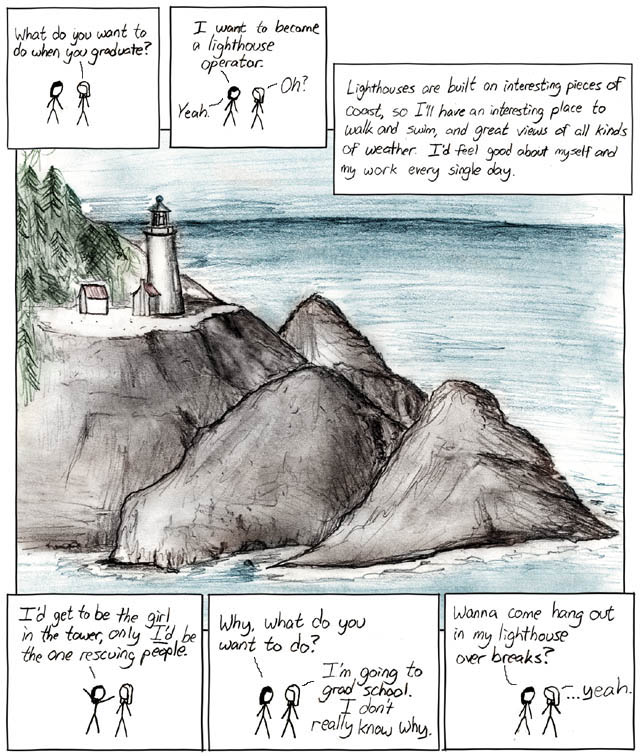
To the lighthouse


From xkcd.

Comment moderation is on, sorry folks!

We have a persistent troll, so have had to turn moderation on. This has been building up for a while, as regular readers might have noticed. Sorry to do this, please do keep commenting as I think we are having some great discussions and we really appreciate your comments.

Update: Here is a link to the comment policy, just in case anyone was wondering. There is only one individual, posting under several names, who has transgressed it, and it is for abusive comments. They are aware that it is them, from the tenor of comments they have attempted to get through moderation since becoming abusive. They have actually made a number of perfectly acceptable comments before today, which remain, and any future ones by this person that are not abusive and which contribute to discussion will be allowed.

Alright, let's talk about something else!

15th Carnival of Radical Feminists

The 15th Carnival of Radical Feminists is up at Rage against the Man-chine.

Cross-post: baby it's you

Cross-posted at the ex-expat.

In principle I should be for parents being able to select the gender of their baby at the pre-implantation stage of IVF programmes on the basis that I am firmly of the pro-choice camp. Moreover the selection is being done at a point where the embryo is at the very early stages of development so it should make me feel far more comfortable about it than a gendered abortion. The example used in the Herald of a family that already had three boys and was desperately after a girl in principle is fine example of people exercising their individual choice and after all, one extra girl to our society wouldn't make a difference. But what if everyone wanted girls, or for that matter a boys? Having spent a number of years in places where gendered abortions do take place this development does bring up an interesting questions of what happens when individual choices clash with societal ones.

Let us look at China and Korea. Sons are highly valued in these countries because not only are sons traditionally the ones that support their parents in their old age, but also because the parents also get get a daughter-in-law to cook and clean for them after their sons get married. Which is all fine in theory except someone needs to have a daughter in order for someone else to have a daughter-in-law. Except in these countries people usually have only one child whether government mandated (China) or economically in the case of South Korea, thus onus then goes on couples to produce a son.

And so they have. I taught at a boys' school and it was interesting that most of my students were either the eldest and only boy or had an older sibling or younger brother, very rarely did they have any younger sisters. And my impressions gives way to statistics. Women around the world usually give birth to 105 or 106 boys for every 100 girls. Slightly more boys are born because more of them die in childhood and as young men through disease and doing silly things (take a look at the Darwin awards and notice how few women grace the halls of fame). But according to China's latest census, there were 117 boys born for every 100 girls in 2000, up from 114 in 1990. During the 1990s South Korea's proportion was 117 boys per 100 girls the rate has since declined reflecting the country's rapid economic transformation which has made people less economically dependent on the traditional patriarchal family unit. However the effects of the gendered generation are likely to have profound effects on Korean, and for that matter Asian, society for many years to come.

Because of the shortage of women, Korea and to a lesser extent China, has taken to importing brides from poorer countries because there are not enough women to go around. In Korea at least, the problem is most acute in rural areas where what few the women those areas are drawn into the city on the promise of a far better lifestyle than a farmer's wife can offer. Thus Korean men are flying to Vietnam, the Philippines, and Uzbekistan to find wives. It isn't always happy endings, spousal abuse and culture shock often result in these women leaving their husbands not long after the marriage.

Aside from the more odious aspects of human trafficking that have resulted from gendered abortion there are security implications as well. Large numbers of men with little job prospects and thus little chance of forming a family could be disposed to turn to violence, whether individually or more problematically organized, will have effects on the stability of a nation's society.

But what effect of an absence of men? Given that that sex selection in favour of baby girls appears to be rare or non-existent, we don't actually know the answer. I'm sure on the surface most heterosexual men would love to live in a society where they had their choice of women, though I'm not sure that they would necessarily like the idea of their sons not having the opportunity to engage in the childhood adventures like they did with their childhood boy friends because so few are born nor would they seek to deny that opportunity for their daughters either.

And there in lies the rub.

What effect do all those individual choices have upon on us both individually and as a society?All things being equal, the sum of the individual choices will not alter the gender make-up of our society. Thus the problem I have with this development isn't necessarily that parents will be making a choice as to the gender of their baby, but they will be doing so in a society which values one gender over another. Perhaps an avenue that pro-life advocates may want to mull over when talking about abortion, as aside from contraception having a society in which pregnancy and parenthood is valued and supported would likely encourage more women to choose the baby option than banning the practice altogether. But I am quickly digressing from my point.

Has New Zealand reached the point where both genders are valued equally? I'm not sure. However the likely prohibitive costs involved in the procedure (unless it is government-funded) mean that few New Zealanders will actually be able to exercise it.

More on abortion - the infanticide objection

Cross posted on In a Strange Land

Here and elsewhere in the NZ blogosophere, people have raised objections and worries about some of the arguments I made in my earlier post on abortion. I want to address these issues here, rather than take them back to the blogs where the points were raised, in part because the conversation on at least one blog has been dominated by someone who is thrashing away at his own views, without paying any attention whatsoever to anything anyone else is saying. I have no desire to try to make myself heard over that kind of racket.

So, the three major objections / points:
(1) But your reasons for supporting abortion must also result in you supporting infanticide. (Raised here.)
(2) What about babies with profound disabilities, who don't fit your criteria of being fully human? Why is it generally held to be morally okay to abort a fetus with severe disabilities but not to allow a baby born with severe disabilities to die? (Raised here.)
(3) "But since Deborah has poked her head in, I'd love to get a feminist perspective on abortion being used to get rid of 'useless' and unwanted girls." (Raised here.)

It's going to take a while to discuss them, so I'm going to divide this into three posts.

The infanticide objection

I argued that it was not morally impermissible to end the lives of human beings that are not 'full human beings'. A full human being is one who has hopes and dreams, thoughts for the future and the past, it can conceive of itself as existing in relation to itself, in relation to other people. Killing a full human being is morally impermissible, because it ends that being’s future, it ends its connections with other people, it ends the existence that it values. However fetuses are not full human beings, so it is not morally impermissible to end their lives.

Here's the rub. It seems that new born babies don't have hopes and dreams, thoughts for the future, can't conceive of themselves as existing, either in relation to themselves, or in relation to other people. If that's the case, then infanticide would not be morally impermissible either.

I don't know about you, but I think that most people, including me, feel that infanticide is wrong. We have what we think is an instinctive reaction against it, a basic, primal gut feel that infanticide is simply wrong. So any argument that allows infanticide must be a bad argument.

This is a standard philosophical move, pointing out the unpleasant consequences of what seems to be a perfectly good argument. The person who put the argument forward then must choose whether to abandon her argument, or modify it so that the unpleasant consequence no longer ensues, or she can simply bite the bullet, and take the consequence.

I'm going to do the latter, and embrace the conclusion that my argument for the moral permissibility of abortion does also admit the moral permissibility of infanticide.

Before you think that the possibility of infanticide makes my argument totally untenable, I want to take a step back and think about slippery slope arguments.

Some theoretical stuff which you should read, because it underpins the rest of what I'm going to say, and because Philosophy is good for you

Here's a lovely slippery slope.

White
Whine
Chine
Chink
Clink
Blink
Blank
Black

At what point does white become black?

I can't hear your answer, so I'm going to have to put one in your mouth... sorry! The answer is that there is no clear point at which white becomes black.

I think it would be bizarre to say that there is a particular point at which 'white' becomes 'black'. Yet we can quite easily make judgements about either end of the scale: there is a clear 'black' and a clear 'white'. However we have nothing sensible to say about the exact point at which 'white' becomes 'black', because there is no exact point.

This is a common feature of slippery slope arguments. We start at one point, then change bit by bit by tiny bit, until we end up at quite a different point. Yet the changes are so small that we cannot say exactly where A becomes Z. It is simply quite clear that A is not Z, and never will be. Nevertheless, because the change from A to B, and then from B to C, and from C to D, and so on and so on, is so very small, we are tempted to apply the same judgements to B that we apply to A, the same judgements to C that we apply to B, the same judgements to D that we apply to C, until we reach the point where we make a judgement about Z, and think that exactly the same judgement ought to apply to A.

I think we should resist doing this. Often, we can quite reasonably make one judgement about A, and a completely different judgement about Z. That's because even though A changes incrementally into Z, A and Z are themselves sufficiently different that we can make judgements about them easily.

Back to abortion and infanticide

So yes, the criteria for 'full human being' that I have used do seem to apply to new born infants too. It is not at all clear that newborn infants can hope and dream, are aware of themselves existing, are aware of their connections to other people and value those connections. And if that's the case, then all other things being equal, infanticide is not morally impermissible.

(That 'all other things being equal' clause is very important. It does seem to me that if there are people who are ready and willing and indeed longing to bring up a child, then it would be better to pursue adoption than infanticide. But that's not to do with the morality of infanticide per se.)

However, based on my own experience, and the reported experience of other mothers, it's not clear to me that newborn infants have no connections to other people. My own newborn infants recognised my voice. They settled and slept in my arms, in a way that they would not with other people. I have very precious memories of one of my twins, unable to sleep in her crib, but falling asleep so peacefully early one morning as I lay back on the pillows, and gazed at her beautiful little body cradled in my arms. More than that, my daughters recognised their daddy. Our eldest daughter arrived screaming (good girl!), but calmed when her daddy held her so tenderly for the first time, and sang to her.

I don't know whether this means that our daughters valued their connection with us, that more than anything else, they were connected to us. But that doesn't lead me to reject abortion. Instead, it leads me to say that I am not sure about abortion in the later stages of a pregnancy. Because I am not sure, I want to push the threshold for the moral permissibility of abortion back to sometime before birth (in a standard pregnancy). Perhaps the start of the third trimester (all other things being equal). Even then, I will want to place the mother's health before the fetus's health. Why? Because I know for sure that the mother is a full human being, and her needs come before the needs of a being that may or may not be a full human being.

Equally, just not being sure about the moral status of new born babies doesn't mean that I can't be sure about the moral status of newly fertilised eggs, or blastocytes, or embryos, or early stage fetuses, before the critical brain connections have been forged. These beings are certainly human, but they are quite clearly not full human beings. Anyone attempting to describe them as full human beings is making bizarre claims, which can only rest on some sort of theological beliefs. A blastocyte bears no resemblance to me, even though I was once a blastocyte. Ending the existence of a blastocyte, of an embryo, of an early stage fetus, is not morally impermissible, just because ending the life of an infant is impermissible. We should not apply the judgements we make about new born infants to blastocytes, embryos and fetuses, just because we can't draw a clear dividing line between blastocytes and infants.

The 'yuck' factor

Famously, some philosophers do say that infanticide is morally permissible. And of course, our reaction is to say 'yuck'. But equally famously, that is just a cultural construct. The Greeks and Romans exposed unwanted infants, and Eskimaux did the same, with no moral consequences attached. Our culture has learned to regard infanticide as repugnant. So just thinking that it is yucky is not an argument in itself. It's just a reaction, and one that should invite us to think hard about exactly why we find whatever it is yucky. To be sure, some of our 'yuck' reactions are based in well-founded worries about disease - there are good reasons for finding rotting dead bodies to be revolting. But it's not clear that there are good reasons for finding infanticide to be repugnant. If you do find it too horrible to contemplate, then I suggest that you get over it, and spend time contemplating it, and thinking about exactly why you find it repugnant. If you can pin down a reason, then you need to to think about whether or not it really applies to fetuses. If it doesn't apply to fetuses, then the fact that you find infanticide to be repugnant is not a reason to find that abortion is repugnant.

Finally, none of what I have written here is new. It is commonplace, everyday, basic level, applied ethics. It's the sort of material that is covered in every introductory applied ethics course in every university in the English speaking world. I urge you, please, if you want to think about this issue some more, then go and get yourself an applied ethics textbook. As I said in my earlier post, we are happy to spend millions of dollars supporting philosophers in universities, people who spend years and years learning how to argue, how to tease apart issues, how to think carefully and clearly about the most complex of issues. But somehow, when it comes to the most perplexing moral issues, we just ignore them. What a waste.