Showing posts with label Sexuality. Show all posts

Saturday, 11 May 2013

When did you choose? Every day, thanks.

Lots of my friends are posting this on Facebook at the moment:


And I get the point, really, that being "born like this" is one way many queer people experience our sexuality, and that, on the strength of this film, lots of straight people believe they are born straight.

But it feels too simplistic to me, and too invisibilising of quite how messy and complicated desire and love are, for lots of people.  Maybe we cling to identity certainty around that because it makes us feel safer.


Because we grow up surrounded by heterosexuality, by images of lust and love being different-gendered, with opposite-sex sex education (if any) in schools, with opposite-sex love stories in music, in film, in books, on television.  Of course most heterosexual people don't feel like they have "chosen" to be heterosexual.  If your desires fit into the dominant forms of desires around you, why would you even think about it?

I know plenty of heterosexual people who have chosen not to act on same-sex desires.  Ask any queer person how often we've had our straight friends drunkenly tell us "I've thought about it....." often followed by clumsy invitations which, at least to me, haven't been that appealing.

I know plenty of people who acknowledge the fluidity of their desires, because their identity has changed from one part of their life to the next.  Phrases like "hasbian" and "on the train to gaytown", while intrinsically disrespectful of people's ability to define our own identity at each moment in time - and explicitly biphobic - illustrate the fact that identities which feel definitive and important to us at one point of our life can feel just plain wrong at others.

For me, the construction of "born this way" as the dominant way of thinking about sexuality is intrinsically conservative, intrinsically seeking solidity around emotions and desires.  Of course many, many people will have identities that remain constant throughout their lives, and of course queer people have different access to that because we have to buck compulsory heterosexuality to name who we want to shag and love.

But what about those of us who don't?  What about people whose identity fluctuates, based on the social contexts they are in?  What about the people who make choices not to follow desires, because it would be too hard for them, for whatever reason? 

Desire is frequently confusing.  Ever been attracted to someone, then freaked out when their gender is different from what matches your monosexual identity?  If you're a straight woman or a gay man who fancies Justin Bieber you might not want to click on the link.

I've claimed a solid identity around being bisexual for 24 years.  The reality of how complex that is for me is something I rarely talk about, because of quite how fragile the respect available to people who identify as bisexual can be.  Since I started knowing I could love women, that's being pretty constant.  My attraction to things masculine is much more ephemeral and context, and masculine person, dependent.  I believe that's mostly about the patriarchy, but it may well also reflect that I just fundamentally on average find hot women hotter than hot men - who knows?

And I've never - before or after I came out - fallen in love with a man.  Never actually even that close. 

Some people would no doubt argue that makes me "really" lesbian.  I know many lesbians who would and do describe their desires quite similarly to mine, but we identify differently because desire, lust and love are complicated things that mean different things to different people.

So my Facebook friends sharing this film, by all means let's encourage heterosexual people to interrogate heterosexuality - and in particular the privileges that come from being the norm, like being able to sleep with your lover when you're paying money to stay somewhere.

But please, please, please let's not shut the door on the delights of nuanced understandings and experiences of desire and love as changing, fluid aspects of our identity.  We lose something when we oversimplify such complex aspects of human experience.

Tuesday, 15 January 2013

Bad science isn't sexy

Gender differences are science, dammit, when will you silly social constructionists get over yourselves and admit girls just like looking after people, trying to be pretty and only having sex if they really, really love him.

When gender differences underpin your scientific investigations into gender differences, we have the kind of causal loop which produces complete nonsense.  And perhaps the worst area for this, scientifically, is around sex and desire.

Scientists have "proved" that women want sex less than men and that men have more sexual partners than women, wanting to spread their evolutionary seed around.  It all goes back to Mr Darwin.

Except they haven't.  Turns out when we remove the gender difference assumption, we remove the gender differences.

In 2003, Michelle Alexander and Terri Fisher used a simple test to investigate attitudes and behaviours around sex, asking questions when their subjects were connected to a fake lie detector, or not.  When asked about sexual partners unconnected to the lie detector, more men reported getting jiggy with it than women.  When subjects believed the lie detector would catch them out - no gender differences.  In fact, women reported ever so slightly more, on average, sexual partners than men.

Then there is the long cherished idea that men will shag anything in the inner-drive-rooted-need to be the daddy.  Speed dating had been previously used to "prove" this.  Basically, men were less choosy in speed dating scenarios, more likely to be keen to give someone a go.

Until you switch who sits still and who approaches the potential date.  Turns out all the earlier studies had men moving around.  Eli Finkel and Paul Eastwick swapped the roles in 2009.  Just being the approacher, rather than the approachee, is the key in dating situations.  You are more likely to have a favourable assessment of a potential date if you're the one putting it out there - regardless of your gender.

Finally, attitudes to casual sex might not be quite as different as more neanderthal scientists have previously proven either.  Terri Conley found in 2011 that if you remove situations in which women's assessment of danger might impact (a stranger asking you back to their place for sex), and focus on actual desire (a close friend you think is sexy invites you to spend a few hours of fun), gender differences in enthusiasm for sexual play without commitment disappear.  Again.

The evolutionists aren't going anywhere.  Harvard psychologist Steven Pinker wrote an email to respond to these studies to the New York Times, saying:
“A study which shows you can push some phenomenon around a bit at the margins is of dubious relevance to whether the phenomenon exists.”
 The gender difference is there, dammit, there.  Just look harder.

Wednesday, 5 October 2011

So how does your lady garden grow?

This post is explicit, and links to pages which feature explicit photographs. Feel free to look away.

I admit to a passing interest in fashion trends. Well ok, maybe that’s exaggerating my interest. So this may not be breaking news, but I’ve been thinking about it since chatting with a lesbian friend 14 years younger than I am.

We were talking about our bodies, and how we felt about them, and she said she shaved all her pubic hair. I asked her how her lovers felt about this, and she looked shocked and said “they all have too, of course.” When I told her I have never slept with a woman who shaves all her pubic hair, she looked shocked again.

Now most of her lovers have been her age or younger, mixed racially, not identifying as feminist.

Nearly all of my female lovers have been my age or older, mixed racially, identifying as feminists (what can I say, women who love women and don’t like gender oppression, *sexy*).

So there’s a generation gap going on here, and possibly a different analysis about how women look after our beautiful bits between feminists and non-feminists.

Before anyone assumes I’m saying “feminists can’t shave their pubic hair”, let me clarify. Growing pubic hair is one of the changes our bodies go through when we move from childhood to adulthood, and I don’t know about you, but I love being an adult woman. Which includes, for me, loving pubic hair.

A couple of years ago in Wellington’s Comedy Fest, the only humour in common from all the wonderful female comics I went to see were “jokes” about their pubic hair being revolting. This is the bit that is anti-feminist as far as I’m concerned – cultural norms which tell us our ordinary bodies are disgusting and a return to a pre-adult look for our genitals is a must. But our bodies, including our pubic hair? Ours to do what we wish with, of course. Kinda a baseline for feminism.

Quite where our wishes come from of course is another matter. Pubic hair fashion, like all fashion, has changed over the years and most agree that Penthouse featuring shaved genitalia in 1970 kicked off a cosmic shift in hair removal.

90s porn culture targeted a new area of hair growth on women and deemed it unattractive and unacceptable. In fact, trimmed, shaped or completely removed pubic hair has become normative. It is difficult many to remember the previous aesthetic, an aesthetic that did not require a woman’s vulva to be shaved, waxed or shorn to be considered “attractive” or desirable.

The “attractive” thing is clearly not just heterosexual in gaze, as evidenced by my friend. It’s also strongly aged. One national survey in the US found that 38% of women aged 18-44 cf 3% women aged 55 and older believe most men prefer a manicured look to their pubes. And what men want is definitely part of selling the package of pubic maintenance to women:

Most women place a good deal of focus on their pubic hair not only for themselves but for their partners as well. In fact, many women are willing to indulge their partners when it comes to pubic hair styles. Why not?
In a recent study:48% of men preferred their women to get rid of it all.
29% of men said they preferred their women to be natural — that being trim and neat but not bare.
16% of men wanted their women to have a little tuft of hair or a patch — would that be a ‘soul’ patch, boys?

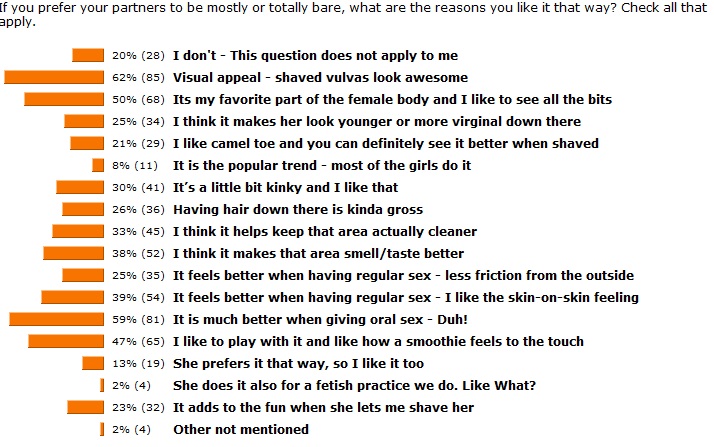
The rates of “heterosexually active men” who answered this small online survey were similarly clear about preferring little or no pubic hair, and the reasons for their preference:

Making oral sex “better”? I guess I have nothing to compare it with, but I’m not really sure how much “better” giving oral sex could get to be brutally honest. One in four men surveyed liking the woman they are having sex with to look younger or virginal while they are having sex with them? Just creepy.

Pubic hair grooming is big business, with a whole heap of options available. Which means companies making the tools to tend to our “lady gardens” can make awesome adverts:


Next time I’m-too-scared-to-call-my-beautiful-vagina-labia-and-clitoris-by-their-non -euphemistic-real-names I’m using tulip. But wait, there’s more:


But the most disgust expressed? The bizarre “neighbourhood is open” series, complete with canned laughter:


I’m really interested in how other people feel about this. But completely uninterested in misogynist expressions of disgust about women’s bodies, so please don’t comment if that’s your thing.

Thursday, 22 September 2011

Flaunting at the Rugby World Cup

Aotearoa New Zealand might be a better place to grow up queer than any of the 72 countries where same-sex love will get you chucked into prison, but it’s still harder than growing up opposite-sex attracted. Same and both-sex attracted young people are more likely to be bullied, use alcohol and drugs, self-harm, feel depressed and try to commit suicide.

So the report released by Green MP Kevin Hague this week is timely. Author Murray Riches interviewed a bunch of people who work with queer youth to come up with some recommendations for making queer life easier – and he also highlights that we may not even know how hard it is for trans young people.

Riches says the problem is heteronormativity and it’s converse, the idea that queer people “flaunt” our sexuality whenever we talk about not being straight, or not having a gender identity which matches our biology, or the gender people assign to us.

How does this work say, in the biggest cultural event going on in Aotearoa right now?

Well, there’s been precisely one out gay male international rugby player, Welsh player Gareth Thomas. It seems statistically unlikely that Gareth’s the only rugby-playing boy who likes kissing boys, so that suggests to me it’s not too easy to “flaunt” being queer if you’re a male rugby player.

What about the messages we get watching the games? There’s plenty of opportunities for enjoying the male body – if you’re female.


Messages about queer desire here, despite how incredibly easy it would have been to include, because really, you’re telling me you couldn’t find any men who like the look of Sonny Bill? Zilch.

More broadly, rugby and Air NZ have made sure we know those All Blacks don’t like queer boys by having Richard Kahui make himself available for random kisses from women, but firmly unavailable for random kisses by men.


Yep, the Rugby World Cup is a pretty good example of what’s wrong with the world if you’re a young queer person. And that’s not even going into the fact we seem to find it impossible to remember we have an international rugby team that wins world cups and which plenty of queer women might enjoy watching.

As well as supporting Kevin Hague with this report, if you’re interested in supporting young queer people check out the Queer Avengers in Wellington on 6th October. They are asking the Ministry of Education to ensure school is a safe place for queer students. It’s hard to argue with that.

Monday, 29 August 2011

It's the putting right which counts

I went to Camp Betty a while back now, and have been meaning to blog about it since. Billed as a "three-day festival celebrating and unpacking sex, sexuality & gender against a backdrop of radical politics and DIY action," Betty wasn't all that for me, but I loved the "Intersex 101" workshop run by some intersex activists from Australia and beyond.

I loved the fact feminism was regularly mentioned as part of the ways in which gender oppression (against intersex people) might be challenged. I loved it because I learnt lots, being woefully ignorant about the kinds of experiences intersex people have in the world, and I felt humbled because it was probably the only workshop I went to where I discovered a new to me way of treating other human beings with the utmost disdain.

By that I don't mean I'm some sort of pain groupie - I'm not, these revelations made me cry - but that I'm pretty familiar with most of the ways gender and sexuality oppression happens. So workshops about trans hatred and same-sex domestic violence, for example, were awful, but not really new to me.

Anyway, the Intersex workshop, and a definition:

Intersex people are people who, as individuals, have congenital genetic, hormonal and physical features that may be thought to be typical of both male and female at once. That is, we may be thought of as being male with female features, female with male features, or indeed we may have no clearly defined sexual features at all.

Basically, intersex people confuse our binary world - not with behaviour, though perhaps that too - but with anatomical differences from medical ideals of female and male. Their very existence proves that our binary world view is flawed. But this flaw has, increasingly since the 1950's, been "put right" by medical professionals with cosmetic surgery and treatments designed to make sure all the external bits of children and infants "look right."

Many believe such medical response should not be performed on children and infants, due to the psychological and physical damage such treatments cause. Since the 1990s, hundreds of intersex people all over the world have come forward to say these treatments should be stopped until intersex people are old enough to come to an informed decision.

What I found even more disturbing though, were some medical interventions being trialled here and now in Cornell University by Professor Dix Poppas. Professor Poppas cuts off bits of little girl's clitorises which are "too big." Then, in front of their parents, he engages in "follow-up clitoral sensory testing" - he uses a vibrator on girls as young as six to see if they still have any feeling in their butchered clitoris. Of course, if they don't it's a little late, but that doesn't seem to worry the medical profession, as he's one of New York Magazine's Doctors of the Year for 2011.

Let me be very plain about this. This is sexual abuse. It should be being shouted from the rooftops by those who care about sexual violence. How this procedure was ever ethically approved is completely beyond me. And the idea that a clitoris can be too big? Sounds like binary-supporting, woman-hating, pleasure-phobic nonsense to me.

If, like me, you find this completely repulsive, feel free to join intersex activists in telling Cornell University.

Then there is the dexamethasone controversy. Dex is being given, now, to pregnant women in US, to make sure their daughters, if they have congenital adrenal hyperplasia, do not develop "ambiguous genitalia." It's not being given to mothers of sons with CAH, because it does nothing to impact on the other characteristics of CAH - it just makes girls "ambiguous genitalia" nice and womanly.

These treatments haven't been medically approved. In fact, there's some ethical concerns because giving dex to pregnant animals leads to birth defects. Early studies with people show brain cell death.

Dr Maria New is one of the world's experts in CAH apparently, and the most enthusiastic cheerleader for pregnant women being given dex. Turns out she also writes papers on women with CAH, not only about "ambiguous genitalia," but on them finding other women sexy in higher numbers than average. One of her collaborators also talks about CAH girls not being interested enough in getting married or playing with dolls. Hell, why wouldn't you prescribe something which might cause brain damage if it's going to result in fewer queers/unnatural women, right?

Pre-natal dex is opposed by intersex activists, endocrinologists and bioethicists.

These are human rights issues beyond doubt. "Intersex 101" was open in it's invitation for non-intersex people to support the struggles for intersex people to have autonomy over their bodies.

And I love their slogan "Everybody equal, nobody left behind."

Saturday, 9 July 2011

25 years

A few weeks ago, there were so many people at the meeting I was at that we ended up sitting on the floor and on the stairs and out into the doorway. Someone who had been involved in the movement for homosexual law reform remarked that changing the law was probably the least important part of what happened then. From the chair I was sitting on (being obsessively early to things sometimes pays off) I looked across at everyone there; gay and bisexual women and men, trans* people, genderqueer people, straight people, people I didn't know how they identify, and probably people who don't know themselves. There were kids in school uniform and people older than my parents. I became suddenly, randomly, tearful. Of course it wasn't.

Unlike most of my friends my age, I remember living in a country (not New Zealand) when male homosexuality was illegal, and I remember a law reform with a crucial difference; there was no movement. That is not to say that there weren't some incredibly brave activists who put their lives on the line, but the arguments in favour of reform - at least that I heard - were legalistic and fatalistic. There was nothing I could have dreamed of being a part of.

The law change was important, of course it was. I'm really fucking glad that none of my friends here fear arrest for their sexuality. And even though it does not directly affect me, it paved the way for a whole heap of changes that make a difference to how I live my life every single day. But earlier this afternoon someone posted on Twitter:

One of my happiest memories is the campaign for Homosexual Law Reform. It taught me, at 15, that if you stand up things can change.
Because we have a long fucking way to go on all fronts. Many of things things I could cite as examples of how different things are - the fact that bank did not give a shit that when my partner and I applied for a mortgage we are both female, for example - rely on an already advantaged position. But thanks to those who stood up then, we have a space to make those changes and an example - even for those, like myself, who were just small children at the time, of how important collective action is, not just in making changes to the law, but in connecting people, transforming attitudes and giving us the confidence that can be so badly needed.

I often cite the example of these two law reforms - and the campaign for the civil union bill which I was actively involved in, and in many ways gave me the courage to come out - to underline the importance of collective action, that mass movements are about so much more than putting pressure on a handful of people in parliament. But I also know from experience that activism is often difficult, even more so when you are defending your right to exist.

So to all those who were there twenty five years ago, thank you. Thank you for the times you were scared as hell but kept going anyway, the times you pushed on past pain you should never have had to experience. Thank you for every time you got splinters in your hands from placards or the Wellington wind blew the glue covered poster right back in your face. To those who didn't make it and to those who are still fighting today, from this twenty something queergirl with a life she never used to think possible, thank you.

Monday, 27 June 2011

Questioning? New group through Akl Women's Centre

Thanks to Leonie at AWC for sending this through :-)

Questioning? This group fills a gap in the current offerings of social support provided to the lesbian, bisexual, queer women’s community. At present there is no where that operates as an open age, safe space to discuss and ask questions about same sex attraction.

Starting Monday July 4th, 7pm-9pm

Topics covered will include:
  • Stereotypes/labels
  • Gender
  • Telling friends and family
  • Out at work?
  • Finding community
  • Dating
  • Sex

Questioning will run over 7 weeks as a facilitated support group. The 3 facilitators, Ellie Lim (Auckland Women’s Centre), Cissy Rock (Low down) and Vicky Wood (independent) will steer the sessions, using a mix of exercises, discussion topics and post-boxing. The format will be mostly participant directed and resources will be distributed over the course of the 7 weeks.

If you have clients, friends or loved ones who could benefit from attending Questioning? please ask them to register their interest with Ellie on 09 376 3227 before the group starts.

Thursday, 9 June 2011

I'm here, I'm queer, get used to it

Tonight is Queer the Night here in Wellington, a chance for people who agree with this:

Everyone has the right to express and explore their queerness without barriers, including fists and bottles on the street.
to walk through the city in solidarity together.

I'll be there. As a female teenager, I had crushes on Paul Weller and Billy Bragg, plus the odd cute boy that I went to school with. When I went to university, I became involved in all kinds of political activities, all of which are still part of my life now. And I met queer people. Beautiful strong stroppy lesbians and bisexual women who so challenged my ideas of attraction and relationships that it changed my life.

I came out when I was 18, as bisexual. At this point, what that meant for me was that I acknowledged the possibility of attraction to women, that I'd come to think that attraction, for me, was more about qualities people have than gender. I knew I liked kindness, and compassion, and the intellectual capacity to take apart an idea. I knew I loved sparkling eyes and wicked grins and people who were comfortable and playful with their bodies. And I didn't think many of these things were gendered only and always ever male, or only and always ever female.

When I came out, several things happened. Despite not having a sexual relationship with a woman until I was twenty, the following year I was demoted from the captaincy of a representative cricket team. We'd won a national tournament, but the word was that an out queer shouldn't be captain of an Under 20 team. The (straight) captain that replaced me led us to coming last of eight teams.

There were all manner of repercussions in my family, still the place in which not being accepted was the most painful. These continue, as for many queer people, to be ongoing. My parents, after some very difficult years, are now not exactly going to be on the march with me but are certainly supportive in a way which was unimaginable when they were threatening to stop me seeing my younger brother in my early twenties.

Being out has affected by employment. I've been bullied, in a feminist organisation, for being bisexual rather than lesbian, and told repeatedly that bisexuality doesn't exist (apparently it's a 22 year phase I'm still rather enjoyably stuck in), and that I just need to be brave and come out "properly." I've been turned down for a job I was imminently qualified for when an existing born-again Christian member of staff said she would leave if I was hired. Everyone interviewing for the position had been informed of this before my interview.

And lets not forget the streets. I've been spat at, yelled at, and threatened with violence on the street, for kissing women. Rather memorably, one night in Newtown as I walked home holding hands with my then girlfriend, we were targetted by a bunch of teenagers, who after shouting abuse at us, starting throwing things. After catching one, we realised the missiles were potatoes, from a huge sack they were carrying. This stopped only when I started throwing them back - thanks to cricket, I had a much more accurate and longer throwing range than any of the strapping boys in their group.

I mention these experiences - over a truckload of others - to give some flavour about why I will be marching. And I'd love to see others there - whether or not you're queer - who agree that people should be able to love who they love, fancy who they fancy, dress and act and be in all the wonderful varied ways that human beings express gender - without any threat or reality of violence.

See you there.

Monday, 30 May 2011

KAZAM! Rainbow Youth Fundraiser - Akl, Wed 1st June

Many thanks to aboveandbeyondgender for the tip off :-)
Come join in a lil bit of Wednesday night fun..... JUNE 1st - 7:30PM - @ Kamo Bar and Cafe – 382 K Rd, AKL.

We are raising money for our upcoming national Takatapui, Queer and Trans Youth Hui in West Auckland over queens birthday weekend.

Please join Rainbow Youth, Blake Skjellerup, Toby from Kamo Bar and his staff, MC Steven Oates and Ms Heidi, plus special guests for an evening of entertainment and help us blast thru our final fun...draising goal!

Up to 200 youth from across Aotearoa are gathering together for a weekend of fun, activities and discussion. In joining us on June 1st and donating a lil bit, even by purchasing a drink at Kamo, you will help to assist youth to travel the country to be there, cover registration costs for each youth and give these young people an opportunity to belong in as vibrant a community as the one we have in Auckland.

Toby and Kamo staff have offered Kamo Bar and Cafe to host this event, and entertainers have generously offered their time and support free of any fees, so thanks to them.
Facebook event page here.

Tuesday, 17 May 2011

I'm not just a vagina who likes men.


Cross posted from Well behaved women rarely make history

My name is Scuba. Danger. Nurse. – yes my middle name is danger. I am THAT awesome!!
I was born with a fully formed vagina.
As a child I self identified as female with occasional yearnings to be a boy, when I realised I couldn’t climb trees that well.
As an adolescent I developed late at around 16, with acceptable female hormone levels and a socially acceptable female mammarys.
I became attracted to men once the hormones kicked in. Previous to that they were there to take me for bike rides and make dinner (dad) or fight (every other boy).
I occasionally feel that being a lesbian would be an acceptable choice for me when I see a petite masculine featured woman, but don’t really feel like the sex stuff with them, which makes it all a bit half hearted really.
I am in a long term, committed relationship with a man, and if the cysts on my ovaries are not an impediment I would like to one day become a mother by means of sexual male-female reproduction.

Are you confused about why I shared all of this?
It all seems a bit freaking pointless really, since it tells you exactly jack about who I actually am.
It tells you nothing about my hopes, dreams, personality, ethics, morals, lifestyle, and sense of humour, strengths or weaknesses (unless you count climbing trees).

So why do people who are Gay/lesbian/bisexual/trans have to explain every facet of their lives?
Why, when someone comes out as Trans, do people feel an explanation is due as to what “level/stage” they are at?
Why do people feel that if someone is not straight, they can quiz someone on when, where, how and what they like as if they should validate what they feel?

People are people, no matter who they love, and what their junk is.
Let people tell you who they are, in their way, on their terms.
Find out the usual way, by leering at strangers in bars, and comparing notes on your favourite films.
Because my vagina and sexuality tell you zilch about which film stars turn me on, and whether I want kids or can have them, or what I want to do with my life.

Judge people by the sum of their parts. Not their parts, or who they bump parts with.
(sorry had to do it!)

IDAHO: Trying to do

For International Day Againist Homophobia and Transphobia (aka IDAHO) I thought I'd try to get out some ideas that have been percolating for a while.  I might bumble through this a bit, and I'm writing in the hope of getting some feedback about this, so please comment gently.  I'm going to focus more on the Transphobia part of IDAHO, as that's the bit that's newest to me and I feel I have a lot to learn about trans issues.

At school I remember an English teacher telling me to avoid using the same word too many times in a paragraph.  Writing about feminist stuff you end up using "woman" a great deal, and I struggle sometimes to come up with variants.  For a while there I thought I had a brain wave that would give me another option to alternate with, by using "XX."  So I played around with that for a while, months I suspect, peppering it gleefully through my rants about A, B and C, ignorant to what I was really saying.

I don't use it now, because being XX is not the defining characteristic of being a woman imho.  It's taken me a while to realise this, and I apologise wholeheartedly for it. 

I've done other exclusionary and unhelpful anti-trans stuff too, I'm sure, not least in writing about abortion focusing on "a woman's right to choose."  While I think there is a strong gender dynamic to the abortion debate, I respect that not everyone who becomes pregnant will identify as a woman.  And thus access to abortion is not just about a woman's right to choose.

I want to thank V for helping me have a few aha moments about this along the way.  I'm definitely open to some more.

To focus more on the overall point of IDAHO, I've been thinking about Yoda.  He was right about "...Fear leads to anger.  Anger leads to hate..."  It seems to me that people tend to fear things they don't understand, and can't control.  One option is to just chillax and shrug and learn when you can.  But it seems there are lots of people who don't take that up and instead opt for the Dark Side.

Hating someone not because of what they've done but because of who they are attracted to, how they identify themselves, the colour of their skin, their gender - it all baffles me.  Why would you expend so much energy hating someone you've never met, or don't really know, because of something that is totally irrelevant to how you live your own life?

Today is a day to say no to homophobia and transphobia.  And everyday is a day to reject hate based on irrelevancies.  Hate someone for how they act; how they treat you, or their kids, or their dog, or their employees, or women.  But hating them for their identity or their sexuality?  That's just lazy - surely you need to know more about someone before you can feel that strongly for or agin an individual?  It must get really tiring to hate so indiscriminately. 

Big love to all my friends today.  If George Lucas had ever got around to making any more Star Wars films (and gee am I grateful he didn't after the terrible prequels) I hope he would have got around to Yoda telling us that love and tolerance are the antidote to hate and fear.  When it comes to being inclusive, try is on the pathway to do.

Monday, 16 May 2011

International Day Against Homophobia and Transphobia (IDAHO) Round-up

May 17th is International Day Against Homophobia and Transphobia (IDAHO), and I'm hoping to get a chance through-out the day to put up links to any posts through-out the NZ blogosphere showing support for this worthy cause.  If you spot anything not yet on the list feel free to add it in comments and when I get a chance I'll add it in. 

The twitter hashtag is #IDAHONZ and there is an @idahomophobia too.  And the NZ website is http://www.idaho.org.nz/ (where I've got most of the events from).

Consider this also a gentle reminder to get your blog on if you feel so inclined :-)

Events:
Everywhere - T-shirts for IDAHO - initiated by some great Dunedinites
Dunedin's Quizically Queer - Quiz night, part of OUSA's Diversity Week - Tuesday night
Auckland's Screening of Courage to Unfold - Tuesday night - & T-shirt making competition - Tuesday daytime

Bloggage:
Amanda at Pickled Think:  IDAHO:  International Day Against... Hate of (all types)
Julie at The Hand Mirror:  IDAHO:  Trying to do
C Connoisseur at missingsparkles:  International Day Against Homophobia and Transphobia
Scuba Nurse at The Hand Mirror:  I'm not just a vagina who likes men (cross-posted at Well-behaved women...)
Lena shares her great t-shirt at In My Head
Octavia at her Spitfire Emporium:  Safe places for cis women
QoT at Ideologically Impure:  No refuge for some in IDAHO
Dougal at Nae Hauf-Way Hoose:  Shinjuku Boys

Let me know if I've missed anything by adding it in comments :-)

Sunday, 15 May 2011

IDAHO T shirt competition at UOA Tuesday 17th

This sounds fantastically awesome. Looking forward to the pics :-)
IDAHO T Shirt Competition at UOA Facebook Event Page:

The 17th May is IDAHO, International Day Against Homophobia and Transphobia.

Some awesome people down south have started a competition where they ask you to create a T-shirt with a slogan against homophobia and transphobia, take a photo of you wearing said T-shirt on Tuesday and put a photo up on the interwebs to show them

We though we'd join in at Auckland Uni so we'll have a stall set up on Tuesday with Fabric Writing Pens and all you need to do is bring along yourself, a white/pale T-shirt and your brilliant ideas. For those who don't hear about it till the day we'll also have pieces of material that they can decorate and safety pin to their tops.


We will have some small but very awesome prizes on the day.


There is also a screening at the Human Rights Commision organised by Rainbow Youth, UniQ and HRC in the evening.


And there is also the page about the T-shirts. Please do not feed the trolls.
It really warms my heart everytime I see some great new initiative from younger feminists (by which I mean younger than me!) like the stuff Campus Feminist Collective and WYFC are up to.

You can find out more about IDAHO in Aotearoa New Zealand here.


Thursday, 12 May 2011

Queer the Night (Wellington)

Poster for 'Queer the Night' featuring a brightly coloured unicorn and rainbow on a dark background and basic information about the march, also included below


On Thursday 9th June a march will be held through Wellington city to stop homophobia and transphobia on our streets.

Queer the Night was inspired by the Reclaim the Night philosophy and initiated in response to a couple of recent incidents where members of the queer community were assaulted in central Wellington. To many, these were a shocking reminder that although we've come far, there are still dangers to those who are or are perceived as being outside heterosexual norms. To others, dealing with homophobia or transphobia on the streets in an everyday experience. Either way, it is unacceptable that any of us are made to fear physical or verbal abuse in our city.

At the same time, we want to celebrate the gains made in this area, and offer our solidarity to those fighting homophobia and transphobia in places it may be even more potent; in their schools, their homes, their workplaces and throughout the world.

We will be marching on Thursday 9th June, meeting at 7pm at Waitangi Park (formerly Chaffers), traveling to Cuba St where there will be guest speakers and an open mic. Please bring glow sticks, torches, etc to light up our city. All supporters welcome.

What if I just don't feel like having sex?

I went to a spectacular lecture last year by Leonore Tiefer, founder of the New View campaign. Ms Tiefer, amongst other things, is a sex therapist who works with people having problems with their sex lives, for whatever reason. The New View campaign was established because:

The pharmaceutical industry wants people to think that sexual problems are
simple medical matters, and it offers drugs as expensive magic fixes. But sexual
problems are complicated, sexuality is diverse, and no drug is without side
effects.
The goal of the New View Campaign is to expose biased research and
promotional methods that serve corporate profit rather than people's pleasure
and satisfaction. The Campaign challenges all views that reduce sexual
experience to genital biology and thereby ignore the many dimensions of real
life.
Ms Tiefer's particular focus has been the creation of pharmaceutical solutions to women not wanting to shag as often as we're supposed to. Yep, really. There's been a disorder about it and everything. Since 1997, medical types have been talking about "Female Sexual Disorder". The first time was at an invite-only sexologist conference funded by pharmaceutical companies, where they agreed no one agreed if this even existed.

Nevertheless, pharmaceutical companies put loads of dosh into finding a "solution". First Pfizer's "female Viagra" came belly-up, despite seven years worth of trials, when their magic shagging pill didn't work any better than a placebo.

Commenting on these trial results on Viagra, John Bancroft, director of the Kinsey Institute, told the BMJ: “The recent history of the study of female sexual dysfunction is a classic example of starting with some preconceived, and non-evidence based diagnostic categorisation for women's sexual dysfunctions, based on the male model, and then requiring further research to be based on that structure. Increasingly it is becoming evident that women's sexual problems are not usefully conceptualised in that way."
The drugs companies kept trying. Next along came Proctor and Gamble, with a testosterone patch called Intrinsa to make us all horny as hell. Sadly, again, it didn't actually work, nor was it deemed clinically safe enough for release by the FDA. More recently, Boehringer Ingelheim's Flibanserin failed to boost women's desire more than a placebo, and was also turned down by the FDA.

In order to create a need for intervention, pharmaceutical companies have consistently stated that as many as 1 in 10 women are suffering from low sexual desire. Quite where this figure comes from, or what it actually means is rarely explored. It is taken as given that if women don't want to be having "sex", then there is something wrong, and that something can be fixed with a magic pill.

I've said this many times before. Whether or not you feel like sex - assuming you are not wrestling with depression; getting used to early motherhood and the sleep deprivation that entails; or in a situation where consent is impossible, for whatever reason - whether or not you feel like sex is enormously dependent on what sex means. And given how lacking in imagination much advice to women having sex with men is, could any woman be blamed for feeling less than enthusiastic?

How about this advice from Women's Health? Sex life a bit stale? Try "maintenance sex", or as their experts explain, "meat and potatoes sex".

On the nights you’re too drained for long, drawn-out foreplay, boil it down to a couple of well-placed caresses that you can count on to expedite arousal. When you’re both riled up enough for intercourse, the goal is to orgasm – fast. To that end, choose O-friendly positions that lend themselves to clitoral contact. Woman on top is your best bet because it lets you control the pace, but don’t count out positions that allow for manual stimulation (side-by-side, from behind).
“You don’t want this to be the only way you have sex, but you should have it a lot,” says Dr Schwartz. “So if you’re having sex four times a week, maintenance sex should account for two or three of those times.”
Thank the goddess I'm vegetarian - because this would bore me stupid, and I'm fairly certain I'm not suffering from low female sexual desire. Aside from the (welcome but not always the be all and end all) instruction to have an orgasm as (less welcome) quickly as possible, is this really any different from women being told to lie back and think of England because their husbands need it?

And the other three kinds of sex which will keep you coming back for more according to Women's Health are not much better I'm afraid.

When this is all sex means, why should we want it? What if we were to reimagine the whole shebang, and come up with some more exploratory ideas of both activities and desires? This doesn't mean I'm suggesting every sexual encounter needs to be a full opus to be worth reading - but nor should it only ever be a short story.

And if you're a sex therapist calling everything other than intercourse "foreplay", you probably need another job. Or to go get some supervision from Leonore Tiefer.

Sunday, 8 May 2011

It's hard to feel good about Viagra

Sexual violence and war have been entwined for a very long time. More recently, as stories from all over the globe emerge, the United Nations has taken a position - rape during conflict is a "war crime". Which begs the question, what is rape in peace time?

War Crimes ambassador David Scheffer has visited areas in conflict all over the globe and said 12 years ago:

In the past, as many in this room are all too aware, rape and acts of sexual
violence against women went unrecognized and unchallenged. In many conflicts,
some soldiers, perpetrators, and world leaders viewed rape as a fringe benefit
of war, an unspoken perk. While some observers have dismissed incidents of rape,
with the reason that men, or as so often seen, boys, simply get out of hand or
out of control after a rough day on the battlefield, recent history has shown
that organized, systematic patterns of rape are a component of deliberate ethnic
cleansing. The world community, on occasion, ignored the truth that these acts
are not simply acts of recklessness, but acts of torture.

Let's not think we are immune in Aotearoa - Waitangi Tribunal reports note that rape of Maori women was a tactic used by Crown troops to demoralise iwi in the Land Wars.

Yet there was something newly horrifying, for me, in the news last week that Libyan troops are being issued with Viagra to help them rape.

The idea that male soldiers might need training to be brutal enough to rape has been explored by feminist Robin Morgan, who first drew my attention to the US Army "training song".

But who is selling Viagra to the Libyan army? And how can they not know this is for rape?

I guess my surprise is kinda ridiculous, in the context that "erectile dysfunction" is a relatively recently discovered problem, established primarily for profit.

This trend towards recognition and acceptance of ‘erectile dysfunction’ has occurred concomitantly with a focus by the medical and pharmacological disciplines on developing physical treatments for sexual ‘problems’. The field of treatment that has proliferated most rapidly over the past 10 years is that of sexuopharmaceuticals.
Viagra of course is not alone in treating "erectile dysfunction." In fact it's market share has been dropping since 2000 as other pharmaceutical companies have jumped in alongside Pfizer. But it's the biggest, the sexiest, the one we see advertised every break in televised sports matches, complete with women glowing with gratitude that their man can get it up when they need it.

Even if some women like intercourse at least some if not lots of the time, most of us also like a range of other sexual delights, for which an erect penis is not strictly necessary. In fact it's not even necessary for penetrative pleasure.

Or even for male pleasure or, say this loudly, male orgasm.

NZ psychologist Nicola Gavey, along with Tiina Vares, Annie Potts, and Victoria Grace interviewed partnered women and men who had started using Viagra due to "erectile dysfunction".

They found some interesting things. Some men loved it. They reclaimed active sex lives, and therefore self-esteem. Others had "side effects" (that ridiculous term, the effect the drug company doesn't want us focused on) which they didn't like, so stopped using it. And many men spoke of enjoying the exploration of sexual activities with lovers without worrying about whether their penis was hard.

Half of the women interviewed spoke of their sex lives improving with age, as they knew their bodies better and were better able to ask for what they wanted, including not being as focused on intercourse. Many women were not involved in the medical consultations which led to Viagra being prescribed. For those who were, many said Viagra was prescribed as a “quick fix” for relationship problems more substantial than a limpish penis.

Some women talked about unwelcome changes in their sex lives from the introduction of Viagra - multiple erections over 12-24 hours, being pressured not to "waste" a tablet, pain and discomfort from prolonged or repeated intercourse.

And most importantly, if you're wanting to have a fun time with your man, women talked about less time spent on other pleasurable sexual activities.

The myth of why we need Viagra has been around for a while. I'm going to write later in the week about similar pushes to deal with women's "sexual dysfunction" - in the meantime I'm going to hold onto my horror of this new (to me) partnership between pharmaceutical capitalism and the armed forces.

Thursday, 8 July 2010

Whose body?

From Echidne of the Snakes:

The sexual liberation of women can be a great thing, a wonderful thing. But it also can be subverted and turned into the sexual liberation of the female body, almost absent its owner, or perhaps owned by others. It is that body which has become a signifier of sexuality for everyone, including heterosexual women, and the shape of that generalized sexy body is now more stringently controlled than ever before. Hence the need to shave the pubic area and the need to have large and perky breasts. The Female Body in that detached sense is now a mythical body, an impossible body, with fixed labia and enhanced breasts. At the same time many view it as an achievable body. A normative body type, if you like.


Taken from Echidne's review of Susan J. Douglas' book about American pop culture and its negotiations or wars with feminism: Enlightened Sexism. The Seductive Message That Feminism's Work Is Done

Sunday, 2 May 2010

only human

i've been wanting to respond to a couple of comments about burqas that have been made in the last few days, but i needed to let my thoughts settle in my head a little. the particular comments i'm thinking of (and i'm sorry to single you two out, it's just that you started my current train of thought) are:

For me supporting Boobquake is part of the same thinking as supporting Muslim women who want to wear their traditional head coverings. People need to have the freedom to dress in whichever manner is right for them without fear of other people's reaction.

and this:

Anjum, what is your position on the wearing of the burqa ? I'm at a loss to understand it any terms other than that it is archly patriarchical.

and i think i'll start with the second one first. the fact is that i don't actually support the burqa. i'd be happy to challenge anyone to find me actually supporting the burqa itself in any of my public comments. i have supported the women wearing them, mostly by default. i just became the go-to person for a little while on matters pertaining to muslim women, and often felt uncomfortable with being put in a position of supporting something i didn't personally believe in.

on the other hand, i had something that many people in this country didn't have, and that is the chance to interact with burqa-wearing women, and to debate with them about the rights and wrongs of wearing one. you might want to think of these women as brainwashed, but i found many of them to well-educated, articulate, some of them born and brought up in the west (and usually deciding to take on the burqa as an adult), and pretty passionate about their beliefs. i've had some pretty in-depth debates, and have yet to convince a burqa-wearing woman that she shouldn't wear one. maybe that just means i'm a poor debater...

but getting back to what they said on the subject, i've heard one woman make a pretty feminist argument about wearing a burqa. her point was that it was her body and no male had any inherent right to view any part of her that she didn't wish to reveal. to her, it was a matter of empowerment that she was getting to decide what to reveal and what to conceal.

i can see her point of view. i can appreciate that, as an individual, she feels empowered and that she sees it as a feminist decision. but i can't agree with her. as an individual, it may well be that way. but at a societal level, it creates too many restrictions on women's full participation in society - in the ability to access many kinds of employment, to partake in politics and leadership, and so on. i accept that a society could theoretically be structured where a woman wearing a burqa could do all those things, but i haven't seen one, at least in our modern world. i've seen burqa-wearing women engaging in a variety of tasks, from driving to being a school principal, but on the whole i don't think it's possible to be a fully engaged member of society while wearing one.

which leads me to conclude that it isn't a feminist choice to wear a burqa, even though the individual woman wearing it may feel that way about it. the societal negatives outweigh the individual empowerment.

so why do i so often defend burqa-wearing women? the main reason is that i don't think forcing women out of the burqa is going to achieve anything positive for them, and it certainly won't change what they believe or how they view the world. if they are oppressed, it won't stop the oppression. the other reason is that i don't believe they deserve the sometimes pretty harsh harassment they received for dressing the way they do. i pretty much covered this ground a couple of days ago.

i have no problem with people criticising the burqa, as long as they actually know what they're talking about. so for example, all of the people who use the "but criminals could be under that burqa and could get away" obviously haven't got a clue. even for the burqa wearers, when it is a matter of public security, they can lift their covering and show their faces for identification purposes. it's really not an issue. nor do i accept the "they're all oppressed" argument, because clearly some of them are not, and have come to this decision through their own reasoning.

which then leads me to the first comment i quoted at the beginning. when it comes to the whole "boobquake" thing, i feel pretty much the same. i can understand why individual women would see this event as empowering and i don't believe they deserve criticism, or "slut-shaming" if you will, for simply taking part in something they believe in. but i disagree that the event as a whole is a feminist event, given the societal context it's happening in. a society where increasingly, the prevalent view we get of women is as dehumanised, sexualised beings rather than whole humans with their own sexuality.

again, i think the ground has pretty much been covered, and i don't need to go into the detailed arguments. but i do feel that we need to have the space to talk about our misgivings about events or the way female sexuality is presented, without it being seen as an attack on the women who want to present themselves that way.

i guess that's what i was trying to do with the post on the v8 coverage in the waikato times. i had no beef with the girls who chose to be grid girls or hood st hotties or whatever else was happening. my problem twofold: the coverage of women in relation to the v8s which gave them such limited roles, and the very narrow definition of what constituted "hot" in terms of the photographs presented. i assumed that it would be understood that i wasn't attacking the girls themselves so didn't articulate it clearly in the post. possibly a mistake on my part.

with boobquake, i know that a lot of people see it differently to me. that's fine, and if they believe it's a feminist event, that's fine. but i don't have to agree with that, and to disagree doesn't mean that i think the person making the argument is a bad feminist. it just means i disagree with their point of view on the issue.

and, yes, i tend to disagree pretty forcefully. i guess that's as a result of some pretty agressive and sometimes nasty comments that come through whenever a post goes up that discusses issues around female sexuality. and i don't react well to people accusing me of saying things i didn't say or didn't mean. but i do try my best to avoid making personal attacks. it's not up to me to judge who is a good feminist any more than it is up to me to judge who is a good muslim or a good whatever.

that i may fall short of the mark on occasion is to be expected. i'm only human after all. but i intend to continue to put my own arguments forward or to say why i disagree with someone else's point of view, even when i know my own position is going to be pretty unpopular. that's nothing new for me, i'm pretty used to being a misfit or the odd one out in a variety of situations.

Wednesday, 2 December 2009

Rainbow Wellington taking NZ Blood Service to the HRC

On Stuff today:
A gay rights group is taking the New Zealand Blood Service to the Human Rights Commission over the ban on sexually active homosexual men giving blood.

Rainbow Wellington wants fewer restrictions on gay men giving blood and will have mediation with the blood service in February.

The service reviewed risks posed by homosexual men in 2007, with a report released in April last year.

Previously, any man who had engaged in homosexual acts over the past decade was banned from giving blood.

The service now prohibits any man who has engaged in protected or unprotected anal or oral sex with another man over the past five years from giving blood.

Rainbow Wellington chairman Tony Simpson said that effectively banned all men in homosexual relationships and was discriminatory.

In Tasmania, men who had gay sex had to wait a year before giving blood, while in Britain they were banned forever, he said.

Simpson said three to six months was all that was necessary for the virus to show up in tests.
Click through for the rest.

Great to see this issue getting an airing. The ban mainly seems to have been about discrimination at worst and ignorance of the actual risks at best.

Monday, 30 November 2009

Family First pimp marriage

Seems that least progressive of organisations, Family First, has decided to turn its great swivelly burning eye away from the pro-smacking lobby and towards the issue of marriage. Their summer advertising campaign is going to feature the following billboard:

Apologies if it's not that large, but never fear, they are raising funds to put ginormous versions of it up all over the show (for surprisingly cheap sums of money too, hmmmm, might be something in that for a journo...)

Now coming from Family First I'm guessing that this campaign is aimed at coming up with a positive message beneath which to sell the following rather negative bits and bobs:
  • No sex before marriage
  • No non-hetero marriage
  • No non-marriage relationships with kids
  • No non-marriage relationships with state-recognition (and that's not just about the Civil Unions Act, which turns 5 shortly, but also about things like state housing, welfare provision, who can be your next of kin, etc)
  • No divorce
And they reckon the PC liberal set are the Fun Police!