The following is an edited version of a short talk I gave on disability and queer issues to a queer, mostly studenty, audience. It is limited by the short time I had to speak, as well as my own perspective. At the end I touched on some aspects of movement building and common experiences, however I have ended this post quite abruptly before that as I'd like to explore these in more depth in a later post.
As a queer disabled person, the disadvantages and exclusion you face end up being multiplied. It’s hard to find queer friendly housing, and it’s hard to find accessible - which may mean quiet or dry or wheelchair accessible - housing. If you need both, you get slammed. Queer friendly healthcare isn’t that easily come by - but try finding queer friendly healthcare that is accessible and includes the specialist knowledge you might need. Queer people generally get useless, inappropriate and often outright damaging sex education. Disabled people can get the same, or often don’t get it at all, perhaps because we are assumed to be non-sexual, because we are removed from those classes for extra tuition, because it is not offered in a way we can understand or interpret or because it is not appropriate to our bodies. Again, the effect is multiplied.
Queer spaces are too often inaccessible - even on the most basic level of being wheelchair accessible. It's not acceptable, and constitutes a 'not welcome' sign on the door for many disabled people. And whilst this isn't okay anywhere, I think most of us here know how essential queer spaces can be, and that they're often the place you go after being excluded from anywhere else. Accessibility needs can be quite varied, though - to give one personal example, I struggle with the reliance on bars and clubs as queer spaces because I have problems in noisy environments. I'm happy that more and more alternatives are being offered, but there's a long way to go. Accessibility is often overlooked in event planning, but it needs to become as routine as booking a room or putting up posters.
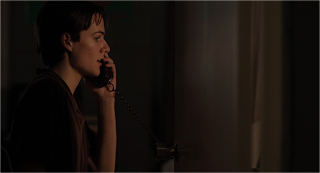
The next thing I want to talk about is family and relationships. The picture above is from the movie Milk in which this young person calls up Harvey Milk for help as his parents are about to send him off to be degayed. He’s advised to run away, and get to a big city. The image then zooms out, revealing he’s a wheelchair user.
That story had a happy ending, but many don’t.
It’s hard enough escaping from abusive or bigoted family - but if you have limited mobility, if sleeping on a couch isn’t possible for you, if you need personal care provided by your parents, if they’re the ones who take you to medical appointments, if public transport is inaccessible and your escape can be attributed to your disability then it’s a whole other story.
You’ve probably heard about parents of disabled adults fighting to be paid for carework in the news recently. Mostly it’s been fought from the angle of these parents’ rights - which is important. But it’s also important that disabled people are not forced to live with family members longer than they would otherwise choose for financial reasons.
Similarly, there can be pressure for disabled people to stay in relationships longer than they otherwise would if they are meeting support needs - this includes abusive relationships, but also those which have simply run their course. I think this issue is particularly important to the queer community, not just because abuse in queer relationships is under recognised, but because we place a lot of value on the fight to be accepted as in relationships, and we need to understand that for some leaving can be just as much as a struggle.
The sexuality and gender identity of disabled people can be linked to their disabled status in a way which pathologises or dismisses that identity. For example, asexual disabled people are assumed to be examples of the belief that ‘disabled people don’t have sex’ rather than having their identity acknowledged in its own right. Disabled lesbians are assumed to be lesbian because they can’t get a man. Genderqueer disabled people can be assumed to be confused or lack understanding of social appropriateness.
That said, I think queer people can often be unaware of the complex ways sexuality and gender identiy can be linked to disability for some people. To give just one specific example, a lot of autistic people see themselves as outside the gender binary. And a number of them would never identify as genderqueer or join groups catering for queer and gender diverse people (though of course some do!). They might see their gender identity as an extension of their autistic identity, but not talk in the terms or feel welcome in the spaces that other non-binary people do.
Disabled queer people of course experience similar issues to many who experience more than one form of oppression. The more acceptable norms a person fits, the more easily they can get away with breaking others. Sometimes this starts externally, and becomes internal, with people trying to hide one part of themselves because it is all ‘too much’.
Okay, shoe time:
Say (to make it simple) if you were at a queer women’s group, and a woman walked in wearing one of these pairs of shoes. You’d probably assume it related to her identity in some way. If I gave you two stereotype hairstyles, I’m sure you could match them with the shoes - and you might make some assumptions about the type of person she is and what she does with her time.
I look at those shoes and see one pair I could never ever conceive of wearing anything like them, because I’d fall over, and another that I might manage but would be a struggle. I don’t see identity; I see functionality.
But so much of identity in the queer community is assumed to be tied up with what we wear or how we look which excludes those of us who have limited choices in this matter.
Related to this is the label of ‘assimilationist’. To me, an assimilationist position is one in which someone seeks to advance the position of their own group whilst leaving the system intact, someone who (for example) focuses on fighting for rich white gay men to have the same rights as rich white straight men, and thinks that’s as far as it needs to go. But I’ve seen it directed at individuals for focussing on meeting personal needs or living a conventional lifestyle.
The truth is, we all do what we need to survive in this society - but the needs of some disabled people may not be recognised as needs. Having - say - a quiet living space or a car because you need it (or even if you don’t need it) isn’t a problem - assuming that because you have the world isn’t broken is.
Disabled queer people can also find themselves in a complicated position when it comes to breaking or conforming to stereotypes. The same action can be viewed as challenging stereotypes in one community, but upholding them in others.
And therefore we really need to stop making this about our lifestyles, about how we live and what we own, because those don’t change anything. But what we fight for - and how we fight it, collectively - does.
Language and concepts associated with disability - intellectual disability and mental illness in particular - are often used to oppress queer people. Two particular examples come to mind; some of you may remember Constance McMillen, a young person in Mississippi who was not allowed to take her same sex partner to her school prom. After public pressure, the school seemingly relented, only trick to her into what was dubbed a ‘fake’ prom with her intellectually disabled classmates, whilst the so called ‘real’ prom went on elsewhere. Meanwhile in New Zealand a woman recently received an apology for years of medical abuse - including electro-convulsive therapy - resulting from her sexual orientation.
And I think it’s so important we’re careful how we respond to these. Our response shouldn’t be “this abuse was so bad because she wasn’t really mentally ill” or “it was wrong to segregate her from the rest of her school because she’s not intellectually disabled” but to acknowledge that people are on the receiving end of similar forms of oppression for ostensibly different reasons and we need to fight it together.


