Look I know it's probably unexpected, but I don't support a female Doctor Who.
Why would we do that? Why would we pretend that it's ok for a shape shifting time-travelling immortal alien to be portrayed as anything, and by anyone, other than a (probably straight) white man who has spoken English from birth?
Sure Missy shows that Time Lords can change their bits, as Mr X pointed out to me, but really that just proves the point. Missy/The Master is a villain character (usually) and they do all sorts of weird and Not Normal things, being female is clearly just another one of those aberrations.
Also what will we do with all the toilet seats in the TARDIS? Will they have to be permanently glued down now? Oh the (in)humanity!
Surely Doctor Who isn't The Doctor without a sonic screwdriver (don't mention Capaldi's sunglasses, sssshhhhh, never happened) and we can't expect a lady to carry around a manly tool of that type (penis compensator?) especially as her clothes won't have any real pockets. Will she have a sonic silicon pot holder instead? Can't see much lock picking and computery twiddling happening with that!
Finally, and this will be hard for some readers to accept, but our society just isn't ready. There are still countries in the world where women have not yet been state leader, can't be lawyers, have little access to education, are barred from driving and even voting. We should be working hard on all of that, not rejoicing at the mere breakthrough of a woman playing an iconic TV character who has inspired generations and is at the apex of the world's biggest English language fandoms.
Look away from the small beautiful victories and see how we still fail. Despair at our lack of power, not stomp our feet as the cliffs crumble.
Do not, ever, hope.
I don't do comments here anymore - you can find me easy peasy on Twitter @juliefairey and similarly on Facebook.
Star Wars was my first movie, a metaphor for tolerance if not
celebration of difference if ever there was one. I’ve explored ideas
about social structures through science fiction ever since.
So when Torchwood began it was a no-brainer I’d be watching.
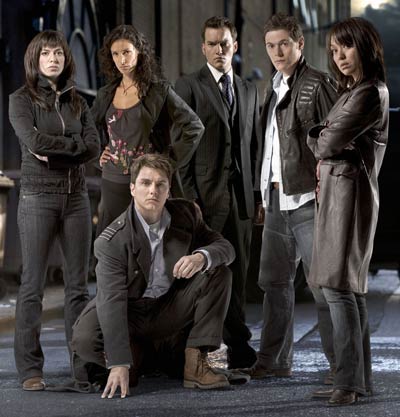
Aliens.
Gadgetry. Explicit and regular examination of gender and power.
Probably the hottest sex scenes, with all manner of couplings, I’ve seen
on a mainstream television show, because desire is explicit by everyone
participating. Set in Wales, so able to gently critique England as the
centre of the universe, and using that as a plot mechanism, repeatedly,
to explore issues of class. Every single main character exploring
attraction at one point or another to the same and different genders.
Season 3 is remarkable. Brutally stripped back plot spoiler: Aliens want to take 10% of Earth’s children as recreational drugs. They will release fatal viruses if Earth’s leaders don’t agree. They can do this; they have the technology.
What makes it remarkable is for the first time, Torchwood turns their beam on the machinations of the state responding to the crisis, in particular, the British government. A kinda sci-fi imagining of how western governments might react to such a dilemma.
We don’t come out well. The UK government had authorised, in 1965, a gift of 12 children to the same aliens, from a children’s home because “no one will miss them.”
The theme is extended to present day. First British ministers offer asylum seeking children in detention centres. When this isn’t enough for the aliens, the British state decides they cannot risk the children who will work in our hospitals and our schools, run our country. But the Deputy Prime Minister says some children matter less:
The British Ministers don’t like what they are doing. There is no joy. But there is the ability to decide that some people are worth less than others. That some people matter less. And therefore, the ability to sanction the unspeakable.
This series was almost unwatchable. As with all good sci-fi, the issues it was exploring were only human. How do we decide worth? What is the power of the state for? When it comes down to it, where do you stand?
One of the many scenes which made me cry featured unarmed men on one council estate running at soldiers kitted out with batons, guns and riot gear, to try and buy their children time to run away. And one police officer, watching in horror, taking off his uniform to fight with the men he knew, rather than stay safe with the state.
Fantastical? Not so much. Can we really say, in Aotearoa today, that all of our children matter the same to the state?
The most obvious parallel is New Zealand armed police rolling into Tuhoe, treating the children of Ruatoki with absolute disdain. Police boarding schools buses, terrifying kids, detaining them illegally. It’s hard to imagine similar actions being signed off for buses headed to private schools in predominantly Pakeha areas.
But there are other parallels too, where the state might not be clad in riot gear. About 270,000 New Zealand children live in poverty, according to the Children’s Commissioner. These levels go up and down, depending on the state’s actions:
So when Torchwood began it was a no-brainer I’d be watching.
Aliens.
Gadgetry. Explicit and regular examination of gender and power.
Probably the hottest sex scenes, with all manner of couplings, I’ve seen
on a mainstream television show, because desire is explicit by everyone
participating. Set in Wales, so able to gently critique England as the
centre of the universe, and using that as a plot mechanism, repeatedly,
to explore issues of class. Every single main character exploring
attraction at one point or another to the same and different genders.Season 3 is remarkable. Brutally stripped back plot spoiler: Aliens want to take 10% of Earth’s children as recreational drugs. They will release fatal viruses if Earth’s leaders don’t agree. They can do this; they have the technology.
What makes it remarkable is for the first time, Torchwood turns their beam on the machinations of the state responding to the crisis, in particular, the British government. A kinda sci-fi imagining of how western governments might react to such a dilemma.
We don’t come out well. The UK government had authorised, in 1965, a gift of 12 children to the same aliens, from a children’s home because “no one will miss them.”
The theme is extended to present day. First British ministers offer asylum seeking children in detention centres. When this isn’t enough for the aliens, the British state decides they cannot risk the children who will work in our hospitals and our schools, run our country. But the Deputy Prime Minister says some children matter less:
“If we can’t identify the lowest achieving 10% of this country’s children, then what are the school league tables for?”So the army rounds up children at school. Many, many parents keep their children home. The army rolls into working class areas, into council estates, and pulls children away from screaming parents.
The British Ministers don’t like what they are doing. There is no joy. But there is the ability to decide that some people are worth less than others. That some people matter less. And therefore, the ability to sanction the unspeakable.
This series was almost unwatchable. As with all good sci-fi, the issues it was exploring were only human. How do we decide worth? What is the power of the state for? When it comes down to it, where do you stand?
One of the many scenes which made me cry featured unarmed men on one council estate running at soldiers kitted out with batons, guns and riot gear, to try and buy their children time to run away. And one police officer, watching in horror, taking off his uniform to fight with the men he knew, rather than stay safe with the state.
Fantastical? Not so much. Can we really say, in Aotearoa today, that all of our children matter the same to the state?
The most obvious parallel is New Zealand armed police rolling into Tuhoe, treating the children of Ruatoki with absolute disdain. Police boarding schools buses, terrifying kids, detaining them illegally. It’s hard to imagine similar actions being signed off for buses headed to private schools in predominantly Pakeha areas.
But there are other parallels too, where the state might not be clad in riot gear. About 270,000 New Zealand children live in poverty, according to the Children’s Commissioner. These levels go up and down, depending on the state’s actions:
That’s
a lot of our children, living in poverty, in families where their
caregivers earn too little or the state allowances for looking after
children are insufficient.
When the state rolls up to reduce real
access to state allowances for those parenting, or introduce new
measures to allow employers to pay less than a living wage for parents,
or sells off state assets meaning essential services like power cost
more, what we are really doing is treating some children as less
important than other children.
It’s got a prettier face than Torchwood.
But the psychological process is the same, make no mistake. Distance.
Othering. Outright denial. Killing off empathy.
In Torchwood, the British government start
using “units” to describe the children they are sending to the aliens as
living happy pills. At Ruatoki, we talked about “terrorists” to
justify that school bus being boarded. And the language and images we
use to describe the poor? Subjective cartoon, anyone?
The motto of Torchwood Season One is: “The
twenty-first century is when everything changes. And you’ve got to be
ready.” Prescient? Or cheesy beyond compare, allowing those of us that
way inclined another chance to gasp admiringly at John Barrowman? Not
for the first time, I’m going to choose both.


