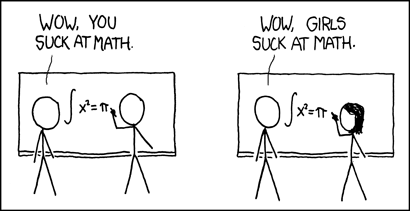
Showing posts with label girls can't do maths. Show all posts

Monday, 15 November 2010

I wonder if it's possible to talk about gender differences without being mansplained in comments?

Cross posted

Which may account for what Prof. Barres calls the main difference he has noticed since changing sex. "People who do not know I am transgendered treat me with much more respect," he says. "I can even complete a whole sentence without being interrupted by a man."

Read the whole thing: He, Once a She, Offers Own View On Science Spat


H/T: Ophelia Benson, at Butterflies and Wheels

Saturday, 13 June 2009

The strangeness of kinders

This feminist blogging business can be a bit soul-destroying at times. So I'm going to take a self-indulgent ramble through a topic that never fails to cheer me up: my kids.

Being austere (pro)feminist leftie types, my partner and I have tried to raise our kids to be accepting of diverse gender identities. With my daughter M, now seven, it was straightforward enough. She's immersed in the same pink hideousness as most of her small female colleagues; but she'll just as happily turn to a kids' book about physics or maths, not realising these have traditionally been areas of male accomplishment. Maybe those divisive days are gone, and she'll move freely between My Little Pony and calculus all her life (although I hope she'll grow out of MLP sooner rather than later).

And then there's Boy. Nearly three, Boy has been difficult since the moment of conception. Relentlessly loud and boisterous, Boy is just so darn boyish. Despite having had the same upbringing as his sister, Boy has gravitated to stereotypically male things since he was old enough to gravitate. He loves cars and balls and mud and being loud. He's a bundle of irrepressible physical energy, jumping on the couch and throwing stuff. Every now and again he feels the urge to pull my hair or dig his wee fingernails into my face. (I'm sporting a scratch on one cheek, and the dorky-looking one on the tip of my nose has only just healed.) Boy truly doesn't have a malicious bone in his little body - he just seems to get flesh-gougingly excited about life from time to time.

I've stopped pondering the nature vs nurture debate, because it doesn't shed much light on what I should actually do as a feminist parent, trying to raise my kids with a certain set of values. Here's what I've concluded. There's nothing wrong with being a rough-and-tumble, full of beans, loud little boy. What would be mistaken would be thinking this is the only way a boy ought to behave, that there's something 'wrong' with the boy who isn't noisy and physical, that it's always appropriate to be boisterous, or that the things girls stereotypically do are in some way inferior to boys' activities.

I guess I'm trying to raise a Renaissance Boy. We spend time jumping in puddles and playing raucous games together, but we also do a fair bit of reading and jigsaw puzzling. Just this morning, I found the little guy singing 'Forest of Feelings' from the Care Bears movie, very earnestly, to the television. He'll yell angrily when his sister refuses to share her Polly Pocket dolls with him. Perhaps best of all, when he's inflicted a particularly deep gouge on my face, he can be relied on to give me a sheepish hug. And whether nature or nurture served up that crazy little personality, I continue to love Boy with all the partial intensity that only a mother wearing rose-tinted spectacles over her one eye can muster.

Wednesday, 4 February 2009

Women's stroppy voices

Ruth Sunderland argues at The Guardian's Comment is Free that high-level discussions of how to resolve to global economic crisis need to include women. Here's a taster:
There was no shortage of women at the gathering of the global elite in Davos this year. It's just that most of them were either delegates' wives, there to enjoy the skiing at the Swiss mountain resort while their menfolk got on with the serious business of mending the world economy, or upmarket usherettes dressed in smart, air-hostess-style blue uniforms, helping people find their seats.

The heavy-hitting women present? There was a handful, including Angela Merkel, the German leader, and Valerie Jarrett, who came as Barack Obama's representative. Skim the handbook containing the names of the invitees and you had to pass 20 men before coming to the first woman, who just happened to be Princess Inaara, Her Highness the Begum Aga Khan. On the abridged list of about 170 business leaders, I counted five women. As a delegate put it: "Men in well-cut suits still come first at Davos."

Does it matter that women are not getting on to the guest list of the biggest male ego-thon on the planet? After all, most females of sound mind would far rather be anywhere else. But the truth is that it does. It sure does.
In New Zealand the voices most often heard in regard to the meltdown seem to me to be men, despite the claims of some that we have been a femi-nazi dominated socialist Nanny state for most of the last decade.

Also discussing women's voices in the public sphere, and their treatment in the media, Cactus Kate comments on the Herald referring to National's "stroppy" women:
Stroppy? They are just doing their job. You wouldn't call a man "stroppy". It's an incredibly patronising comment to make to a woman in a profession or of such seniority as any of these three. By definition they all have to be aggressive, leaders and give orders. So that = stroppy? Nonsense.
The spikey one and I probably agree once in a blue moon. I'll be checking the colour of our lunar satellite this evening.

Tuesday, 30 September 2008

But women just get paid less because they are less skilled don't they?

Hmmmm, research shows otherwise:
The Education Ministry's Adult Literacy and Life Skills survey found women who were highly skilled at maths and reading earned at least $18,000 less than their male counterparts on average.

Salaries for women with high literacy and numeracy skills ranged between $39,000 and $46,000 on average, while men received between $57,000 and $75,000.

Men in the lowest skilled bracket earned between $24,001 and $30,000, while women received $10,001 to $17,000.

The article doesn't seem to quite make the connection between the gap and the possibility of a whole heap of subtle sexism, so let's make it for them.

The evidence here is that women are paid less even when they have the same skill level as men. To my way of thinking this can only partly be explained away by the whole "women take more time out because of their biological urge to breed" argument. Low-paid (not necessarily low-skilled) occupations are dominated by women, not because they have uteruses and sometimes like to fill them, but because women's work has been undervalued for eons - not just the work of individual women who are underpaid, but also the lack of recognition of the positive contribution that traditional "women's work" makes to our society.

And speaking of work, my lunch break is nearly over. Feel free to discuss amongst yourselves, especially Megan who I must tip my hat to on this one :-)

Thursday, 29 May 2008

I couldn't help but wonder...

Two intelligent, feminist, New Zealand women are waiting at a tram stop in a highly international city. One of them works for NZAID, the other for a UN disaster agency. They have both just seen the Sex and the City movie.

'Um.'
'Am I asleep? I feel like I'm asleep.'
'Hmm.'
'Wouldn't it be great if you had Sarah Jessica Parker's voiceover in your head all the time, telling you exactly what was happening in front of you, so you'd never have to think.'
'That was a long movie. It wasn't as bad as I expected.'
'It was as bad as I expected, but I enjoyed it. I think half my brain has been switched off. It feels good. Numb. It's the top half. The half with the earthquake and the cyclone in it.'
'Do you need a tram ticket?'
'No, I have one of those, um... things. Which mean you don't need a ticket. The name of which. Is French. I can't remember the word. The only words I can bring to mind right now are... like... shoes... handbags...'
'What are you doing on Saturday?'
'Um. Doing. Saturday. Uh... Shoes? Um... handbags? Restaurants?'
'Dior? Chanel?'
'On Saturday, uh... what's the word... Marriage? Apartments? Money? Um... Dresses? Shoes?'
'...'
'...Cake?'
'mmm, cake.'
'I don't even like shoes.'

Saturday, 17 May 2008

Looking and Seeing Revisited

Ages ago I put up a link to a clever advertisement about our inability to notice something really obvious, when we are focused on something else. It was made to point out the difficulty of spotting cyclists when you are driving your car and looking for larger moving objects, and it has since been circulated widely through the internets.

While the ad was created to make us think about traffic it also made me think about politics. Specifically the (many) times that I have noticed absences that haven’t always been apparent to others; a forum panel that lacks women, or coloured faces, or anyone under fifty; a television discussion about immigration that bats the subject back and forth between only those whose families immigrated a few generations ago, not recently; advertisements for nappies that never show a man with a child; a lecture where the MC is a woman, the speaker is a woman, but all the questions are asked by men; political blogs where white right-wing* men (mostly heterosexual) dominate and some come over all troll when faced with someone from outside their demographic.

Lyn has written recently about the impact of exemplars on encouraging those absent to become present. When you see someone like you doing something it becomes more feasible to see yourself in that role too. I read a Joanne Black column in the Listener a month or two back in which she bemoaned the announcement that NZ had its first female motorcycle cop. She felt that now that we were all equal this kind of thing was ridiculous and unnecessary – we should only mark firsts when it is the first person, regardless of gender. Yet this denies that actually there are many areas of life where women, and Maori, and the young, and Asians, and indeed men, are rare or non-existent.

If we want to have more women plumbers, or more male kindergarten teachers, or more Maori surgeons, or more young politicians, if we want to have a society that isn’t about putting people in a little box based on the Lotto of birth, then we need to notice when there are people missing. To see the absences we need to start looking for diversity. And then hopefully we will start seeing the barriers to participation too.


* There seems to be a particular type of right-wing in the NZ political blogosphere that is not actually all that representative of the vast majority of those who vote right-of-centre. It’s as if the right wingers who have hearts and souls (and some would add brains) haven’t discovered this part of Internet City, but their climate-change-denying, taxation-equals-theft-touting brethren have moved into the locality in droves. For evidence of this skewing of the Right you need only look at the results from some of Kiwiblog’s online polls.

Wednesday, 7 May 2008

Their Stories

Brad Shipton's parole hearing is happening at the moment. Louise Nicholas, Donna Johnson and another woman that had been raped by Brad Shipton asked to be heard by the parole board. The parole board refused to let them speak.

These women weren't allowed to tell their stories. They weren't allowed to stand up and say "Brad Shipton raped me. Not a day goes by where I don't think about it. He could leave what he did behind, until I was just a number in his notebook, but it will never leave me." Maybe they would have said something very different, but they didn't get a chance. Their experiences weren't considered relevant by the parole board.

The woman Brad Shipton was convicted of raping was able to give evidence at the parole board, but she hasn't been given copies of what the court said about her experience.

I may be deeply confused about whether or not Brad Shipton should get parole. But the casual way women's lives are being thrown about by the system, demonstrates that there is no fundamental conflict between feminism which honours the experience of women who have been abused, and feminism which wants to tear the prison down. Our justice system treats women who have been abused, and their stories, as peripheral to the actions that are taken about that abuse.

For writing about what a response that centred on those who had been hurt, rather than on the Brad Shipton's of this world, I recommend this article.